Have you ever wondered why some paragraphs tell a story while others explain facts or convince you to agree with an opinion? The answer lies in understanding the different types of paragraphs.
Each type has its own purpose and helps writers communicate ideas more effectively. However, many students mix them as I notice in my class because they focus on the topic instead of the writer’s goal.
In this guide, I’ll explain the four main paragraph types with simple definitions, practical examples, and useful writing tips. You’ll also find a comparison table that makes choosing the right paragraph much easier, whether you’re writing for school, exams, or everyday communication.
What Are the Types of Paragraphs?
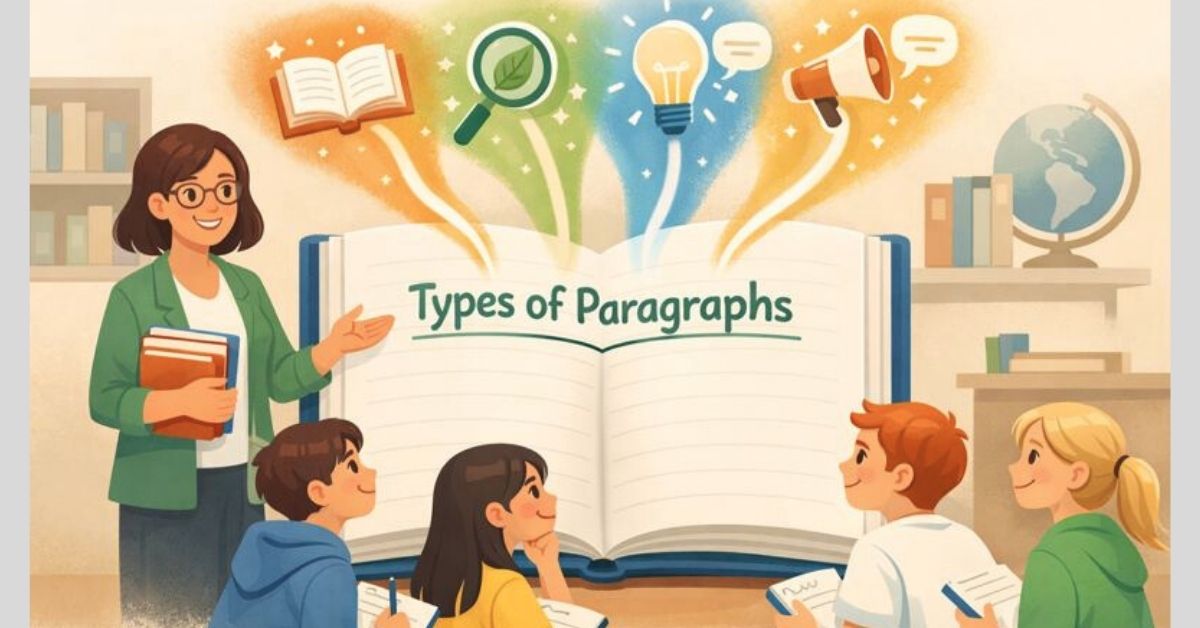
Paragraph types are different ways of organising ideas to achieve a specific writing goal. In English writing, the four main types are narrative, descriptive, expository, and persuasive.
Each type organises ideas differently to match the writer’s purpose- whether telling a story, creating a vivid description, explaining information, or convincing readers.
Here’s a quick overview of the four main paragraph types before we explore each one in detail.
| Paragraph Type | Main Purpose |
| Narrative | Tell a story |
| Descriptive | Paint a vivid picture |
| Expository | Explain information or ideas |
| Persuasive | Convince readers |
Beyond these four, you’ll also encounter several other paragraph forms commonly used in academic and professional writing. So, keep reading…

Table of Contents
Why Learning the Types of Paragraphs Matters
Understanding the types of paragraphs enables you to choose the right approach before you start writing. This skill improves paragraph writing in school assignments, college papers, academic essays, exams, emails, blogs, reports, and many everyday situations.
Each paragraph type serves a different purpose, so choosing the right one makes your writing clearer and more effective. In my classroom, I’ve noticed that students write with greater confidence once they recognise whether they need to tell, describe, explain, or persuade.
Mastering paragraph writing in English isn’t about memorising rules. It’s about knowing which paragraph best suits your goal.

The Four Main Types of Paragraphs (With Examples)
Each paragraph type communicates ideas in its own unique way. Some entertain through storytelling, others paint vivid pictures, explain ideas, or persuade readers. Let’s explore the four main types with definitions, characteristics, examples, and practical tips for using each one effectively.
i) Narrative Paragraph
A narrative paragraph tells a story by describing events in the order they happen. Its objective is to share an experience, whether real or imaginary, and guide readers from the beginning to the end of the action.
A strong narrative paragraph usually includes characters, a setting, and a clear sequence of events. It often answers the question, “What happened?” Transition words such as first, next, then, after that, finally, and at last help connect each event smoothly.
Narrative Paragraph Example: A Lesson Learned
Last week, I walked into class only to realize my lesson plan was sitting peacefully at home, sipping coffee without me. For a moment, panic danced in my head. Then I looked at my students’ curious faces and began talking about panic itself. Somehow, that unplanned lesson became one of my best classes ever. Sometimes, the best stories come from accidents that teach us grace under pressure.
Why This Example Works:
- Topic Sentence: Introduces the story (what it’s about).
- Supporting Sentences: Give actions, thoughts, and emotions- show, don’t tell.
- Concluding Sentence: Delivers a reflection, the “aha!” moment.
Use paragraphs in narrative writing whenever you want to tell a story, describe personal experiences, or write creative compositions.
ii) Descriptive Paragraph
Unlike narrative writing, which tells a story, descriptive paragraph writing paints a vivid picture. It allows readers to imagine a person, place, object, or event through carefully chosen details. Instead of telling what happened, it focuses on what something looks, sounds, smells, tastes, or feels like.
Its main goal is to create a vivid mental picture. Good descriptive writing uses sensory language and specific details rather than general statements. Words that show location, such as above, beside, nearby, across, and behind, often enable readers to visualise the scene.
Descriptive Paragraph Example: A Person (My Grandfather)
My grandfather’s face is a map of stories. Each wrinkle seems to mark a journey- some happy, some heavy. His white beard glows faintly in the morning light, and when he laughs, it’s the sound of an old song coming back to life. He smells faintly of sandalwood and tea, and his hands, though rough, always feel like home.
Here’s How the Writer Did It:
- Topic Sentence: “My grandfather’s face is a map of stories.” (What the paragraph describes)
- Supporting Sentences: Detailed images using senses and metaphors.
- Concluding Sentence: “His hands, though rough, always feel like home.” (Leaves the reader with emotion)
Choose a descriptive paragraph whenever your goal is to help readers experience something through clear and engaging descriptions.
iii) Expository Paragraph
When your goal is to explain rather than entertain, an expository paragraph is the best choice. This type of paragraph explains an idea, process, or topic by presenting information in a clear and organised way.
Rather than expressing personal opinions, it focuses on helping readers understand a subject.
It often includes facts, examples, explanations, definitions, and supporting details that help readers understand the main idea. Transition words such as for example, because, for instance, in addition, and as a result guide readers through the explanation.
Expository Paragraph Example: Sequence (The Water Cycle)
The water cycle is nature’s recycling system that keeps water moving around the planet. First, water from oceans, rivers, and lakes evaporates due to the sun’s heat. Next, the vapor cools and condenses to form clouds. Finally, it falls back as rain, snow, or hail- returning to rivers and seas to start again. This endless loop keeps Earth alive and thriving.
Why This Example Works:
- Topic Sentence: Introduces the water cycle.
- Supporting Sentences: Step-by-step process.
- Concluding Sentence: Explains its importance.
Use expository paragraphs in textbooks, reports, classroom assignments, and informative articles whenever your goal is to explain rather than entertain or persuade.
iv) Persuasive Paragraph
Sometimes writers don’t just inform. They want readers to agree. That’s where a persuasive paragraph comes in.
A persuasive paragraph encourages readers to accept an opinion, change their thinking, or take a specific action. Unlike an expository paragraph, which explains information objectively, a persuasive paragraph presents a viewpoint and supports it with strong reasons and relevant evidence.
An effective persuasive paragraph begins with a clear opinion, follows it with well-reasoned arguments, and ends by reinforcing the writer’s position. Facts, examples, and relevant evidence make the argument stronger and more believable. Transition words such as therefore, because, clearly, consequently, and for this reason connect ideas naturally.
Persuasive Paragraph Example: Learning a Second Language
Every student should learn a second language. Knowing another language opens doors to better job opportunities, improves memory, and helps us understand other cultures. It also makes travel more enjoyable and communication smoother. In today’s global world, learning a second language isn’t just useful. It’s essential.
Structural Breakdown:
- Claim: Every student should learn a second language.
- Proof: Jobs, brainpower, culture, and travel.
- Final Word: It’s essential today.
Choose a persuasive paragraph whenever you want readers to agree with your ideas or take action based on your recommendation.
Comparison Table: Types of Paragraphs at a Glance
My students often ask how to remember the four paragraph types. I tell them to focus on the writer’s objective. The paragraph comparison table below highlights the main differences, making each type easier to recognise and choose
| Type | Purpose | Example | Common Signal Words |
| Narrative | Tell a story | Lost wallet | First, then, finally |
| Descriptive | Describe a person, place, object, or event | My grandfather | Above, beside, nearby, fragrant, bright |
| Expository | Explain information | Water cycle | For example, because |
| Persuasive | Convince readers | Save trees | Therefore, clearly, for this reason |
Remember: A paragraph’s type depends on its main purpose, not its topic. For example, two paragraphs about “climate change” could be descriptive, expository, or persuasive depending on what the writer wants to achieve.
How to Choose the Right Paragraph Type
Choosing the right paragraph becomes much easier when you first identify your writing goal. Instead of asking, “Which paragraph should I write?” ask yourself, “What do I want my reader to gain?”
Remember: The topic doesn’t determine the paragraph type- the writer’s purpose does.
- Want to tell a story?→ Choose a Narrative paragraph.
- Want to describe someone or something?→ Choose a Descriptive paragraph.
- Want to explain information or a process?→ Choose an Expository paragraph.
- Want to convince readers?→ Choose a Persuasive paragraph.
Once you understand your paragraph purpose, selecting the right paragraph organization becomes simple, and your writing feels more focused from beginning to end.
Other Common Paragraph Types
Although narrative, descriptive, expository, and persuasive are the four main paragraph types, academic and professional writing also commonly uses the following paragraph forms. Understanding them will strengthen your writing skills and improve communication with greater clarity.
| Paragraph Type | Purpose |
| Definition paragraph | Explains the meaning of a term or concept. |
| Classification paragraph | Groups ideas into meaningful categories. |
| Process paragraph | Explains how something works or provides step-by-step instructions. |
| Compare and contrast paragraph | Shows similarities and differences between two subjects. |
| Explanatory Paragraph | Explains an idea, concept, theory, or topic by providing facts, details, and examples. |
| Argumentative Paragraph | Presents a clear claim and supports it with evidence and sound reasoning. |
| Cause and effect paragraph | Explains reasons and their results. |
| Problem-solution paragraph | Presents a problem and suggests practical solutions. |
| Illustration paragraph | Develops an idea through examples. |
| Analytical paragraph | Examines information critically and logically. |
| Reflective paragraph | Shares personal thoughts, learning, or experiences. |
| Evaluation paragraph | Judges something using clear criteria and evidence. |
Note: These specialised paragraph types often overlap. For example, an argumentative paragraph may also include cause-and-effect reasoning or examples to support its claim.
Common Mistakes Students Make
Many students confuse paragraph types by trying to tell a story, explain facts, and express opinions all in the same paragraph.
Others begin without a clear topic sentence, provide too few supporting details, skip transition words, or finish with a weak conclusion.
Good paragraph writing follows a logical paragraph format, where every sentence supports one central idea and contributes to clear paragraph organization.
FAQs:
Can one paragraph include more than one type?
Yes, it can. Although most paragraphs have one main intention, skilled writers sometimes blend two types, such as description within a narrative. However, one purpose should always remain dominant to keep the paragraph clear.
Which paragraph type is easiest for beginners?
Many beginners find the descriptive paragraph easiest because it focuses on describing a person, place, object, or event. It encourages observation and simple organisation without requiring complex arguments or detailed explanations.
What is the difference between paragraph types and paragraph structure?
Paragraph types explain why a paragraph is written, such as telling, describing, explaining, or persuading. Paragraph structure explains how it is built, including the topic sentence, supporting sentences, and concluding sentence.
Which paragraph type is most common in exams?
The most common type depends on the subject and exam. English language exams often require descriptive, narrative, expository, or persuasive paragraphs, so learning all four prepares you for most writing tasks.
How can I identify a paragraph type quickly?
Look at the writer’s main aim. If it tells a story, it’s narrative. If it paints a picture, it’s descriptive. If it explains information, it’s expository. If it tries to convince readers, it’s persuasive.
Conclusion:
Understanding the different types of paragraphs makes it easier for you to express ideas with greater clarity and confidence. Practise each type individually before combining them in longer pieces of writing.
The more you write, the more naturally you’ll recognise which paragraph best fits your purpose. Which one will you practise first?