
Expository paragraph writing is used to explain an idea, process, or subject so that a reader can understand it easily. When introducing this form in class, I start with one question: What does the reader need to understand?
The answer helps students decide which details belong in the paragraph and which ones should be left out. Good exposition does not depend on impressive vocabulary. It depends on a clear focus, information, and a sensible arrangement of ideas.
This guide explains the definition, types, structure, writing process, examples, topics, common mistakes, and related paragraph forms.
What Is an Expository Paragraph?
An expository paragraph is a piece of writing that explains, informs, or clarifies one main idea. Its purpose is to help readers understand a subject through relevant information and logical development.
Unlike a narrative paragraph, which mainly recounts events, an expository paragraph focuses on explanation. A descriptive paragraph, by contrast, mainly creates an impression through sensory details and imagery.
Expository writing may use facts, examples, definitions, comparisons, causes, effects, or process details to develop its subject.
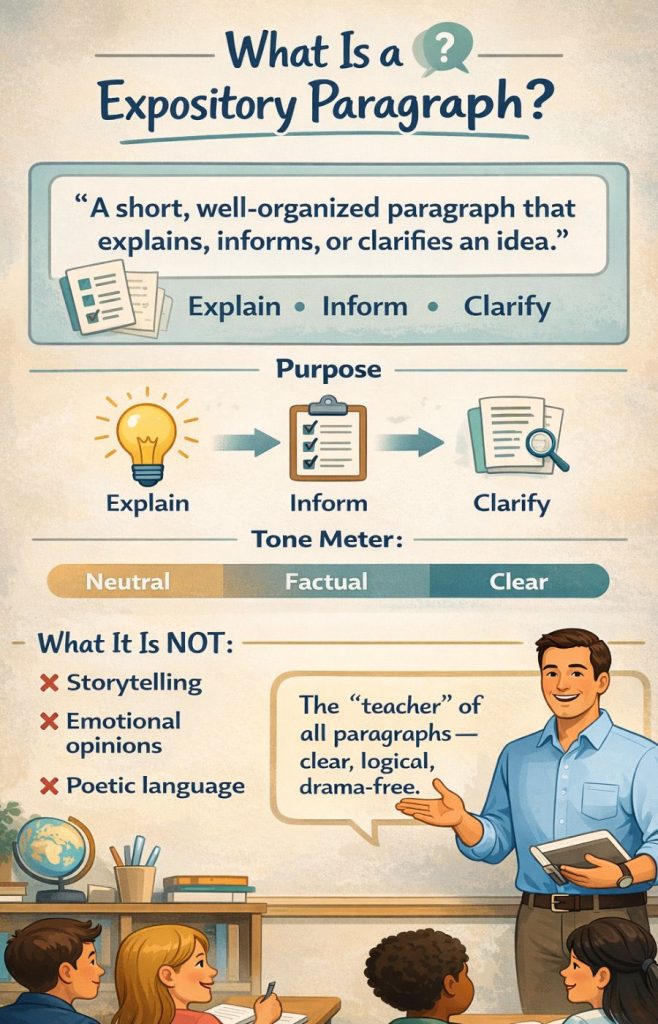
Table of Contents
Types of Expository Paragraphs
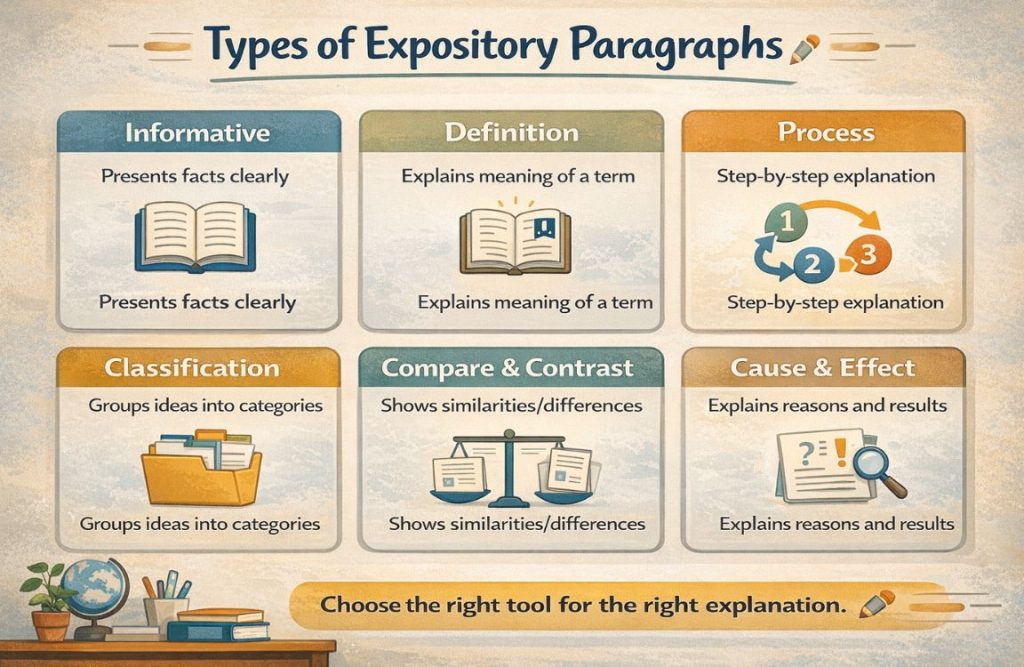
Expository paragraphs can be developed in several ways.
i) Informative Paragraph
An informative paragraph gives readers knowledge about a subject.
ii) Definition Paragraph
A definition paragraph explains the meaning of a word, concept, or subject. It may go beyond a dictionary meaning by adding characteristics, examples, or context.
iii) Process Paragraph
A process paragraph explains how something happens or how a task is completed.
iv) Classification Paragraph
A classification paragraph divides a broad subject into groups. The writer explains the basis for the categories and gives enough information to make the grouping understandable.
v) Comparison and Contrast Paragraph
This form examines two subjects by discussing their similarities, differences, or both. Placing related features together can make an unfamiliar subject easier to understand.
vi) Cause-and-Effect Paragraph
A cause-and-effect paragraph explains why something happens, what results from it, or how causes and consequences are related. These patterns are not rigid boxes. A paragraph may combine approaches when the subject requires it.
Features of an Expository Paragraph
A strong expository paragraph has several qualities that make its explanation easy to follow.
| Feature | Meaning |
| Clarity | The reader can understand the main point without unnecessary difficulty. |
| Logical order | Ideas appear in a sequence that suits the subject. |
| Relevant support | Facts, examples, definitions, or other useful details develop the main point. |
| Direct language | Unnecessary decoration and emotional language do not distract from the explanation. |
Expository vs Informative Paragraph
The terms informative and expository are not defined in exactly the same way in every textbook. Some teaching materials use them almost interchangeably, while others treat informative writing as one form of broader expository writing.
| Informative paragraph | Expository paragraph |
| Mainly gives information about a subject. | Explains a subject, idea, process, or relationship. |
| Often focuses on facts and background. | May use facts, examples, definitions, causes, effects, or comparisons. |
| May answer what, who, or where. | May also address how and why. |
| Example: facts about recycling. | Example: how recycling works or why it matters. |
Structure of an Expository Paragraph
A well-developed paragraph usually moves from a central point to supporting material and then to an ending. Each part contributes to the development of one idea.
i) Topic Sentence
The topic sentence introduces the main idea. It should be specific enough to establish direction but not so broad that the writer cannot develop it in one paragraph.
ii) Supporting Details
Supporting details provide the information needed to develop the topic sentence. Depending on the subject, they may include facts, examples, reasons, evidence, or other relevant information.
iii) Explanation
A detail becomes more useful when the reader understands why it matters. Explain its connection with the idea so that the paragraph does not become a list of disconnected facts.
iv) Concluding Sentence
The concluding sentence brings the discussion to a natural close. It may restate the central idea in fresh language or show why the explanation matters. It should not introduce an unrelated point.
How to Write an Expository Paragraph: Step-by-Step
Step 1: Choose a Clear Topic
Select a subject that is focused enough for one paragraph. Suitable topics include how rainbows form, why sleep matters, how recycling works, causes of exam stress, benefits of daily reading, or the science behind laughter.
Step 2: Plan the Main Points
Before writing sentences, note the central idea and the information that will support it. A simple chart or graphic organizer can help you decide what belongs in the paragraph.
Step 3: Arrange the Information
Choose an order that suits the subject. A process may follow time, while a cause-and-effect topic may move from causes to results. Use transitions when they help the reader follow the ideas.
Step 4: Write and Revise
Turn your notes into complete sentences. Check the facts, grammar, sentence connections, and word choice. Remove repeated ideas and details that do not serve the topic.
Expository Paragraph Examples: Short, Student-Friendly
Example 1: Learning from Failure
Failure can become a useful learning experience when people examine what went wrong and respond thoughtfully. For example, a student who performs poorly in a debate may discover that limited preparation affected the result. The student can then improve by researching the topic more carefully, practicing the speech, or managing preparation time better. The poor result does not guarantee future success, but it can provide information that guides the next attempt. In this way, reflection can turn an unsuccessful experience into an opportunity to improve.
Example 2: A Well-Organized School Bag
A well-organized school bag can save time and make the school day easier to manage. When books and notebooks are arranged by subject, a student can find the required material without searching through every compartment. Pens, pencils, rulers, and other small supplies can be kept together in a separate pouch. This arrangement also makes it easier to notice missing items before leaving home. A simple organizational habit can therefore improve preparation and reduce unnecessary confusion during the school day.
Example 3: Photosynthesis
Photosynthesis is the process by which green plants use light energy to produce glucose from carbon dioxide and water. Chlorophyll absorbs light and helps provide the energy needed for the reactions involved. Oxygen is released during the process, while the glucose produced by the plant can be used in respiration or converted into materials needed for growth. Photosynthesis is important to ecosystems because plants form the base of many food chains and contribute oxygen to the atmosphere. Studying this process helps explain how plants produce organic matter that supports many other forms of life.
Expository Paragraph Topics
- How social media affects teenage communication
- Why sleep matters for students
- Causes of exam stress
- How peer pressure influences decisions
- The importance of time management
- Why critical thinking matters in education
- How climate change affects daily life
- The role of technology in education
- Why reading improves writing skills
- How habits influence long-term success
Common Mistakes in Expository Paragraph Writing
i) Too Many Opinions Instead of Evidence
Personal reactions can weaken an explanation when they replace useful support. Use facts, examples, or reliable information when making a claim. If the task allows a viewpoint, explain the reasoning behind it.
ii) Weak Topic Sentence
A vague opening makes the reader guess what the paragraph will discuss. State the main idea clearly and give the paragraph a definite direction.
iii) Lack of Logical Order
Even accurate information becomes difficult to understand when it appears randomly. Arrange details according to the subject: time, cause and effect, comparison, classification, or another suitable pattern.
iv) Unnecessary Adjectives and Filler
Complex vocabulary does not automatically improve an explanation. Extra adjectives, repeated statements, and decorative phrases can hide the main point. Prefer words that communicate the intended meaning directly.
Expository Paragraph vs Narrative and Descriptive Paragraph
The three forms have different primary purposes.
| Paragraph | Purpose | Typical Features | Main Reader Effect |
| Expository | Explains or informs | Facts, explanations, examples | Understands an idea |
| Narrative | Recounts events | Characters, action, sequence | Follows what happens |
| Descriptive | Creates an impression | Sensory details, imagery | Forms a mental picture |
My Simple Classroom Formulas:
When students confuse paragraph types, I use these short memory aids:
- Expository = “Let me explain it to you.”
- Narrative = “Let me tell you what happened.”
- Descriptive = “Let me show you the picture.”
These phrases are not formal definitions. They simply help students remember the purpose of each type before writing.
Why Expository Writing Matters?
Expository writing is useful far beyond examinations. It trains students to identify a main point, choose relevant support, and explain how ideas are connected. These skills appear in history answers, science explanations, instructions, reports, articles, and communication.
A student who can explain a process can give instructions; a student who can explain causes and effects can produce stronger academic answers. Clear exposition helps readers understand information without confusion.
FAQs:
Can opinions be included in an expository paragraph?
Yes, but opinion should not replace explanation. If a personal view is relevant, support it with evidence or clear reasoning. The paragraph should still fulfill its main explanatory purpose.
How long should an expository paragraph be?
There is no universal word limit. Many academic paragraphs are roughly 100–200 words, but the appropriate length depends on the assignment, subject, and amount of explanation required. Always follow the instructions given by your teacher or examination authority.
How can an expository paragraph be made clearer?
Check whether every supporting sentence contributes to the main idea. Removing repetition and unnecessary wording can also improve readability.
What is the best way to end an expository paragraph?
Bring the explanation to a natural close. You can restate the main idea in fresh language or briefly indicate why the information matters. Avoid introducing a completely new point in the final sentence.
Conclusion:
Expository paragraph writing becomes easier when the writer understands that the goal is not to sound complicated but to make an idea understandable. I have seen students improve when they stop searching for impressive words and start thinking about the reader’s needs.
A focused topic, well-chosen support, logical development, and careful revision are more valuable than fancy language. With regular practice, students can learn to explain ideas with greater confidence and control.