
Descriptive paragraph writing helps readers see, hear, smell, touch, taste, or experience a subject through words. Instead of telling readers that a person is kind or a place is beautiful, it uses carefully chosen details to create an impression.
When I teach descriptive writing, I often tell students: Don’t describe everything. Describe what matters. A few precise details can create a stronger picture than a long list of adjectives.
In this guide, you’ll learn the format, structure, techniques, and steps for writing a descriptive paragraph, with examples, topics, and revision tips.
Table of Contents
What Is a Descriptive Paragraph?
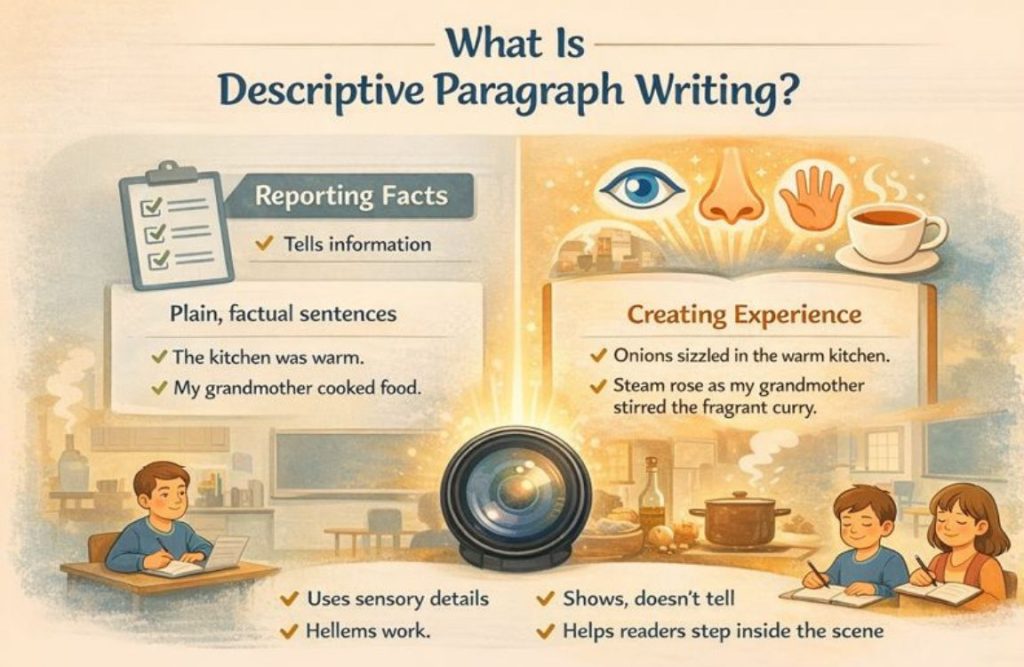
A descriptive paragraph is a focused group of sentences that describes a person, place, object, event, experience, or moment through carefully selected details. Its purpose is to help readers form an impression.
Descriptive writing does more than list facts. It shows what something is like.
Basic: The village was quiet.
Descriptive: Empty roads stretched between the houses while distant birds called from the trees and thin lines of smoke rose from village kitchens.
The second sentence gives the reader something to imagine. A good descriptive paragraph usually has a dominant impression, the feeling or idea the writer wants to create. A beach might seem peaceful, lonely, exciting, or frightening. The details should support that impression.
A writer cannot, and should not, describe everything. The best details are those that support the intended impression. If you want a classroom to feel tense, you might describe a ticking clock, restless students, and a teacher speaking in a low voice. You do not need to describe every desk.
Good description is selective, not crowded.
Read Also, “What Is a Paragraph? Types, Structure & Examples Explained:”
Descriptive Paragraph vs. Narrative Paragraph
Students often confuse these forms because both can include people, places, and experiences. The main difference is their purpose.
| Descriptive Writing | Narrative Writing |
| Focuses on what something is like | Focuses on what happens |
| Creates an overall impression | Develops a sequence of events |
| Uses sensory and specific details | Uses actions and events |
| Often pauses around a subject | Usually moves through time |
A descriptive paragraph builds a picture, while a narrative paragraph tells what happened. The dominant purpose determines the type.
Characteristics of a Good Descriptive Paragraph
A strong descriptive paragraph usually has these features:
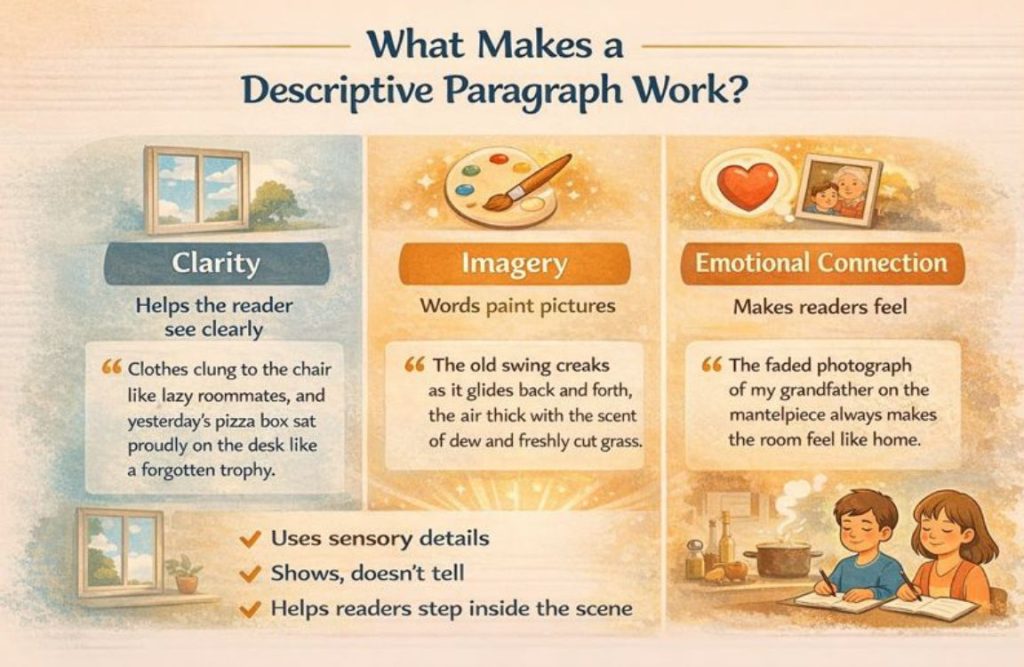
- One clear subject: Focus on one person, place, object, event, or experience.
- Specific details: Concrete details create a clearer picture.
- Sensory language: Use relevant details connected to the senses.
- Precise word choice: Choose nouns, verbs, and adjectives carefully.
- Logical organization: Arrange details in an order readers can follow.
- A dominant impression: Make the details work together to create a feeling or idea.
Simply adding adjectives does not make writing descriptive.
Weak: The garden was beautiful and nice.
Stronger: Wet roses bent beneath the morning rain while the scent of soil rose from the flowerbeds.
The stronger version gives readers specific details instead of simply calling the garden beautiful.
Descriptive Paragraph Format and Structure
In school writing, a descriptive paragraph is often taught as:
Topic sentence → Supporting details → Concluding sentence
Real descriptive writing can be flexible, so a concluding sentence is useful but not always required.
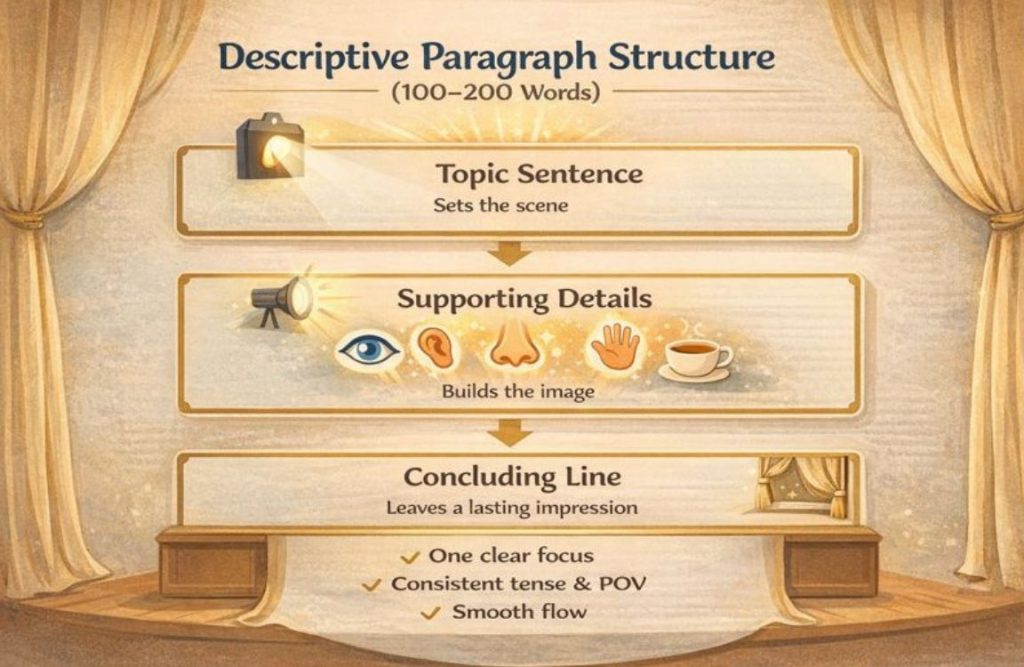
i) Topic Sentence
The topic sentence introduces the subject and establishes the main impression.
Example: Our village library is a quiet little place where I can escape from everyday noise.
ii) Supporting Details
Supporting sentences develop the description through sensory observations, physical features, actions, comparisons, or relevant information. The details should work together.
iii) Concluding Sentence
A concluding sentence gives the paragraph a natural ending. It may reinforce the dominant impression or leave a final image.
Example: Whenever I leave the library, the quietness of the room seems to follow me home.
Simple formula: Clear subject + dominant impression + specific details + sensory language + logical organization + effective ending.
How to Write a Descriptive Paragraph Step by Step
Writing a descriptive paragraph becomes easier when you move from choosing a subject to selecting details, organizing them, drafting, and revising.
1. Choose One Clear Subject
Choose one person, place, object, event, experience, or moment. Keep it narrow enough to describe properly. Instead of “My City,” choose “The Old Market Near My Home.”
2. Decide Your Dominant Impression
Ask: What do I want my reader to feel or understand? Your impression might be peaceful, frightening, joyful, lonely, or exciting. Let it guide your details.
3. Brainstorm Sensory Details
Think about what you can see, hear, smell, touch, or taste. Then select only details that strengthen your impression. You do not need to use all five senses.
4. Choose an Organization Pattern
For a room or place, spatial order may work best. For an experience, organize details around its setting, atmosphere, or important moments. For a person, you might move from appearance to behavior.
5. Draft With Specific Language
Use concrete nouns, strong verbs, and precise adjectives. Add a simile or metaphor when it genuinely clarifies the image. Do not try to make every sentence sound poetic.
6. Revise for Unity and Clarity
Check that every sentence relates to the subject, the details are specific, the tense is consistent, and the ending reinforces the impression.
How to Organize a Descriptive Paragraph
Once you have chosen your details, arrange them in an order that helps readers follow your description. The best pattern depends on what you are describing and the impression you want to create.
i) Spatial Order
Arrange details according to location: left to right, near to far, top to bottom, outside to inside, or entrance to the back of a room. This works well for places and objects.
ii) General to Specific
Begin with the overall impression and then move toward particular details.
Example: The library was peaceful and welcoming. Tall wooden shelves lined the walls, while sunlight fell across the reading tables.
iii) Order of Importance
Present the most noticeable or meaningful details first. This can work well when describing a person or memorable object.
Choose the pattern that best suits your subject and keep its movement easy to follow.
Descriptive Writing Techniques
Descriptive writing techniques help you turn ordinary statements into clear and memorable images. You do not need to use every technique; choose those that make your description more precise and effective.
i) Sensory Details
Sensory details appeal to the five senses.
Example: The smell of wet earth rose from the garden as rainwater trickled from the leaves.
ii) Precise Language
Precise words create clearer images.
Basic: The bird moved.
Precise: The sparrow hopped across the windowsill.
iii) Strong Verbs
Compare “The leaves moved in the wind” with “The leaves trembled in the wind.” Strong verbs such as whispered, rattled, stumbled, glimmered, and drifted can create movement and atmosphere.
iv) Simile and Metaphor
A simile compares things using like or as: The lake shone like glass. A metaphor makes a direct comparison: The lake was a sheet of glass.
Use comparisons when they strengthen the image, not simply because they sound literary.
v) Show, Don’t Tell
Reveal a quality through observable details instead of stating it directly.
Tell: She was nervous.
Show: Her fingers tapped rapidly against the desk, and she kept glancing at the clock.
The second example lets readers infer the emotion.
Weak vs. Strong Descriptive Paragraph
Weak: My village is very beautiful. It has many trees and houses. There is a pond near my house. Birds sing there. The people are friendly.
This version is understandable but relies on vague words such as beautiful, many, and friendly.
Stronger: Mist hangs above our narrow pond while palm trees stand along the muddy road. The smell of wood smoke rises from nearby kitchens, and birds call from the bamboo groves.
The stronger version creates a clearer picture through specific sensory details. Choose better details, not more words.
Descriptive Paragraph Examples
Each example is followed by a brief explanation of what makes the description effective.
About a Person
My English teacher has a calm presence that makes our classroom feel comfortable. He usually stands beside the board with a worn notebook in his hand and speaks in a quiet, steady voice. His glasses often slip down his nose while he reads, and he pushes them back without interrupting his lesson. Even when a student gives a wrong answer, he smiles and explains the point again. His patient manner makes difficult lessons seem less frightening.
Why it works: It uses physical details and actions to show the teacher’s patience.
About a Place
Our village library stands at the end of a narrow road beside a pond. From the entrance, rows of wooden shelves stretch toward the back wall, filled with books of different sizes and colors. A large window on the left lets afternoon sunlight fall across the reading tables. Near the far corner, an old ceiling fan turns slowly above two quiet students. Outside, leaves rustle beside the pond, but inside, the room remains peaceful.
Why it works: It uses spatial order and sensory details to reinforce the library’s peaceful atmosphere.
About an Object
An old fountain pen rests inside my wooden desk drawer. Its black body has become slightly dull with age, and a thin silver line circles the cap. The nib is scratched, but it still leaves a smooth trail of blue ink on paper. A small crack near the clip reminds me that it has been used for years. I rarely write with it now, yet I keep it because it belonged to my grandfather.
Why it works: It combines physical details with personal significance to show why the pen matters.
About an Experience
The first rain after a long summer felt like a welcome change. Dark clouds covered the afternoon sky, and heavy drops began striking the tin roof. The dusty road turned dark as rainwater gathered in small pools. Children ran outside, laughing as they avoided the deeper puddles. I stood beneath the veranda and breathed in the fresh smell of wet earth. For a while, the whole neighborhood seemed renewed.
Why it works: It combines sight, sound, smell, movement, and personal response to create a refreshing atmosphere.
Descriptive Paragraph Writing for Exams
For school or college examinations, creativity is useful, but clarity and organization come first.
- Read the question carefully.
- Stay focused on what you are asked to describe.
- Follow the word limit given by your teacher or examination board.
- Begin with a clear topic sentence.
- Use specific, relevant details.
- Organize the details logically.
- Maintain consistent grammar and tense.
- Check spelling, punctuation, and repetition before submitting.
A focused paragraph is stronger than a long paragraph filled with unrelated details.
Descriptive Paragraph Topics
People: My favorite teacher; My best friend; A family member; A memorable stranger.
Places: My classroom; A busy marketplace; A school library; A beach at sunset.
Objects: An old photograph; My favorite book; A childhood toy; An old fountain pen.
Experiences: A rainy afternoon; My first day at school; A memorable celebration; A day I will never forget.
Before writing, ask: What impression do I want to create?
Common Descriptive Writing Mistakes
Avoid:
- using too many adjectives
- listing details without organization
- relying on vague words such as nice, good, or beautiful
- mixing verb tenses
- describing everything instead of choosing what matters
- telling emotions instead of showing them
- forcing all five senses into the paragraph
- overusing similes and metaphors
- adding unrelated information
If a sentence does not make the subject clearer, more vivid, or more meaningful, consider removing it.
Revision Checklist
Before submitting, ask:
- Is my subject clear?
- Is there a dominant impression?
- Are my details specific and relevant?
- Have I used appropriate sensory details?
- Are the details logically organized?
- Is the tense consistent?
- Have I checked grammar, spelling, punctuation, and the ending?
FAQs:
What is a descriptive paragraph?
It is a focused group of sentences that describes a person, place, object, event, or experience using specific details to create an impression.
How long should a descriptive paragraph be?
Follow the word limit given by your teacher or examination board. If no limit is provided, write enough to develop the subject clearly without unnecessary details.
Should every descriptive paragraph use all five senses?
No. Use the senses that naturally fit the subject. Forcing all five senses can make the writing feel artificial.
Can a descriptive paragraph include facts?
Yes. Relevant facts can be useful, but descriptive writing should go beyond factual listing by showing meaningful characteristics and creating an impression.
Conclusion
Descriptive paragraph writing is not about covering a subject with adjectives. It is about helping readers experience a subject through carefully selected details.
As a teacher, I remind my students to choose one clear subject, create a strong impression, and use specific sensory details. I also encourage them to organize ideas clearly and revise carefully.
Remember, good description is selective: choose what matters, show it clearly, and let your reader see the scene through your words.