
A student stays up late preparing for a test. The next morning, the student feels tired and struggles to concentrate in class. One event helps explain the other: staying awake late can lead to tiredness, which may affect learning.
This is the basic idea behind cause and effect paragraph writing. Instead of simply describing what happened, a writer explains why something happened or what followed from it. A clear paragraph makes that connection easy for readers to understand.
What Is a Cause and Effect Paragraph?
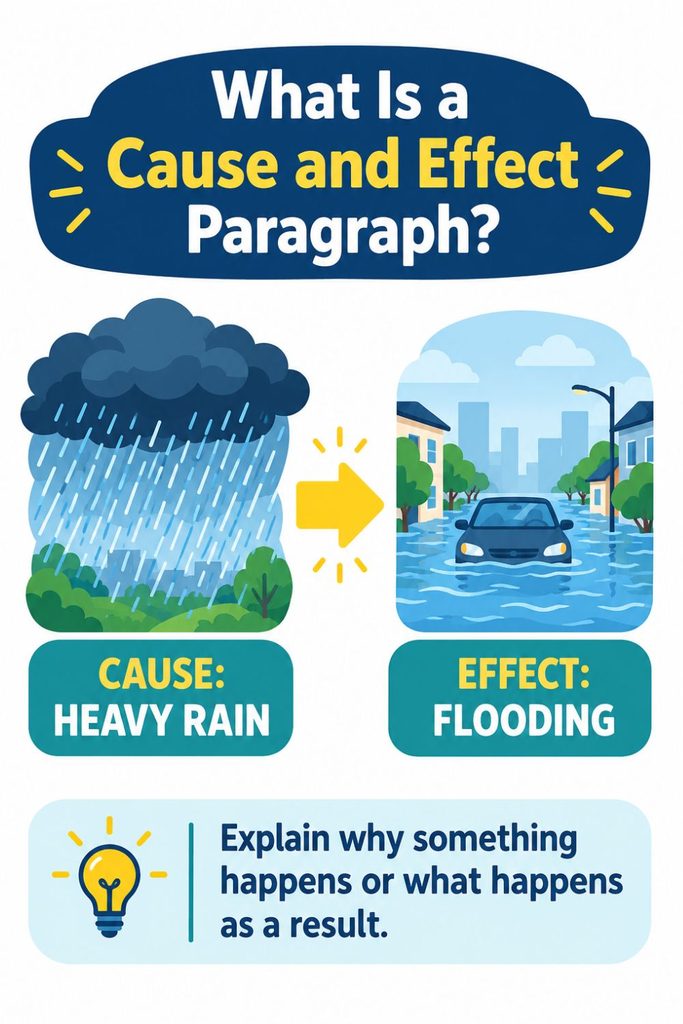
A cause and effect paragraph explains the reason for an event, the result of an action, or the relationship between them. A cause is why something happens. An effect is what happens as a result.
Consider heavy rain that continues for several hours. Water may cover a low-lying street because drains cannot carry it away quickly enough. In this example, heavy rain is the cause, and flooding is the effect.
The purpose is not simply to mention two events that happen together. Writers must explain how the events are connected and avoid claiming that one event caused another without enough evidence.
What Is the Structure of a Cause and Effect Paragraph?
A well-organized paragraph usually contains three parts:
- Topic sentence: Introduces the subject and states the main cause, effect, or relationship.
- Supporting sentences: Explain the connection through relevant reasons, details, or examples.
- Concluding sentence: Reinforces the central idea without copying the opening sentence.
Writers can arrange information in two common ways:
- Cause-to-effect order: Begin with the reason and explain the result. Example: Heavy rainfall filled the drains, so several streets became flooded.
- Effect-to-cause order: Begin with the result and explain why it happened. Example: Several streets became flooded because heavy rainfall filled the drains.
Choose the order that makes your explanation easiest to follow. You do not need a fixed number of sentences. Every sentence should help readers understand the central relationship.
How to Write a Cause and Effect Paragraph Step by Step
A simple plan keeps the paragraph focused and makes revision much easier.
Step 1: Choose a Specific Topic
Begin with a subject you understand. A broad topic such as education is difficult to explain fully in one paragraph. Narrow it to a clear relationship, such as how regular reading improves vocabulary or why students sometimes miss classes.
Ask whether you can explain the topic in a few connected sentences. If you cannot think of relevant details or an example, choose a more focused subject.
Step 2: Identify the Main Cause or Effect
Decide what readers should understand. You might explain why an event happens, describe its consequences, or discuss both sides of the relationship.
For example, in “How Lack of Sleep Affects Students,” insufficient sleep is the cause, while difficulty concentrating is an effect. Tiredness and trouble remembering information can support the explanation.
I encourage students to focus on one main cause and its clearest effects before adding supporting details.
Step 3: Write a Clear Topic Sentence
The topic sentence should state the main idea directly.
Weak: Sleep is important.
Stronger: Lack of sleep can make it harder for students to concentrate during lessons.
The stronger sentence identifies an effect and prepares readers for an explanation. A useful topic sentence should not promise more than the paragraph can explain.
Step 4: Develop Supporting Details in Logical Order
Explain how the cause leads to the effect. Arrange details in a sequence readers can follow, and add an example when it clarifies the connection.
For instance, a student stays awake late at night, feels tired the next morning, and struggles to pay attention during a lesson. As a result, the student may miss important instructions.
Step 5: Write and Revise the Conclusion
End by returning to the central idea without copying the topic sentence. Then revise the paragraph. Remove details that do not support the main point, check each transition, and make sure the relationship is reasonable. A simple outline can help:
- Topic: Lack of sleep
- Cause: Staying awake too late
- Effects: Tiredness and reduced concentration
- Closing idea: Sufficient sleep supports classroom learning.
What Words Show Cause and Effect?
Cause and effect signal words explain why something happens and what happens as a result.
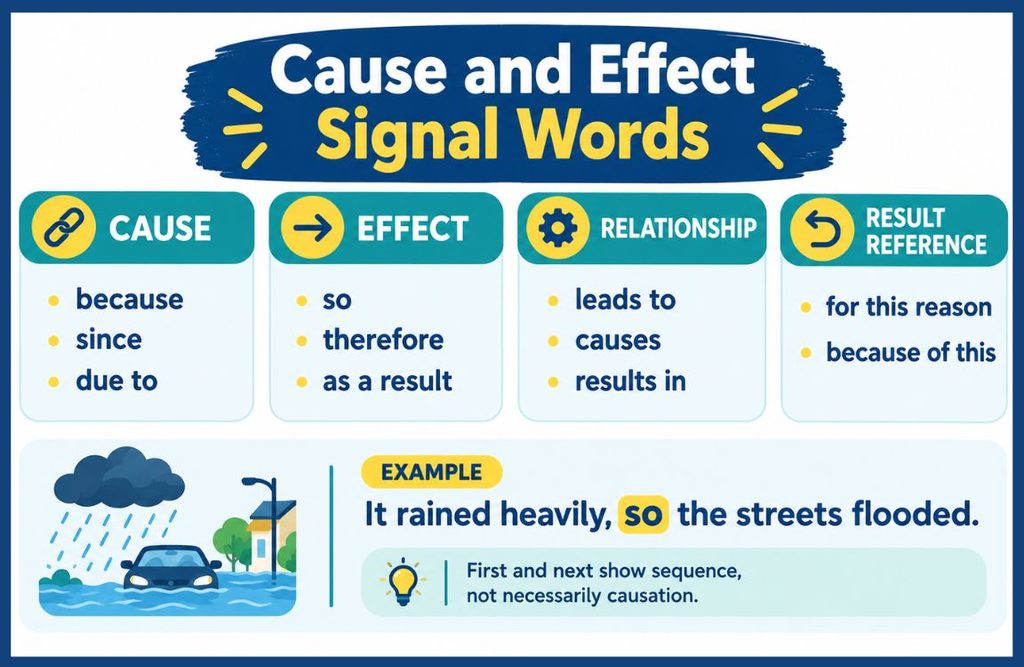
| Function | Words and phrases |
| Introduce a cause | because, since, as, because of, due to, owing to |
| Introduce an effect | so, therefore, thus, consequently, as a result, hence |
| Explain a relationship | causes, leads to, results in |
| Refer to a result | for this reason, because of this |
Examples:
- Cause first: It rained heavily, so the streets flooded.
- Effect first: The streets flooded because it rained heavily.
- Noun phrase: Due to heavy rain, the event was canceled.
Words like first and next show sequence, not necessarily causation. Choose signals that accurately express the relationship.
Cause and Effect Paragraph Examples
The examples below show how a paragraph can introduce a central idea, develop the relationship, and end with a related point. They use familiar subjects so you can focus on the writing pattern.
Example 1: How Regular Reading Improves Vocabulary
Regular reading helps learners develop a stronger vocabulary. When students read books, articles, and stories, they meet unfamiliar words. The surrounding sentences often provide clues to their meanings. As a result, readers gradually learn new expressions and see how words work in different contexts. A student reading short stories, for example, may discover useful ways to describe feelings and actions.
Example 2: How Lack of Sleep Affects Students
Lack of sleep can make it difficult for students to concentrate during lessons. When learners stay awake late at night, they may feel tired the following morning. This tiredness can reduce their attention and make new information harder to understand. Consequently, a task that normally takes a short time may require more effort. For example, a student who has slept only a few hours may find it harder to follow the steps in a mathematics problem.
Example 3: How Plastic Waste Harms the Environment
Careless disposal of plastic waste can harm the environment. Bags, bottles, and packaging left on the ground may be carried into drains, rivers, and other waterways. When rubbish blocks drainage systems, it can contribute to flooding during heavy rain. Plastic waste can also threaten wildlife because animals may swallow small pieces or become trapped in discarded materials. For instance, an animal may mistake a floating plastic bag for food.
Common Cause and Effect Paragraph Mistakes
A focused topic can still produce a weak paragraph if the explanation is unclear. Avoid these mistakes:
- Choosing a topic that is too broad: Narrow it to one main relationship.
- Listing events without explaining the link: Show how the cause may lead to the result.
- Using transitions incorrectly: Check whether a word introduces a reason, a result, or only a sequence.
- Adding unrelated details: Keep every sentence connected to the topic sentence.
- Treating a possible connection as proven: Use careful language when a result is not certain.
I advise learners to check whether each supporting sentence explains a genuine connection between the cause and its effect.
For example, “The internet is useful. Therefore, students study” does not explain a convincing connection. A clearer version is: “Students can use educational videos to review difficult lessons, which may help them understand the material.”
Cause and Effect Paragraph Topics to Practise
Choose a familiar topic that you can explain with specific details. Try these ideas:
- Education: How regular reading improves vocabulary; why students miss classes.
- Health and habits: How insufficient sleep affects concentration; how daily exercise supports fitness.
- Environment: How plastic waste harms wildlife; how polluted water affects communities.
- Technology: How phone notifications interrupt study; how online lessons help learners access materials.
FAQs:
How long should a cause and effect paragraph be?
The required length depends on the assignment. Include enough sentences to explain the main relationship and support it with relevant details, but remove repetition and unnecessary information.
Can a cause and effect paragraph have more than one cause?
Yes. Several causes may contribute to one result. Explain how each cause connects to the outcome, and include only reasons that support the paragraph’s main idea.
How do I choose a good cause and effect paragraph topic?
Choose a familiar, specific subject with a relationship you can explain clearly. Make sure you have enough relevant details or an example to support your explanation.
What is the difference between cause and effect and problem and solution?
Cause and effect writing explains why something happens or what results from it. Problem and solution writing identifies an issue and describes one or more ways to address it.
Does every cause and effect paragraph need transition words?
No. Transitions can clarify relationships, but not every sentence needs one. Use expressions that fit the meaning, and make sure the connection between ideas remains clear.
Conclusion:
A cause and effect paragraph explains why something happens or what follows from an action. To write one, choose a specific topic, identify the central relationship, and develop it with relevant details and examples.
Use transitions that accurately express the connection, then revise the paragraph to remove repetition and unsupported claims. The goal is not simply to tell readers that two events are related. It is to help them understand how or why the relationship makes sense.