
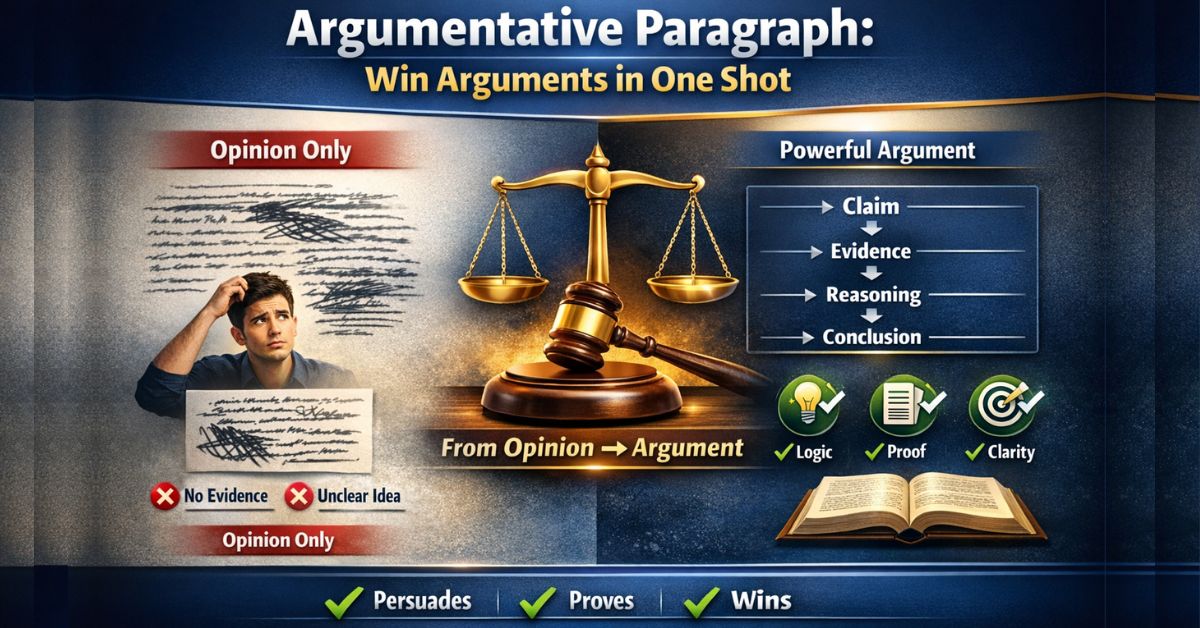
“What if one paragraph could convince, challenge, and win an argument?”
I ask my students this, and suddenly the room goes quiet, because deep down, we all want that power. An argumentative paragraph is not just about writing. It’s persuasion in its sharpest form. It’s where your ideas stop being opinions and start becoming arguments.
But here’s the struggle I see every year: students either say too much without proof or say too little without purpose. The result? A weak argument paragraph that convinces no one, not even the writer.
So, in this lesson, I’m not just giving you definitions. I’m handing you a tool. By the end, you’ll understand how to shape your thoughts into a structured, powerful argumentative paragraph- one that argues, proves, and wins. Think of it as learning to build a courtroom case…. in just a few sentences.
What Is an Argumentative Paragraph?
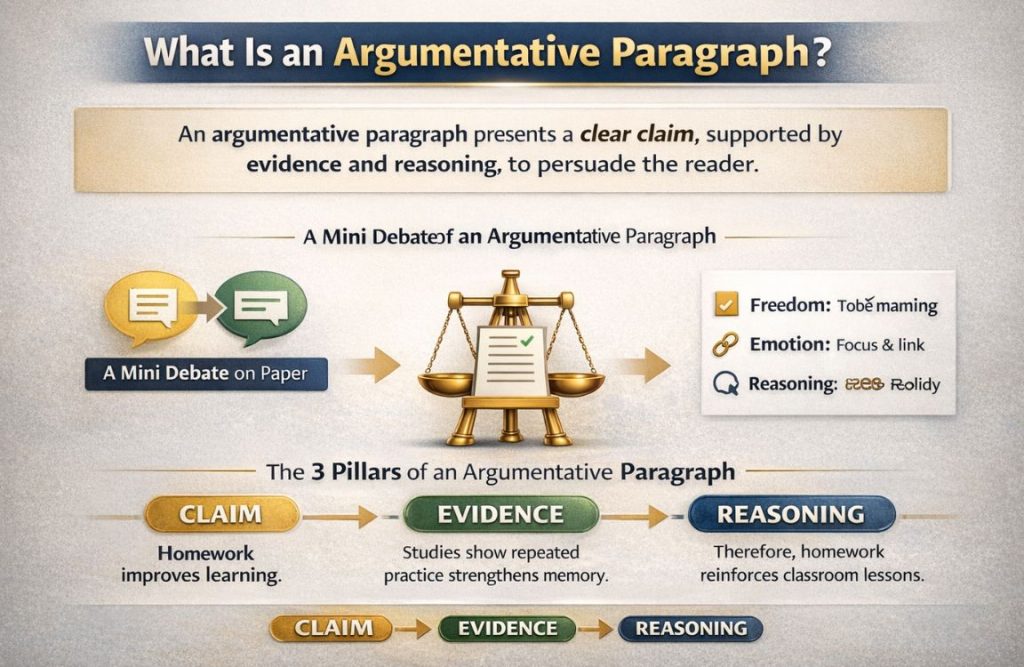
An argumentative paragraph is a focused piece of writing that presents a clear claim and supports it with evidence and reasoning to persuade the reader.
Let me put it simply, the way I explain it in class: when I define an argumentative paragraph, I call it a mini-debate on paper. It’s a focused piece of writing where you present a clear position and support it with logic and evidence.
The argumentative paragraph’s meaning goes beyond just “arguing.” It’s not about shouting louder. It’s about proving smarter. Your goal is to convince the reader that your viewpoint is valid, using reasoning that stands strong even under doubt.
For example, if I claim, “School uniforms should be mandatory,” I don’t stop there. I prove it. That’s what transforms a thought into an argument.
Now, here’s the moment I tell my students: every strong argumentative paragraph has three pillars- like a tripod. Remove one, and everything collapses.
First, the claim– your main argument. This is your bold stand.
Second, evidence– facts, examples, or real-life cases. Think of this as your proof in court.
Third, reasoning– the magic link. This explains why your evidence supports your claim.
Let me show you quickly:
- Claim: Homework improves learning.
- Evidence: Studies show repeated practice strengthens memory.
- Reasoning: Therefore, homework reinforces classroom lessons.
See the pattern? That’s not just writing- that’s persuasion working quietly but powerfully.
Table of Contents
How to Start an Argumentative Paragraph
Let me pause here, because this is where most students struggle- how to start an argumentative paragraph. I tell my class, “Your first sentence is your first impression- make it count.”
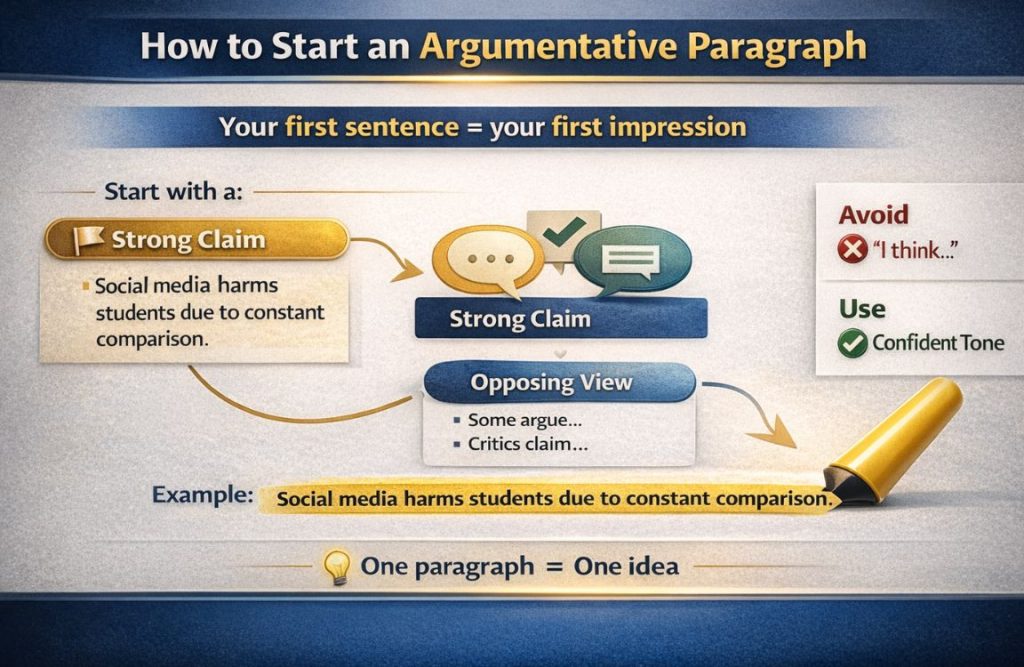
Start with a clear topic sentence (claim) that directly supports your main idea. Avoid weak phrases like “I think”– be confident.
For example:
One of the main reasons social media harms students is constant comparison.
You can also use transitions like “Furthermore,” “However,” or “Therefore” to connect ideas smoothly. Sometimes, starting with an opposing view and then challenging it creates a strong impact.
Remember: one paragraph, one idea. Start sharp, and your argument will follow.
Argumentative Paragraph Structure Explained
In this section, I’ll break down the argumentative paragraph structure step by step, showing you how each part works together, from claim to conclusion, so that you can write clear, logical, and convincing arguments with confidence.
i) Parts of an Argumentative Paragraph
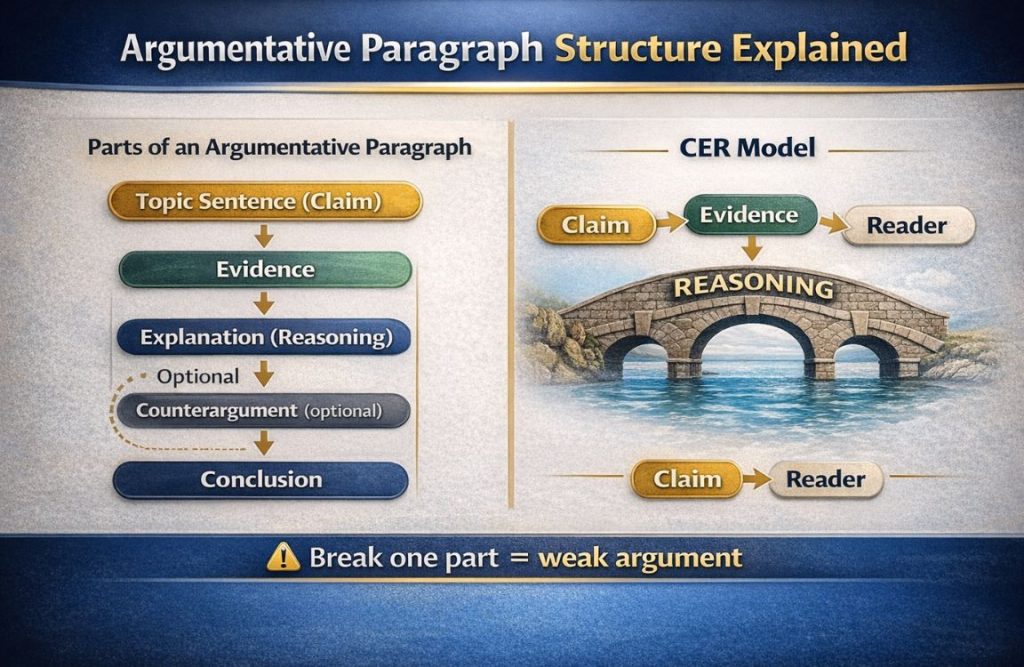
The parts of an argumentative paragraph include a topic sentence (claim), supporting evidence, analysis (reasoning), and a concluding sentence, all working together to present and prove a clear argument.
Let me take you into a real class session moment. I once asked a student to “argue” in writing. He wrote one powerful sentence… and stopped. I smiled and said, “You’ve opened the case, but where’s your evidence?”
That’s how I teach the parts of an argumentative paragraph- as a clear, logical journey:
First, the topic sentence (claim), your bold opening move. It’s like pointing your finger and saying, “This is my position.”
Example: Social media does more harm than good for students.
Next comes supporting evidence, your proof. Facts, studies, or even a real-life example.
For instance, I might reference a study showing reduced attention spans.
Then, the most ignored, but most powerful, part: explanation. This is where you connect the dots. I remind my students, “Don’t assume your reader understands- guide them.” Explain why your evidence matters.
Optionally, a brief counterargument can appear, showing awareness of other views.
Finally, the concluding sentence wraps it up neatly, reinforcing your point. Think of it as the judge’s final nod.
Each part works together like a chain- break one, and your argument weakens.
ii) CER Structure (Claim-Evidence-Reasoning)
Now, if structure feels overwhelming, I simplify everything into the CER paragraph structure, my favorite teaching shortcut.
Claim → Evidence → Reasoning
That’s it. Three steps. But don’t let its simplicity fool you. It’s incredibly powerful.
Imagine this:
Claim: Reading daily improves writing skills.
Evidence: Students who read regularly score higher in writing tests.
Reasoning: Because exposure to vocabulary and sentence patterns strengthens expression.
Why does this work so well? Because CER mirrors how we naturally think when we argue. It’s logical, clear, and persuasive.
I often tell my students, “CER is like a bridge, your claim is one side, your reader is the other, and reasoning is what connects them.”
Master this, and your argumentative paragraph stops being just writing. It becomes convincing.
How to Write an Argumentative Paragraph Step by Step
In class, I often say: writing is thinking made visible. Now, I’ll walk you through writing an argumentative paragraph step by step, the exact method I teach before exams when panic quietly turns into confidence.
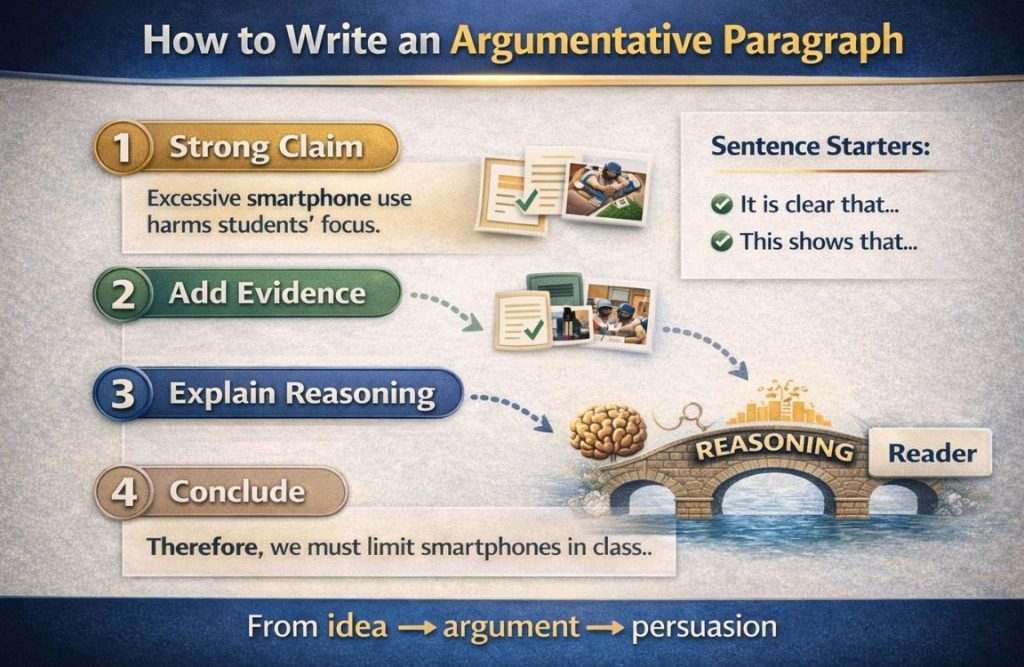
Step 1: Choose a Strong Claim
Everything begins with a decision. I tell my students, “If your claim is weak, your argument limps.” A strong claim is clear, specific, and debatable, not a bland fact.
For example, instead of saying “Technology is useful,” sharpen it: “Excessive smartphone use harms students’ focus.” Now we have tension, and tension creates an argument.
When learning how to start an argumentative paragraph, begin with conviction. Your reader should feel, instantly, that you have something worth proving.
Step 2: Add Evidence
Here’s where many students panic- they think evidence must be fancy. I reassure them: it just needs to be relevant and credible.
Evidence can be:
- A study (Cambridge research shows attention spans are shrinking)
- A real-life example (students distracted during study hours)
I once had a student use his own experience of failing a test due to distractions, and it worked beautifully.
Think of evidence as your witness. Without it, your argument is just opinion dressed up as fact.
Step 3: Explain Your Reasoning
Now comes the “teacher’s favorite” part, because this is where real thinking happens. I always tell my class, “Don’t drop evidence and run away, stay and explain it.”
Let’s say:
Evidence: Students check their phones every 5 minutes.
Reasoning: This interrupts deep focus, reducing learning efficiency.
This step is where your argument breathes. It shows you understand, not just repeat. In exams, this is often the difference between average and excellent writing.
Step 4: Conclude Effectively
A paragraph without a conclusion feels like a story without an ending. I guide my students to echo the claim, but with strength.
For example:
Therefore, limiting smartphone use is essential for academic success.
Short. Clear. Confident. You’re not adding new ideas. You’re sealing the argument.
Sentence Starters & Tips
Students often ask me for quick help, so I share simple argumentative paragraph sentence starters:
- It is clear that…
- One key reason is…
- This shows that…
- Therefore…
Use them wisely. They’re like training wheels. Helpful at first, but your goal is fluency.
Argumentative Paragraph Examples
In my live classroom, examples are where theory finally clicks. So instead of more explanation, let me show you two short argumentative paragraph examples- the kind I use to turn confusion into clarity.
Example: 1 (School Topic)
Here’s a sample argumentative paragraph I once built live on the board with my students:
School uniforms should be mandatory because they promote equality among students. In many schools, students feel pressured to wear expensive clothes to fit in, which creates unnecessary competition. For example, a report from the UK Department for Education found that uniforms reduce bullying related to appearance. This means students can focus more on learning rather than social comparison. Therefore, school uniforms create a more inclusive and focused educational environment.
Now, I pause and ask my class, “Did you notice the hidden structure?”
- Claim: uniforms should be mandatory
- Evidence: report + real situation
- Explanation: links to learning focus
- Conclusion: reinforces the claim
When students see the pattern, writing suddenly feels less mysterious.
Example 2 (Social Issue)
Let’s step outside school and into a real-world issue:
Plastic pollution should be strictly controlled because it poses a serious threat to the environment. Every year, millions of tons of plastic waste end up in oceans, harming marine life. For instance, sea turtles often mistake plastic bags for food, leading to fatal consequences. This shows that unchecked plastic use directly destroys ecosystems and biodiversity. Therefore, governments and individuals must take immediate action to reduce plastic consumption.
Here, I advise my students, “Feel the difference?” This isn’t just an argument. It’s a warning.
Notice how the paragraph doesn’t just inform. It persuades with urgency. That’s the power of a well-crafted argument.
And once you master this, you’re not just writing paragraphs anymore. You’re shaping opinions.
Argumentative Paragraph Topics for Students
In class, this is the moment students either light up or freeze. “What do I even write about?” they ask. So I give them argumentative paragraph topics that spark curiosity, not boredom.
Here are some I’ve seen work like magic:
- Should mobile phones be banned in classrooms?
- Is online learning better than traditional education?
- Should homework be reduced for students?
- Are exams a fair way to measure intelligence?
- Should social media have age restrictions?
- Is climate change the biggest global threat today?
- Should school uniforms be compulsory?
- Is artificial intelligence harmful to creativity?
- Should junk food be banned in schools?
- Is gaming a waste of time or a skill?
- Should students choose their own subjects?
- Is competition better than collaboration?
I always tell my students: a strong topic is half the argument won. Choose one that makes you feel something, because emotion fuels curiosity, and curiosity fuels writing.
Counterargument Paragraph? (Advanced Skill)
A counterargument paragraph is an advanced writing skill where you acknowledge an opposing view and then respond to it with logic and evidence. It strengthens your argument by showing balance and critical thinking.
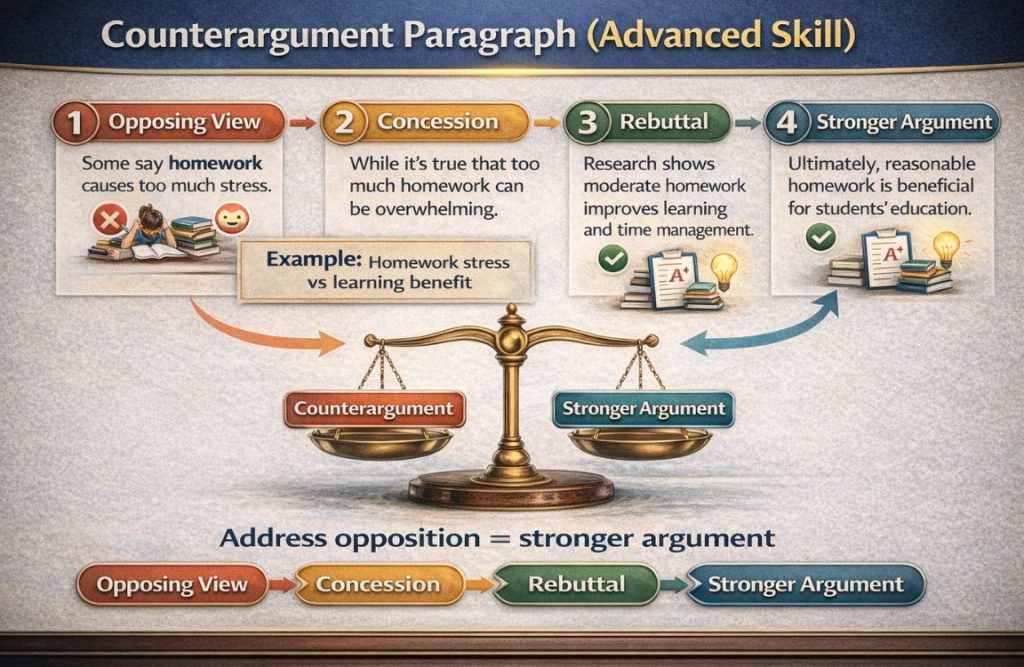
In a strong counter-argument paragraph, you begin with the opposing idea (e.g., “Critics argue…”), briefly accept its possibility (concession), and then challenge it using facts or reasoning (rebuttal). This builds trust and makes your writing more persuasive.
Here’s a simple counterargument paragraph example:
Some argue that homework increases student stress. While this may be true in extreme cases, moderate homework actually improves understanding and retention. Therefore, the problem is not homework itself, but how it is assigned.
Great writers don’t ignore opposition. They address it confidently. That’s what makes a counterargument paragraph powerful and essential in academic writing.
Argumentative vs Persuasive vs Opinion Paragraph
Students often mix these up, so I break them down like this:
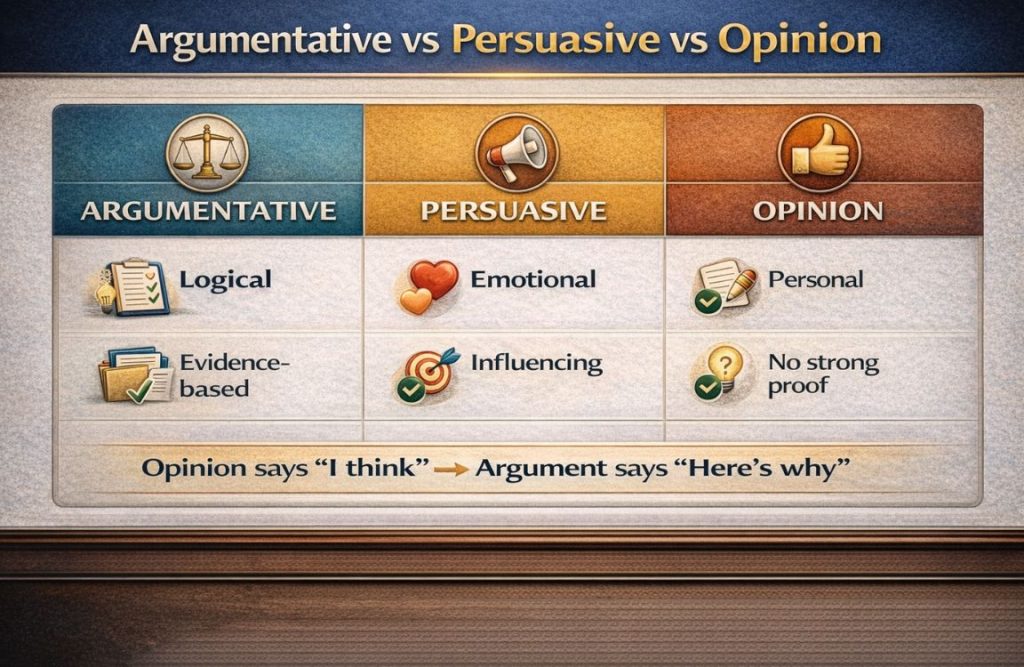
| Type | Tone | Purpose | Evidence |
| Argumentative | Logical, balanced | Prove a point | Strong facts & reasoning |
| Persuasive | Emotional, convincing | Influence feelings | May use opinions |
| Opinion | Personal, informal | Share belief | Little or no evidence |
When teaching argumentative vs persuasive paragraphs, I say: persuasive writing pulls your heart, but argumentative writing trains your mind.
And in argumentative vs opinion paragraph, the difference is simple: opinion says “I think,” while argument says “Here’s why I’m right.”
Common Mistakes to Avoid
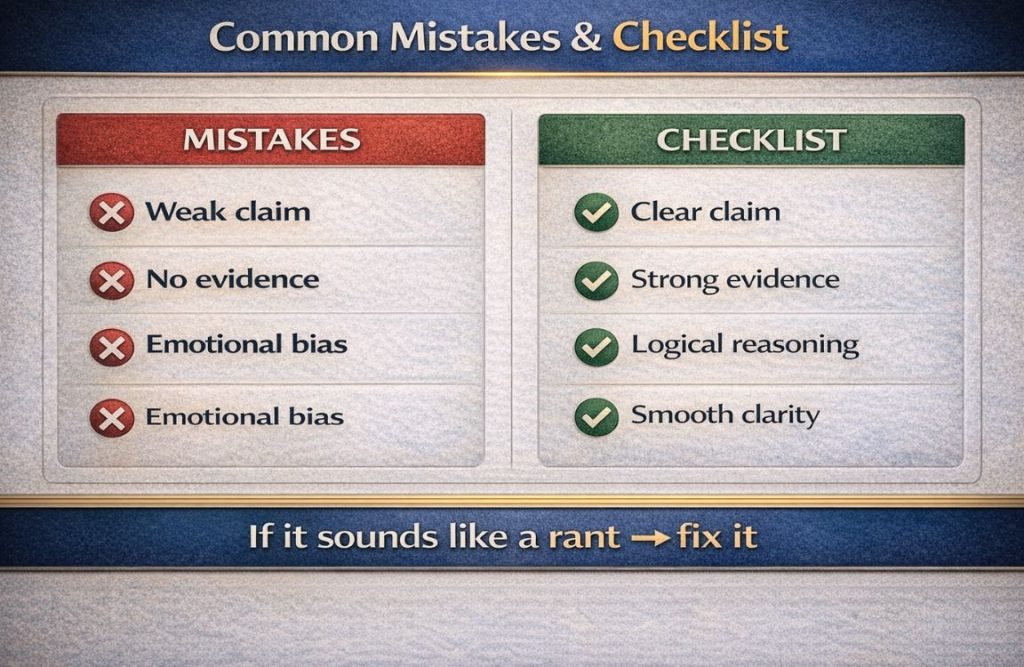
Ah, the traps! I’ve seen even good students fall into these:
- Weak claims: If your idea isn’t clear, your argument collapses.
- No evidence: This is like going to court without proof- hopeless.
- Emotional bias: Passion is good, but logic must lead.
I often joke, “If your paragraph sounds like a rant, not a reason. It needs fixing.”
Quick Checklist for Argumentative Paragraph Writing
Before submitting, I always tell my students to pause and check:
✔ Clear claim
✔ Strong evidence
✔ Logical reasoning
✔ Smooth clarity
This simple argumentative paragraph checklist can turn a rushed answer into a refined one. And sometimes, that small difference is exactly what earns the extra marks.
FAQs:
How long should an argumentative paragraph be?
I guide my students to aim for 5-8 sentences. Long enough to argue clearly, short enough to stay focused. Think of it like a sharp speech, not a rambling lecture.
Can an argumentative paragraph include personal opinion?
Yes, but carefully. I always advise my students, “Your opinion is the spark, not the fire.” It must be supported with logic and evidence, or it remains a belief, not a convincing argument.
What makes a strong claim in an argumentative paragraph?
A strong claim is clear, specific, and debatable. I often challenge students: “Can someone disagree with you?” If not, it’s a fact, not an argument worth writing.
Do I need evidence in every argumentative paragraph?
Absolutely. Evidence is your backbone. Without it, your paragraph is like a chair with missing legs. It simply cannot stand, no matter how confident your tone sounds.
How is CER different from a regular paragraph structure?
CER (Claim-Evidence-Reasoning) gives your thinking a logical flow. Unlike general paragraphs, it forces you to prove ideas step by step, making your writing more structured, persuasive, and exam-ready.
Conclusion:
I often tell my students, “An argumentative paragraph is the backbone of persuasive writing.” Once you master it, essays stop feeling overwhelming and start feeling manageable.
Let’s take a breath and look back. You’ve learned how structure shapes clarity, how writing steps turn ideas into arguments, and how examples reveal what strong writing truly looks like. More importantly, you’ve seen how logic, not just opinion, wins the reader’s trust.
But here’s the real secret I share in class: writing improves only when you do it, not just read about it.
So don’t stop here.
👉 Now try writing your own argumentative paragraph using the steps above, and test your power to persuade.