I often ask my students, “Have you ever written something that truly reflects you?”
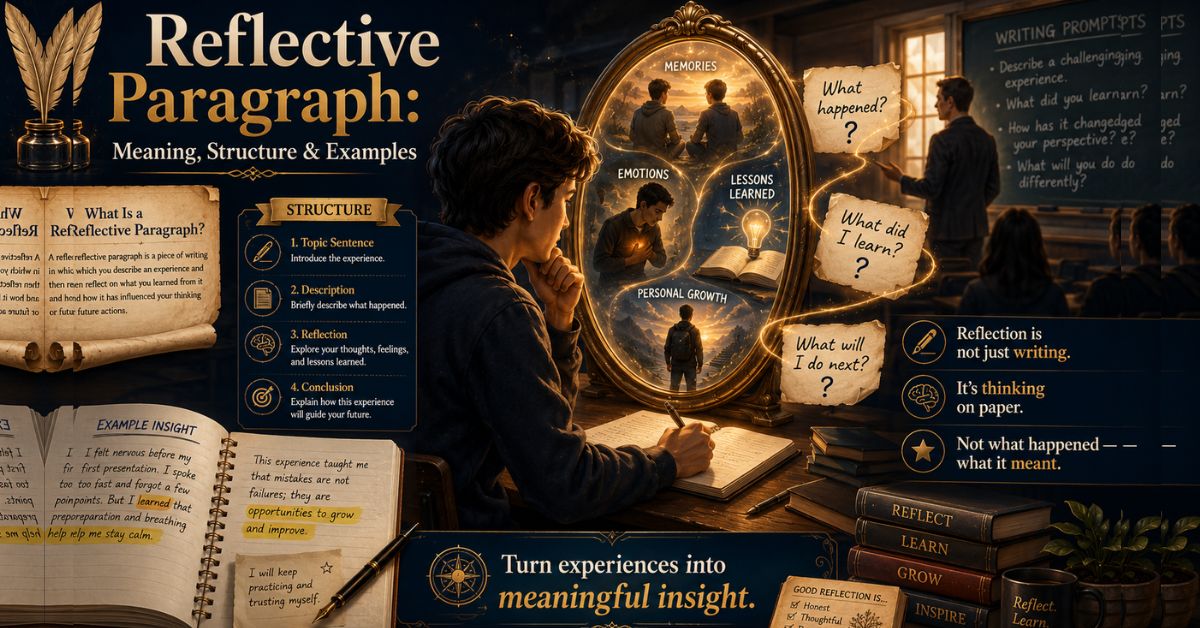
Most of them smile, some hesitate, and a few look worried. Because a reflective paragraph is not just about writing. It’s thinking on paper. And that’s where students struggle.
They can describe events easily, but when I ask, “What did you learn from it?”— silence. That’s the gap between writing and reflecting.
Reflection means looking back, not like a camera, but like a mirror. It doesn’t just show what happened. It reveals what it meant.
In this lesson, I’ll guide you step by step. By the end, you won’t just write a reflective paragraph. You’ll understand how to turn your thoughts into powerful, meaningful writing.
What Is a Reflective Paragraph?
Let’s begin with a clear answer, the kind examiners love.
A reflective paragraph is a short piece of narrative writing where you describe an experience and, more importantly, explain what you learned, felt, or understood from it. That is the true meaning of a reflective paragraph— not just what happened, but what it changed in you.
Here’s how I explain it in class:
Normal writing says, “I failed my test.”
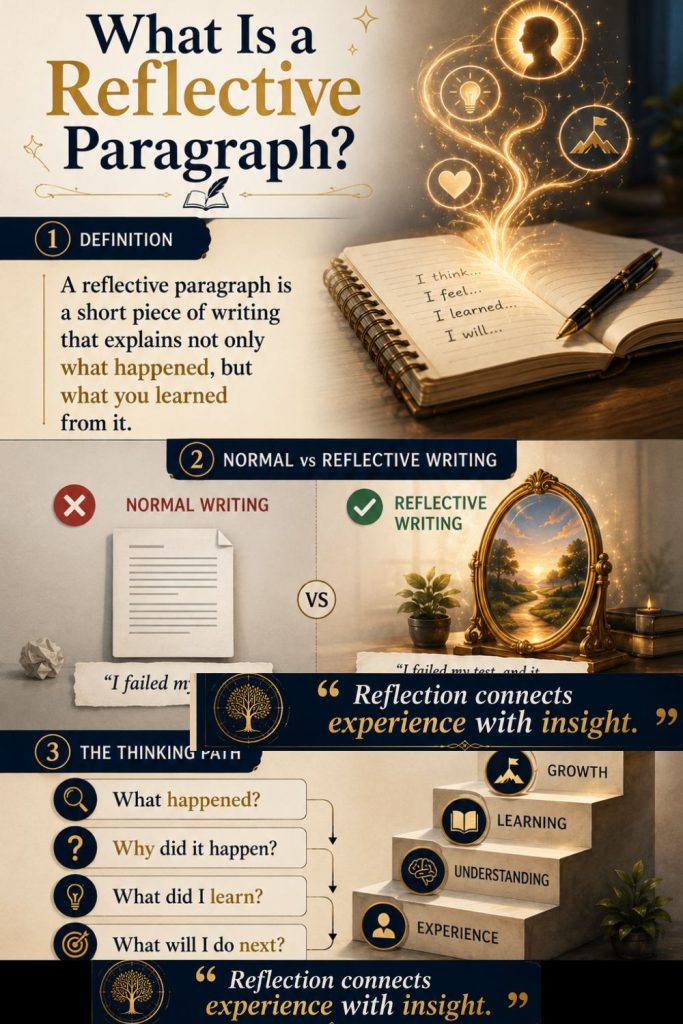
Reflective writing says, “I failed my test, and it made me realize I depended too much on memorization.”
See the difference? One reports. The other reveals.
Reflective writing is personal, thoughtful, and often honest in a way that feels slightly uncomfortable, and that’s a good sign. It shows you are thinking deeply.
At its core, a reflective paragraph connects experience with insight. It usually follows a simple thinking path:
- What happened?
- Why did it happen?
- What did I learn?
- What will I do next?
Once students understand this shift, from description to interpretation, their writing begins to breathe.
Why Is Reflective Writing Important?
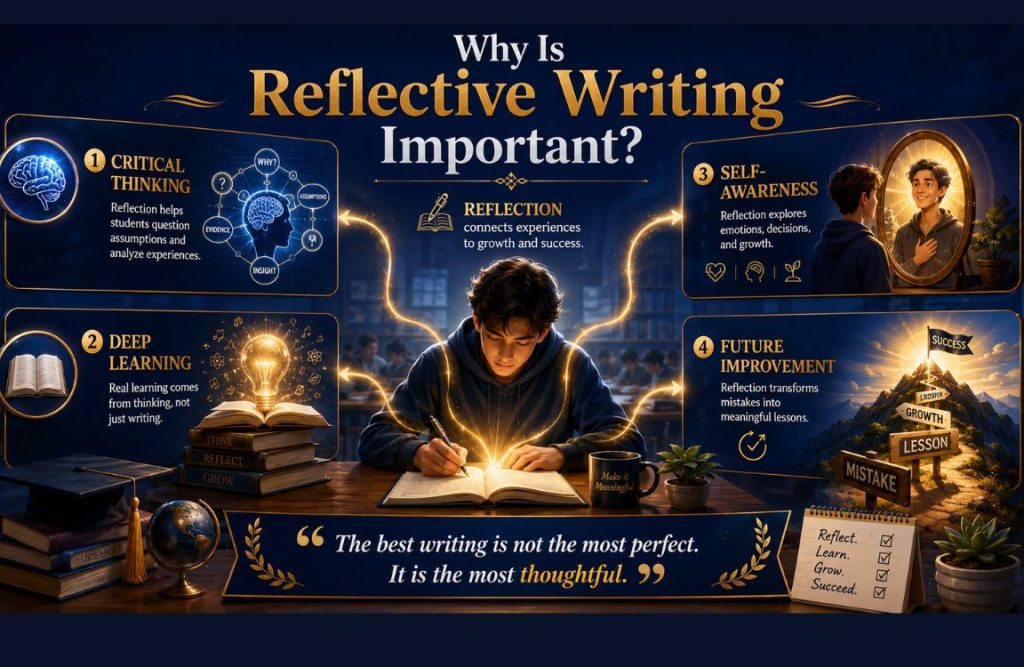
Reflective writing is important because it turns experience into learning by helping individuals analyze actions, improve thinking, and apply lessons to future situations.
The reflective writing definition goes beyond simply describing events. It means examining experiences to gain a deeper understanding and personal growth.
Students often ask, “Why do we need reflective writing?” The answer is simple: real learning comes from thinking, not just writing.
Reflective writing deepens understanding by connecting new ideas with real-life experience. It strengthens critical thinking, encourages students to question assumptions, and helps identify gaps in knowledge.
It also builds self-awareness by exploring emotions, decisions, and personal progress over time.
In both academic and professional settings, reflection improves future performance and decision-making. It transforms mistakes into lessons and experiences into meaningful knowledge.
In my classroom, the best writing is not the most perfect. It is the most thoughtful.
Reflective Paragraph Structure
Before students begin writing, one question always arises: “Where do I start?” A clear reflective paragraph structure provides that answer, guiding ideas from experience to insight. In this section, I’ll explain the three essential steps that shape effective reflection.
i) Introduction Sentence:
The introduction sentence sets the stage. It briefly introduces the experience you are reflecting on.
For example: “Last week, I gave my first class presentation, and it was more challenging than I expected.”
Notice how simple it is. There’s no need for long descriptions. Just give enough context so the reader understands what happened. Think of this as opening a door. You invite the reader in, but you don’t tell the whole story yet.
ii) Reflection (Body):
This is the heart of your paragraph, where real thinking happens. Here, you explore your feelings, reactions, and lessons.
Instead of saying, “I was nervous,” go deeper: “I realized my nervousness came from a lack of preparation.”
That shift, from feeling to understanding, is reflection.
I often tell students, ” Don’t just show emotions, explain them. Ask yourself:
Why did I feel this way?
What did I discover?
This part transforms your paragraph from simple writing into meaningful reflection.
iii) Conclusion Sentence
The conclusion brings everything together. It answers the most important question: What did you learn?
For example: “This experience taught me that confidence comes from preparation, not luck.”
Keep it clear and thoughtful. Avoid repeating ideas. Instead, end with insight.
A strong conclusion doesn’t just finish the paragraph. It leaves the reader with something to think about.
How to Write a Reflective Paragraph
Now comes the part students enjoy most— actually writing. When learning how to write a reflective paragraph, I always break it into simple steps.
First, choose an experience. It could be:
- A class test
- A presentation
- A mistake
- Or even a small success can become a meaningful reflection.
Reflection doesn’t need a big event. It needs a meaningful one.
Second, describe it briefly. Don’t turn it into a story. Just give the key idea. For example: “I struggled during my group discussion because I didn’t share my ideas.”
Third, reflect deeply. This is where most students stop too early. Ask yourself:
- Why did this happen?
- What did I feel?
- What does this say about me?
Let me share a classroom moment. A student once wrote, “I failed because the exam was hard.” I smiled and asked, “Was it the exam, or your preparation?” That question changed the entire paragraph.
One simple framework many students find helpful is the DIEP model: Describe, Interpret, Evaluate, and Plan.
Finally, conclude with meaning. What lesson will you carry forward? Reflection always looks ahead, even when it begins in the past.
If you’re unsure how to start a reflective paragraph, begin with honesty. Not perfection. Reflection is not about writing beautifully. It’s about thinking truthfully.
And remember: the best reflective writing doesn’t impress the teacher. It reveals the writer.
Reflective Paragraph Example (For Students)
Let me show you a complete reflective paragraph example, the kind I often share in class:
Last month, I participated in a group project where I chose to remain silent most of the time. I believed my ideas were not good enough, so I let others lead the discussion. However, when the final presentation was delivered, I realized that some important points were missing— ideas I had but never shared. This made me feel regretful and frustrated with myself. I understood that my silence was not a sign of respect, but a lack of confidence. I also realized that teamwork requires participation, not just presence. This experience taught me that my voice matters, even if it is not perfect. In the future, I will try to express my ideas more openly and take responsibility for contributing to group work.
Now, notice the structure:
- Beginning: introduces the situation
- Middle: reflects on feelings and realization
- End: presents a clear lesson
That’s what makes this reflective paragraph sample effective. It doesn’t just tell a story. It shows growth.
Reflective Paragraph Topics & Ideas
When students ask for reflective paragraph topics, I remind them that reflection lives in ordinary moments, not just dramatic ones. The best ideas are often already part of your life. You simply need to notice them.
Almost any personal experience can become a meaningful reflection:
- A class presentation
- A group discussion
- A difficult exam
- A mistake
- A friendship conflict
- Or even a quiet success
The key is not the event itself, but what it taught you.
Strong reflective writing goes beyond describing what happened. It explores how the experience changed your thinking, emotions, or understanding. A simple classroom moment can reveal lessons about confidence, communication, responsibility, or personal growth.
Choose a topic that made you pause, question yourself, or see something differently. That’s where genuine reflection begins.
Reflection Sentence Starters
Many students struggle not with ideas, but with beginnings. That’s where reflection sentence starters become helpful tools. Think of them as keys that unlock your thoughts.
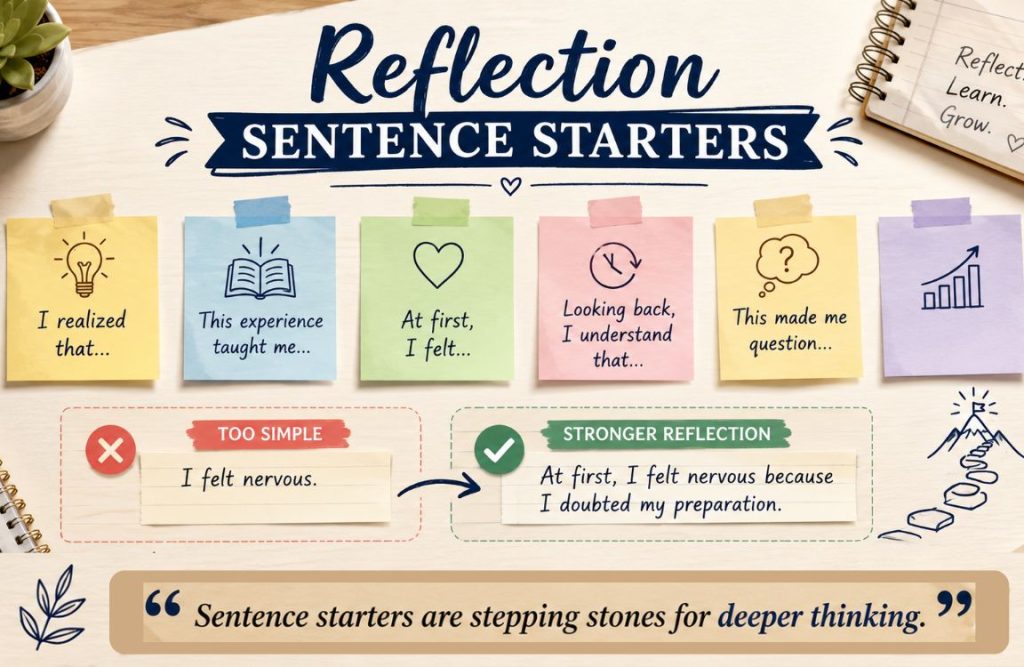
In class, I always write a few on the board:
- “I realized that…”
- “This experience taught me…”
- “At first, I felt…”
But here’s the trick. Don’t use them mechanically. Use them meaningfully. For example, instead of writing, “I felt nervous,” try, “At first, I felt nervous because I doubted my preparation.”
That small addition turns a simple sentence into a reflection.
You can also try:
- “Looking back, I understand that…”
- “This made me question…”
Sentence starters are not shortcuts. They are stepping stones. They guide your thinking until you can walk on your own.
Common Mistakes in Reflective Paragraph Writing
Over the years, I’ve noticed 3 common mistakes students make.
First, they become too descriptive. They narrate events like a story but forget to reflect. Remember, reflection is not about what happened. It’s about what it meant.
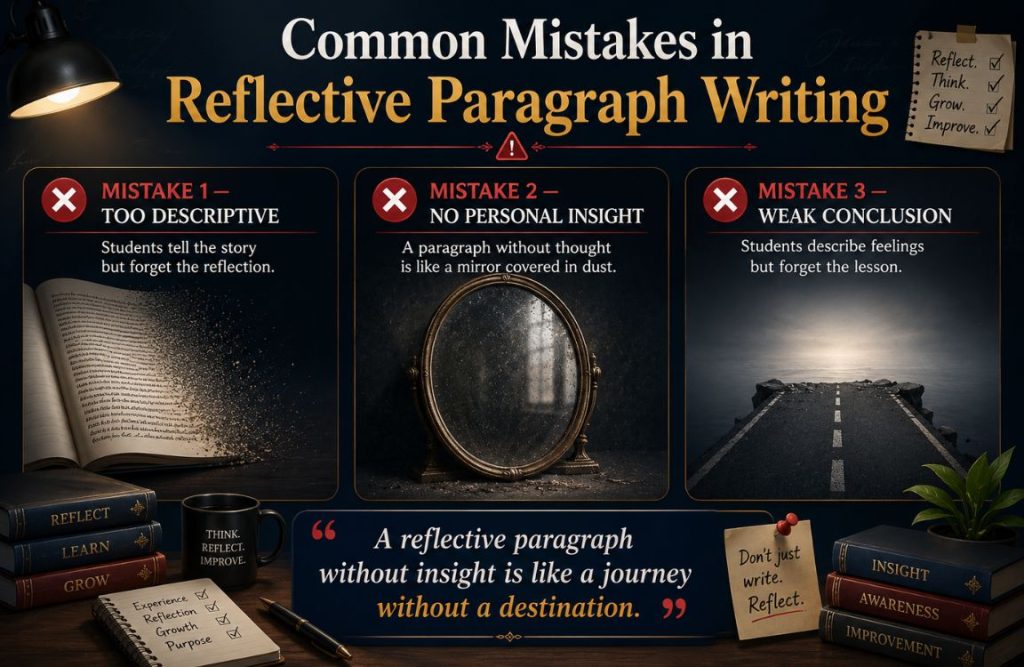
Second, there is no personal insight. A paragraph without thought is like a mirror covered in dust. It shows nothing clearly.
Third, many forget the conclusion. They stop after describing feelings but never explain the lesson learned.
I often tell my class: a reflective paragraph without insight is like a journey without a destination. It moves, but it never arrives.
FAQs:
How long should a reflective paragraph be?
A reflective paragraph is usually 100 to 200 words long. It should be long enough to describe the experience briefly and explain your thoughts and learning clearly without unnecessary details.
Can a reflective paragraph be written in the first person?
Yes, a reflective paragraph is typically written in the first person because it focuses on personal experiences, thoughts, and feelings, making “I” a natural and appropriate choice.
What tense is used in reflective writing?
Reflective writing often uses the past tense to describe the experience and the present tense to explain insights or lessons learned, creating a connection between past events and current understanding.
Is a reflective paragraph formal or informal?
A reflective paragraph is usually semi-formal. While it includes personal thoughts and feelings, it should still maintain clear structure, proper grammar, and a thoughtful tone suitable for academic writing.
Can I use examples in a reflective paragraph?
Yes, using examples strengthens your reflection. Real experiences make your writing more authentic and help explain your thoughts clearly, showing not just what you learned but how you learned it.
Conclusion:
A reflective paragraph is more than an academic task. It is a way of thinking. It teaches you to pause, question, and understand your own experiences.
In my classroom, the strongest writers are not those who use difficult words, but those who think deeply and write honestly. Reflection turns everyday moments into meaningful lessons.
So don’t wait for the “perfect” topic. Start small. Reflect on something real.
👉 Start writing your own reflective paragraph today and discover your voice. Because once you learn to reflect, you don’t just become a better writer. You become a better thinker.