

Having an opinion is easy. Turning that opinion into a paragraph that makes readers pause and consider your point is a different skill.
Persuasive paragraph writing teaches you how to present a clear position and support it with your reasons, evidence, and explanation. In this guide, you will learn:
- What a persuasive paragraph is
- How to structure one
- How to support your ideas
- How to address another viewpoint
- How to end with a strong conclusion
What Is a Persuasive Paragraph?
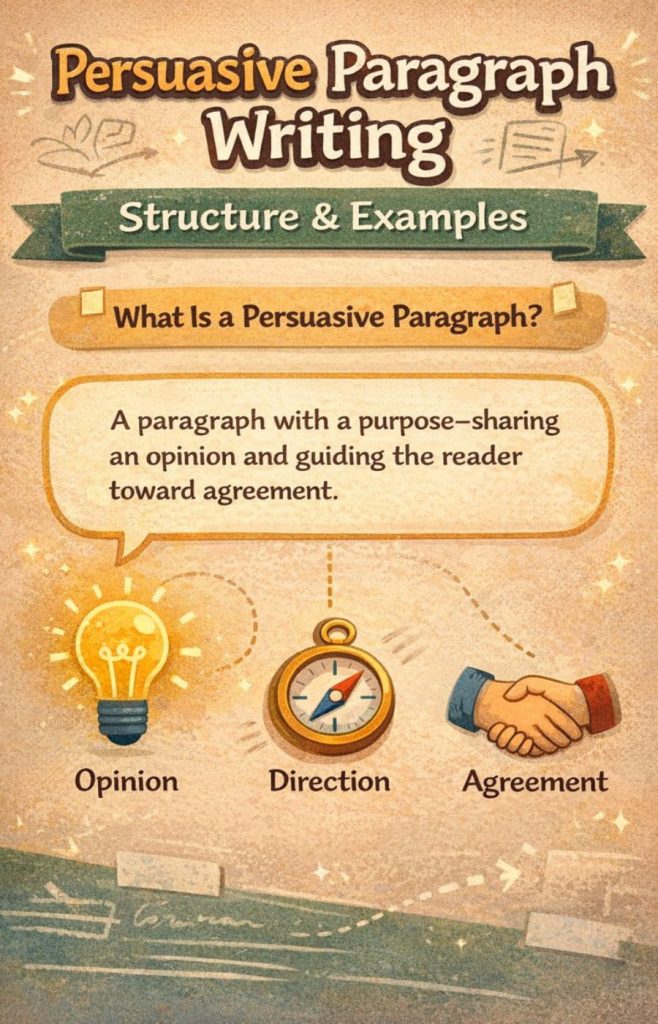
A persuasive paragraph takes a clear position on an issue and uses supporting reasons, relevant evidence, clear explanation, and suitable language to influence or convince the reader.
Its purpose is not simply to announce an opinion. You need to give readers enough support to understand why your position makes sense.
A persuasive paragraph should also consider its audience. For example, if you argue that schools should provide more reading time, think about what teachers, classmates, or school administrators may value. You can then choose reasons and examples that suit those readers.
In my classes, I often find that students have strong opinions but struggle to explain them. Teaching them to ask “Why should the reader accept this point?” usually helps them move beyond simply stating what they think.
Unlike a descriptive paragraph, which creates a picture with details, or a narrative paragraph, which tells what happened, a persuasive paragraph presents a position and gives reasons for accepting it.
Table of Contents
What Is the Purpose of a Persuasive Paragraph?
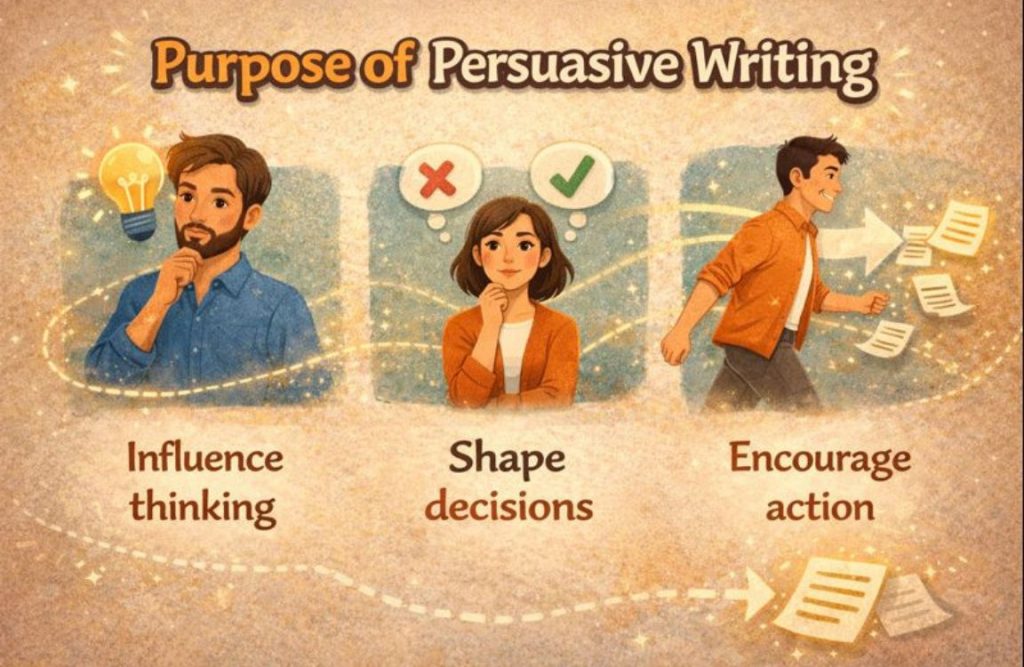
The purpose of persuasive writing is to influence how readers think, feel, or respond to an issue. A paragraph may encourage readers to accept an opinion, reconsider an idea, change a habit, or take an action.
Persuasion does not always mean making someone agree with you. Good persuasive writing gives readers reasonable support for considering your position, even if they reach a different conclusion.
What Makes a Persuasive Paragraph Effective?
Several features help a persuasive paragraph work well:
- Clear position: Readers should know exactly what you believe.
- Relevant reasons: Your reasons should directly support your position.
- Useful evidence: Facts, examples, observations, or expert views can strengthen your ideas.
- Clear explanation: Show how the evidence supports your point.
- Audience awareness: Choose ideas and language that suit your readers.
- Respectful tone: Sound confident without becoming rude or exaggerated.
Most importantly, keep the ideas connected. Every sentence should develop or support the main position.
Persuasive Paragraph Structure and Format
A simple persuasive paragraph structure has five main parts:
1. Topic Sentence or Claim
State your position clearly. The reader should quickly understand what you want to establish.
2. Supporting Reason
Give a reason for your position. This explains why the claim makes sense.
3. Evidence or Example
Support the reason with a fact, statistic, example, quotation, observation, or expert opinion.
4. Explanation
Explain what the evidence shows and why it matters. This connects the support to your main point.
5. Concluding Sentence
Reinforce the main idea and bring the paragraph to a natural close. Do not simply copy the topic sentence. You can remember the pattern like this:
Claim → Reason → Evidence → Explanation → Conclusion
This is a guide, not a strict formula. Some paragraphs may need more sentences than others. The important thing is to keep the ideas focused and connected.
How to Write a Persuasive Paragraph Step by Step
Here are the most effective steps to write a powerful persuasive paragraph:
Step 1: Choose a Debatable Topic
Start with an issue about which reasonable people can disagree. Good persuasive paragraph topics give you something to defend.
For example:
School uniforms should be optional because students need some freedom to express their individuality.
This is debatable because someone else may believe uniforms are necessary. By contrast, “The school library has books” is a fact, not a persuasive position.
Ask yourself:
Could another reasonable person disagree with me?
If the answer is yes, you probably have a workable topic.
Step 2: Decide Your Position
Be specific about what you believe. Avoid a vague statement such as: Uniforms can be good or bad. A clearer position is:
Schools should allow students some choice in what they wear while keeping reasonable dress rules.
Now you know exactly what your paragraph needs to defend.
Step 3: Plan Your Support
Think of one or two reasons that can support your position. Then consider what kind of support could make each reason clearer.
For the uniform topic, one reason might be that students need some freedom to express their individuality.
Step 4: Write the Topic Sentence
Turn your main position into a clear opening sentence.
Schools should allow students some choice in what they wear while keeping reasonable dress rules.
The reader immediately knows what the paragraph will argue.
Step 5: Develop the Reason
Explain why your position makes sense.
Giving students some choice can help them express their individuality while still following basic school rules.
Keep the reason closely connected to the claim.
Step 6: Add Evidence or an Example
Now give support for the reason. For instance, a school might allow students to choose from several approved clothing options.
A specific example helps readers understand how the idea could work in practice.
Step 7: Explain the Support
Do not stop after giving an example. Ask yourself:
So what does this show?
If students can choose from several approved options, the school can maintain basic standards while giving students some personal choice. That explanation makes the connection to the argument clear.
Step 8: Consider Another Viewpoint
When it fits the topic, mention a reasonable opposing idea.
Some teachers may believe that uniforms create a stronger sense of equality.
You can respond briefly:
However, a balanced dress policy can still promote equality without removing every choice from students.
A short counterpoint is usually enough for a single paragraph. There is no need to turn the paragraph into a long debate.
Step 9: Write the Conclusion
End by reinforcing the main idea without copying the opening sentence.
For example, you could remind readers that clear school rules and some personal choice can exist together.
When I mark student paragraphs, I pay particular attention to the final sentence. A student may develop a good argument and then weaken it by ending abruptly or introducing a completely new point.
Persuasive Paragraph Examples
Here is a model paragraph showing how the five parts work together.
Example 1: School Libraries Should Stay Open After Classes
[Claim] School libraries should remain open for at least one hour after classes.
[Reason] Some students need a quiet place to study because they do not have a suitable study environment at home.
[Evidence] For example, a student may share a small home with several family members or have limited access to reference materials.
[Explanation] An after-school library gives such students time to read, complete assignments, and use school resources without the distractions they may face at home.
[Conclusion] Keeping the library open for an additional hour would give students a practical opportunity to study and make better use of resources already available at school.
Example 2: Students Should Read Books
Students should develop the habit of reading books because reading can improve both knowledge and language skills. Books introduce us to new ideas, places, people, and experiences. Regular reading also helps students learn new words and become familiar with different sentence patterns. For example, a student who reads English stories regularly may gradually become more confident in writing and speaking. Although some students prefer watching videos, books can provide deeper information and encourage careful thinking. Therefore, students should make time for reading every day.
Example 3: Schools Should Have More Trees
Schools should plant more trees because trees can make the school environment healthier and more pleasant. They provide shade during hot weather and can help keep the surroundings cooler. Trees can also improve the appearance of a campus and reduce dust in some areas. For example, a school could plant trees beside walkways, playgrounds, and other suitable spaces. Some people may worry that trees will take up valuable space, but schools can choose planting areas without disturbing regular activities. A greener campus can also give students an opportunity to learn about caring for nature. Therefore, schools should encourage tree planting wherever suitable space is available.
Persuasive Paragraph Starters
Students who find it difficult to begin can use simple starters such as:
- Schools should…
- Students should…
- One important reason to…
- Communities should consider…
- I believe that…
- It would be better if…
These are starting points, not complete answers. Add your own position, reasons, and evidence instead of memorizing them.
Persuasive Paragraph Topics for Practice
Try writing about:
- school uniforms
- homework limits
- later school start times
- school phone policies
- recycling
- school libraries
- tree planting
- healthy food in schools
Choose a topic that gives you something specific to argue.
Common Persuasive Paragraph Writing Mistakes
Watch out for these common problems:
- Unclear claim: The reader cannot tell what you believe.
- Unsupported opinion: You state an idea but give no reason or evidence.
- Irrelevant evidence: The example does not support the claim.
- Unexplained evidence: You provide support but do not explain its importance.
- Repeated reasons: Several sentences make the same point.
- Aggressive language: Strong emotion replaces reasonable argument.
- Weak conclusion: The paragraph ends suddenly or introduces a new idea.
When revising, ask yourself:
Does every sentence help support my main position?
If not, revise it, move it, or remove it.
Persuasive Paragraph vs. Argumentative Paragraph
The terms persuasive paragraph and argumentative paragraph often overlap, especially in school writing. The difference is usually one of emphasis.
Persuasive writing often focuses on convincing readers through reasons, evidence, and suitable appeals. Argumentative writing usually places greater emphasis on formal evidence, counterclaims, and refutation.
However, the distinction can vary by teacher, textbook, or course. Always follow the requirements of your particular assignment.
FAQs:
Can personal experience be used as evidence in a persuasive paragraph?
Yes. Personal experience can support a point when it is relevant and clearly connected to the claim. However, it does not automatically carry more weight than factual or expert evidence.
Should every persuasive paragraph use statistics?
No. Statistics can be useful, but relevant facts, examples, expert opinions, quotations, and observations can also provide support.
Can a persuasive paragraph use emotional language?
Yes, but use it carefully. Emotional appeal can make writing engaging, but it should support sound reasoning rather than replace evidence.
Should a persuasive paragraph always include a counterargument?
No. A short paragraph may not have enough space for one. However, mentioning a reasonable opposing view can strengthen a developed paragraph when it fits the topic.
How can I sound confident without sounding aggressive?
Use clear claims, relevant evidence, respectful language, and precise wording. Strong persuasion comes from good reasoning, not exaggerated language.
Conclusion:
Effective persuasion does not require complicated English. It requires a clear position, relevant reasons, useful evidence, and an explanation that connects your ideas.
When practicing persuasive paragraph writing, choose one debatable topic and decide exactly what you want to argue. Support your position with a reason, add relevant evidence, explain why it matters, and finish with a clear conclusion.
The goal is not simply to make readers agree with you. Give them a clear and reasonable basis for taking your position seriously.
In my experience, students make better progress when they focus less on memorizing a model paragraph and more on understanding how each sentence supports the central claim.