
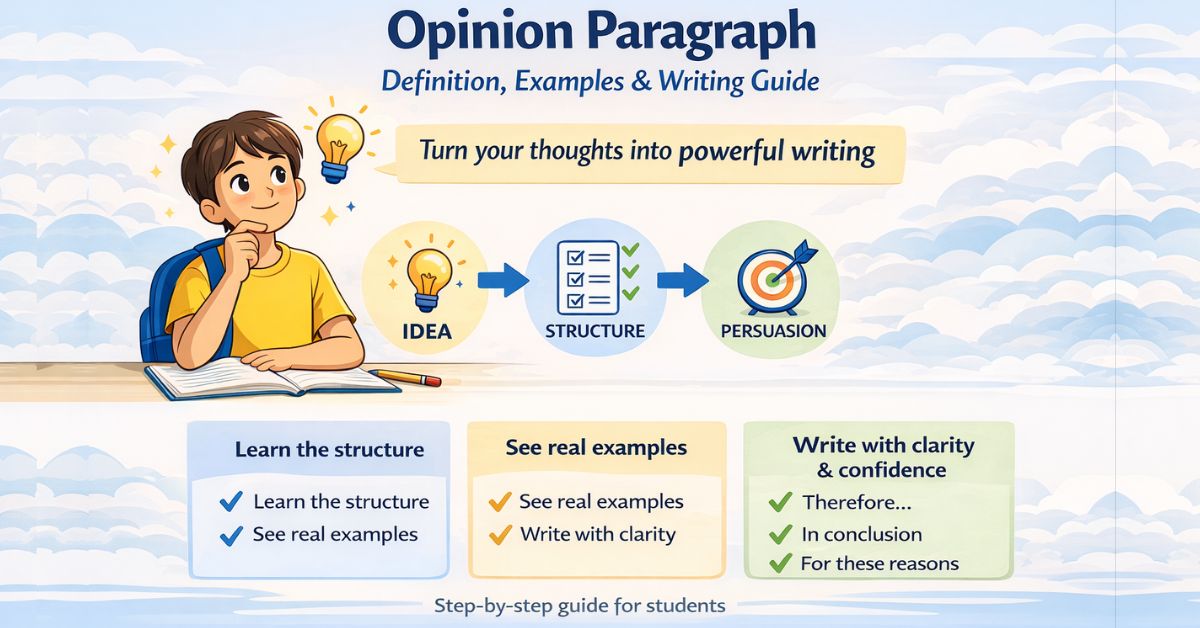
What if your opinion paragraph could actually persuade someone in just five sentences?
For many students, expressing ideas clearly feels harder than it should. They know what they think, but struggle to turn that into strong, structured writing. So, what is an opinion paragraph, and how do you write one effectively?
In this guide, I’ll show you exactly how to write an opinion paragraph that is clear, convincing, and well-organized. From understanding the structure to exploring real opinion paragraph examples, you’ll learn how to turn simple thoughts into powerful writing.
Let’s break it down step by step.
What Is an Opinion Paragraph?
Let me start with a question I often ask in class: “If you say, ‘Chocolate ice cream is the best,’ are you stating a fact, or revealing your personality?”
An opinion paragraph is a short piece of writing where I clearly express what I think, feel, or believe about a topic, and then support it with reasons, facts, or examples to convince the reader.
That’s the key difference between fact and opinion. A fact can be verified (“Water boils at 100°C”), but an opinion invites discussion (“Online learning is better than classroom learning”).
The purpose of an opinion paragraph isn’t just to say something. It’s to persuade effectively. Think of it like standing in front of your friends and making your case: you need clarity, confidence, and a little charm. Using simple transition words like first, another reason, and therefore helps ideas flow smoothly.
In exams, essays, or blog writing, mastering this skill helps you argue clearly, think critically, and sound worth listening to.
Table of Contents
Opinion Paragraph Structure Explained
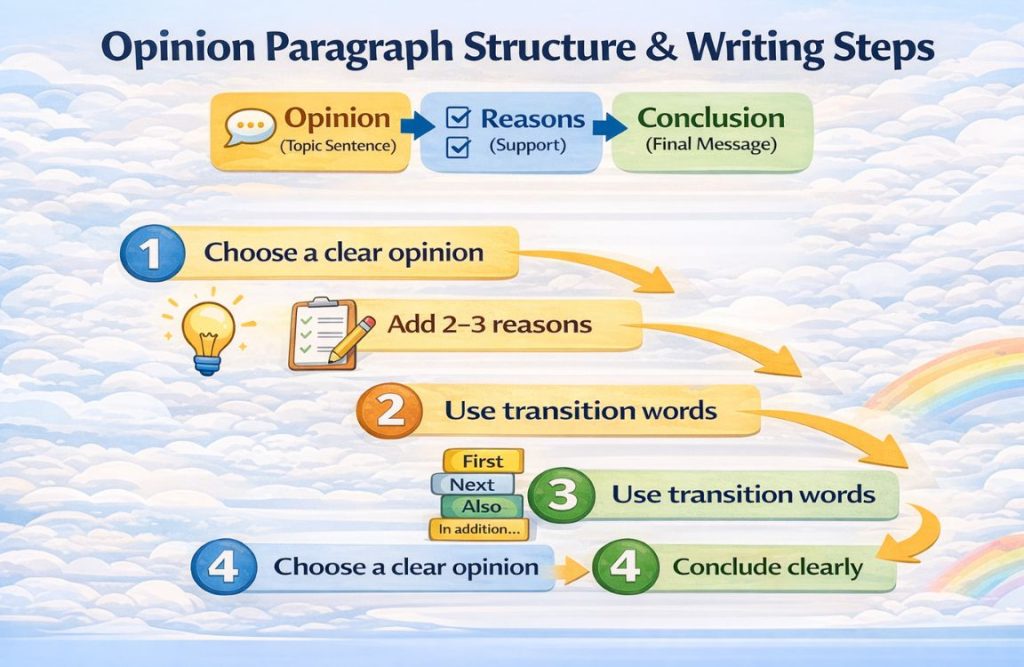
Before writing, I always tell my students: structure is your backbone. An effective opinion paragraph format includes three parts: your opinion (topic sentence), supporting reasons, and a concluding sentence that reinforces your stance with clarity and impact.
i) Topic Sentence (Opinion Statement)
This is where your voice enters the room, confidently. Your topic sentence must clearly state your opinion without hesitation. I tell my students: don’t whisper your idea, declare it.
For example: “I strongly believe that social media does more harm than good for students.”
Notice how direct that is? No confusion, no apology. A strong stance immediately tells your reader what to expect. Avoid vague phrases like “maybe” or “sometimes.” Your job here is to take a side and invite your reader into your argument.
ii) Supporting Reasons
Now comes the “proof”, and this is where many students stumble. Having an opinion is easy. Defending it is an art.
I recommend giving 2-3 clear reasons, each logically connected. For instance, if I argue that social media is harmful, I might say: it distracts students, affects mental health, and reduces face-to-face interaction.
Think of each reason as a leg of a chair- remove one, and your argument weakens. Use examples or mini-stories to make your points vivid. A real-life reference- like a student losing study time to scrolling- can turn a simple reason into a compelling argument.
iii) Concluding Sentence
This is your final impression- make it count. Your concluding sentence should restate your opinion, but with a sense of closure, not repetition.
I often tell my class: “Leave your reader nodding, not wondering.”
For example: “Therefore, social media, while entertaining, ultimately harms students’ focus and well-being.”
Notice how it wraps everything neatly? It reminds the reader of your stance and reinforces your argument, like the final note of a song that lingers just long enough.
How to Write an Opinion Paragraph (Step-by-Step Guide)
Let’s walk through the process together. Writing an opinion paragraph isn’t magic. It’s a method. I’ll break it into four simple steps so you can move from idea to polished paragraph with strong belief.
Step 1: Choose a Clear Opinion
First, pick a side. Not a blurry, hesitant idea- but a clear, bold opinion. I tell my students: if your reader can’t identify your position in one sentence, you haven’t chosen properly.
For example, instead of saying, “Online learning has pros and cons,” say, “Online learning is less effective than traditional classroom education.”
Clarity is power. Your opinion is your compass- everything else follows it.
Step 2: Add Supporting Reasons
Next, ask yourself: “Why do I believe this?”
List 2-3 strong reasons. Keep them logical and focused. For instance, if I argue against online learning, I might mention the lack of interaction, distractions at home, and reduced discipline.
Here’s a tip I give during exams: imagine someone challenges you. Would your reasons survive? If yes, you’re on the right track.
Step 3: Use Transition Words
Now, let’s make your writing flow like a smooth conversation. Transition words are your connectors- because, therefore, however.
Example: “Online learning is less effective because students often feel isolated. Moreover, distractions at home reduce focus.”
Without these, your paragraph feels like disconnected thoughts. With them, it becomes a logical journey your reader can follow easily.
Step 4: Conclude Effectively
Finally, bring it home. Restate your opinion with confidence and a sense of finality.
Avoid introducing new ideas here. That’s like adding a new character in the last minute of a movie. Instead, summarize your stance:
“Therefore, traditional classroom learning remains the most effective method for students.”
Clear, concise, compelling. That’s your goal.
Opinion Paragraph Sentence Starters & Transition Words
Let me share a classroom secret: sometimes students don’t struggle with ideas. They struggle with starting.
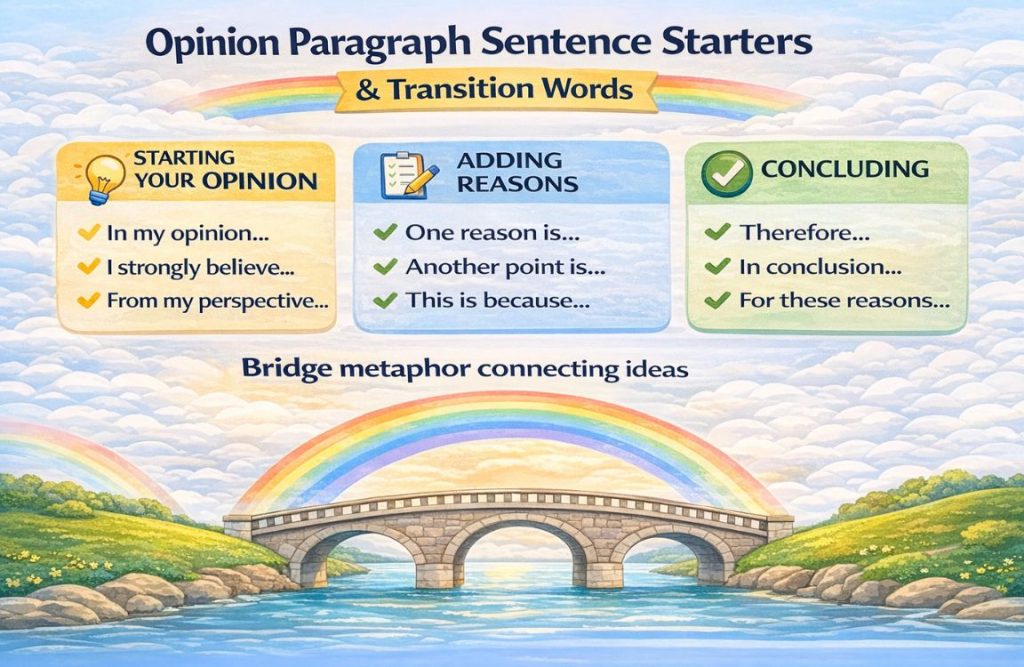
That’s where opinion paragraph sentence starters become your best friends. When expressing your thoughts, you can begin with:
- “In my opinion…”
- “I strongly believe…”
- “From my perspective…”
These phrases act like a confident handshake. They introduce your voice clearly.
For supporting ideas, use:
- “One reason is…”
- “Another important point is…”
- “This is because…”
And when concluding, guide your reader with:
- “Therefore…”
- “In conclusion…”
- “For these reasons…”
I often remind my students: writing is like building a bridge. These words are the connectors that keep everything from falling apart. Use them wisely, and your paragraph won’t just make sense. It will persuade.
Opinion Paragraph Examples
Now, let me show you how theory turns into practice. In this section, I’ll walk you through sample opinion paragraph examples, from simple to advanced, so you can see how ideas grow stronger with clarity, structure, and self-assurance.
Short Opinion Paragraph Example
I often tell my students, “Watch how a paragraph breathes.” Here’s a compact one:
In my opinion, reading books is better than watching movies because it improves imagination and focus. When I read, I create scenes in my mind, which makes the experience more personal. Moreover, books require concentration, helping me develop patience and deeper thinking skills. For example, while reading a novel, I stay engaged for hours without distraction. Movies, however, present everything visually, leaving little room for creativity. Therefore, reading books not only entertains but also strengthens the mind in ways movies cannot.
See how every sentence pulls in the same direction?
Opinion Paragraph for Students
Let me step into a real classroom moment. A student once argued passionately:
I strongly believe that school uniforms should be mandatory because they create equality among students. When everyone wears the same clothes, no one feels judged based on fashion or wealth. This helps reduce bullying and builds a sense of unity. For instance, in schools with uniforms, students often focus more on studies than appearance. Moreover, uniforms save time in the morning, making daily routines easier. Therefore, school uniforms are not just about dress code but about creating a fair and focused learning environment.
That’s what I call a confident, exam-ready response.
Beginner-Level Example
Now imagine I’m teaching a beginner who’s just learning to express ideas:
I think playing games is good for students because it makes them happy and active. When students play, they feel relaxed after studying. Also, games help the body stay healthy. For example, running and outdoor games improve fitness. However, students should not play too much and forget their studies. Balance is important. Therefore, playing games is good, but students should manage their time wisely.
Simple words, clear ideas- that’s the beauty here. I always remind beginners: don’t try to sound smart. Try to sound clear.
Opinion Paragraph Topics, Prompts & Ideas
Let me confess something: students don’t usually struggle with writing. They struggle with what to write about. So, I like to hand them a box of ideas and say, “Pick one, and argue like a lawyer.”
Here are some engaging opinion paragraph topics and prompts to spark your thinking:
i) School Topics:
- Should homework be banned?
- Is online learning better than classroom learning?
- Should exams be replaced with continuous assessment?
ii) Social Issues:
- Is social media harmful to teenagers?
- Should plastic be completely banned?
- Is equality truly achievable in modern society?
iii) Fun & Creative Topics:
- Is chocolate better than ice cream?
- Should students have a 4-day school week?
- Are video games a waste of time?
I often challenge my class: “Can you defend your opinion even if I disagree?” That’s where real learning begins.
A good topic should feel like a spark. It should make you think, react, and even argue a little. Because when you care about the topic, your writing naturally becomes more persuasive, more alive, and far more memorable.
Opinion Paragraph Graphic Organizer & Checklist
Let me simplify this for you. An opinion paragraph works like a clear three-step structure- your idea, your reasons, and your final message. This simple organizer helps turn confusion into confident writing.
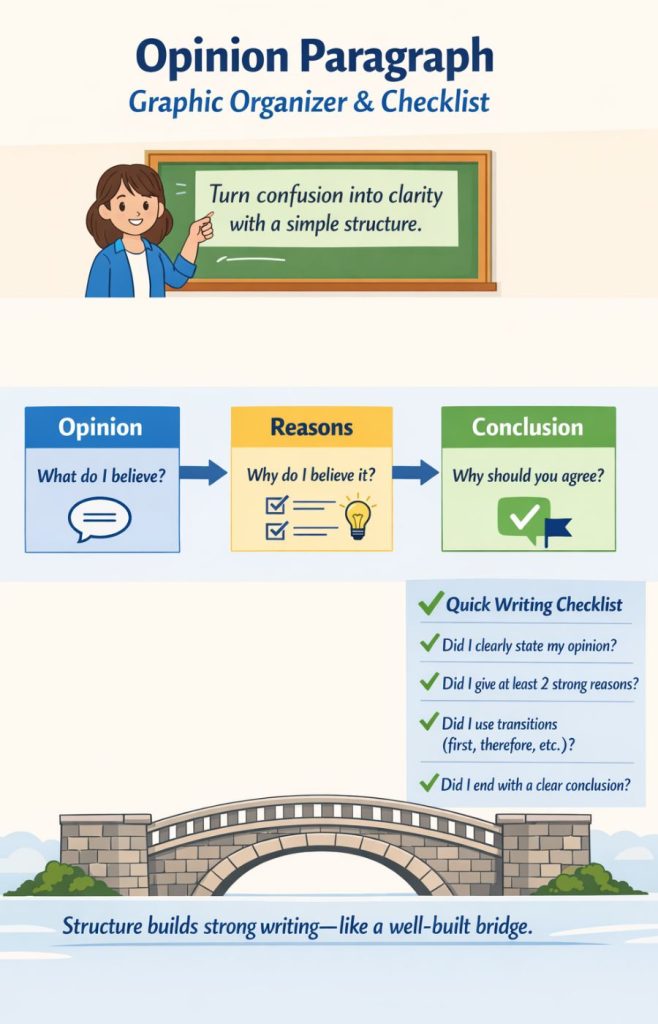
Use this as your quick writing checklist before submitting. A clear structure doesn’t just organize your ideas. It makes your argument stronger and more convincing.
Common Mistakes in Opinion Paragraph Writing
Ah, the classic pitfalls- I’ve seen them all, and perhaps you’ve fallen into one too. Let’s fix them together.
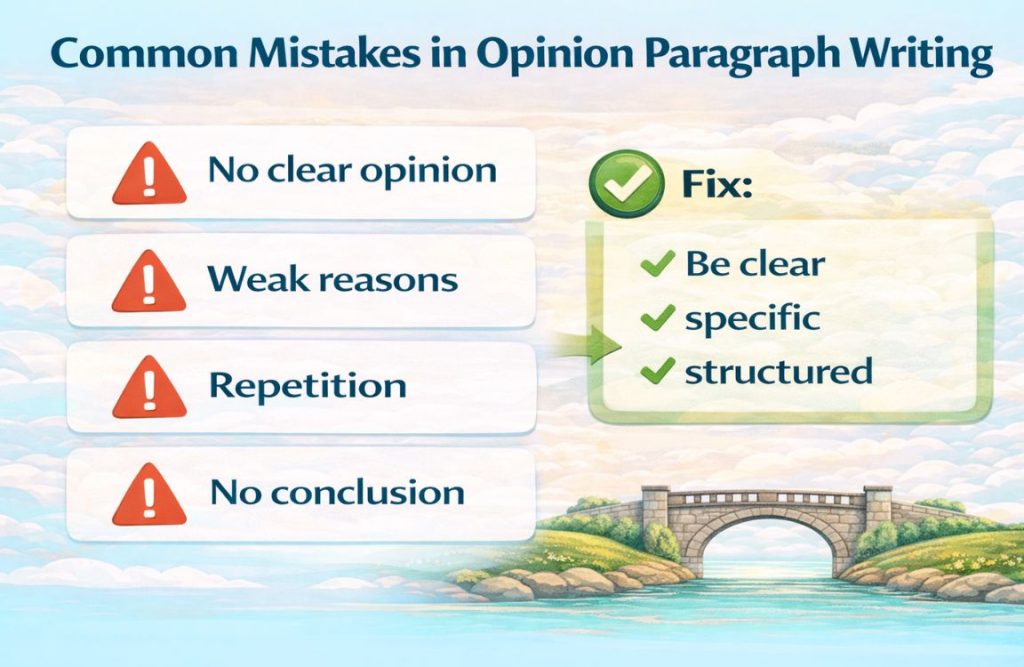
The biggest mistake? No clear opinion. Students dance around the topic but never take a stand. I always say, “If I can’t find your opinion, you haven’t written one.”
Next comes weak support. Saying “because it is good” is not a reason. It’s an escape. Your ideas need strength, not shortcuts.
Then there’s repetition– repeating the same point in different words, hoping it sounds deeper. It doesn’t. It sounds tired.
And finally, the silent ending- no conclusion. Ending abruptly is like walking out of a conversation mid-sentence.
Avoid these, and your writing instantly improves. Sometimes, progress isn’t about adding more. It’s about fixing what’s already there.
Opinion Paragraph for Students (Beginner Tips)
Let me sit beside you as a teacher for a moment. If you’re just starting, don’t overcomplicate this. Writing an opinion paragraph is about clarity, not perfection.
Start with simple language. Use words you’re comfortable with. A clear sentence is always better than a confusing “advanced” one.
Next, practice regularly. I often give my students a 5-minute challenge: pick a topic and write just one paragraph. No pressure, just progress.
Also, read what you write aloud. If it sounds awkward, it probably needs fixing. Writing should feel natural, like explaining your thoughts to a friend.
And here’s my golden rule: Don’t fear mistakes, fear not trying. Every strong writer you admire once struggled with a blank page.
So write, revise, and grow. That’s how strong belief is built, one paragraph at a time.
Opinion Paragraph vs Argumentative Paragraph
Let me take you into a real classroom moment. I once asked my students, “If you say, ‘Online classes are better,’ is that enough to convince me?”
They smiled. One said, “Sir, that’s my opinion.”
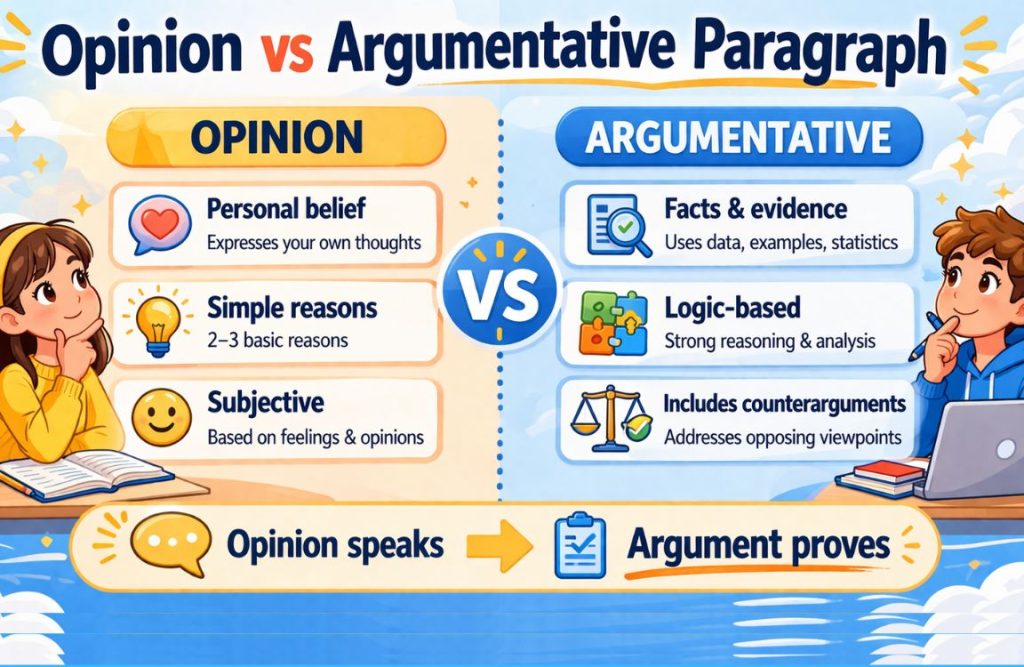
I replied, “Good. Now prove it, and you’ve stepped into an argument.”
An opinion paragraph shares what I think or believe, supported by personal reasons or examples. An argumentative paragraph goes further. It proves a claim using facts, logic, and evidence, often addressing opposing views.
Here’s how I explain it to my students: opinion says, “This is my view.” The argument says, “Here’s why it must be true.”
Think of it this way:
👉 Opinion speaks.
👉 Argument proves.
Master this shift, and your writing becomes powerful, persuasive, and worth trusting.
FAQs:
What is the difference between an opinion paragraph and an opinion essay?
I often explain it like this: an opinion paragraph is a single, focused idea, while an opinion essay is a full argument with multiple paragraphs, including an introduction, body sections, and a conclusion. One is a step. The other is a journey.
How many sentences should an opinion paragraph have?
From my classroom experience, a strong opinion paragraph usually has 5-7 sentences. Enough to express your opinion, support it with reasons, and conclude clearly- without overwhelming the reader or losing focus.
Can an opinion paragraph include personal examples?
Absolutely, and I encourage it. Personal examples make your writing feel real and relatable. When a student connects an idea to their own life, the paragraph becomes more impactful and far more memorable.
What are the best transition words for opinion writing?
Think of transition words as bridges. My favorites include because, therefore, however, moreover, and for example. They guide your reader smoothly from one idea to another, making your argument feel connected and logical.
How can beginners improve opinion paragraph writing skills?
I always tell beginners: start small and stay consistent. Practice daily, read simple examples, and focus on clarity. Improvement comes step by step- not from perfection, but from showing up and writing regularly.
Conclusion:
Let me leave you with this thought: mastering an opinion paragraph is not just about passing exams. It’s about learning how to think, express, and persuade. When you focus on writing an opinion paragraph with clear structure, strong support, and logical flow, your ideas gain power.
I’ve seen students transform from hesitant writers to confident thinkers simply by practicing consistently and learning from opinion paragraph examples. That’s the real magic- progress, not perfection.
So here’s my challenge to you: pick a topic today, write one paragraph, and apply what you’ve learned. Don’t wait for the “perfect moment.” Start now. Because every great writer you admire? They began exactly where you are- one opinion at a time.