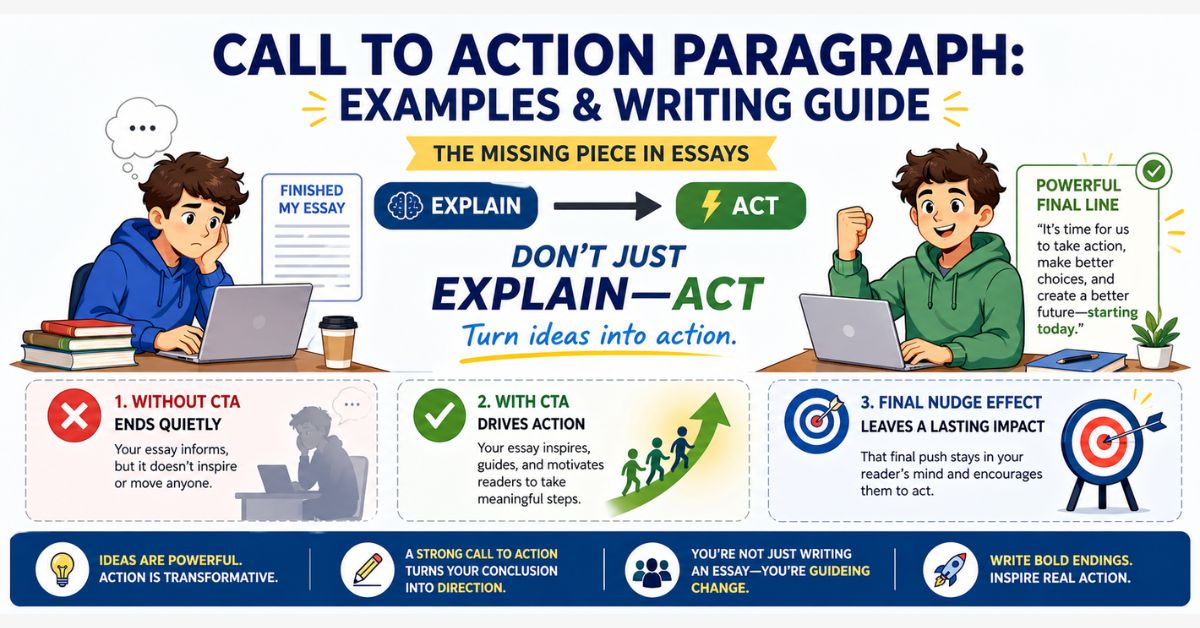
I still remember a moment in class when a student finished reading a brilliant essay, and then just… stopped. No punch. No push. Just silence. I looked at them and asked, “So what should we do now?” They blinked. That’s when I introduced the idea of a call to action paragraph— the missing heartbeat of many essays.
Let me ask you: why do essays often feel incomplete, even when the ideas are strong?
Because they explain, but don’t move us.
A call to action statement changes that. It tells the reader: don’t just understand— act.
In my classroom, I call it the “final nudge.” Without it, your essay informs your readers. With it, your essay transforms. And once you see that difference, you’ll never want to end an essay quietly again.
What Is a Call to Action Paragraph?
A call to action paragraph is the final part of an essay that tells the reader exactly what to do next, using clear, direct, and action-focused language.
It moves the reader from understanding an idea to taking action. Instead of summarizing, it directs the next step.
Let’s break it down simply. This is the moment in your essay where you stop explaining and start guiding. It answers one crucial question: Now that we understand this, what should we do next?
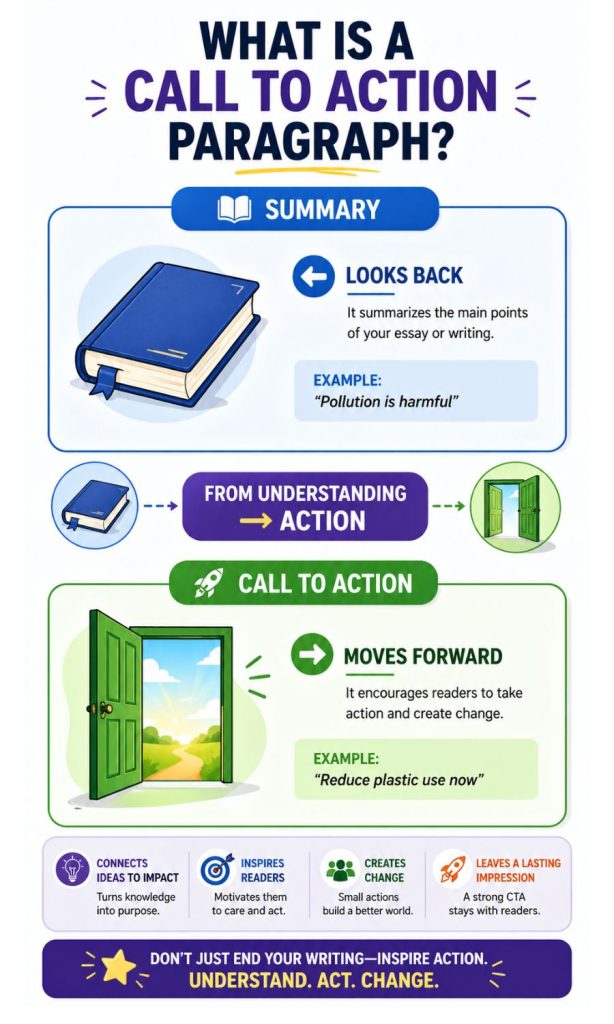
In my live class, I describe it as the point where your voice turns outward. You’re no longer just presenting ideas. You’re directing the reader toward action.
Here’s where many students get confused: a summary looks back, but a call to action looks ahead. Think of it this way— a summary closes the book; a call to action opens a door.
Let me show you a quick example.
Summary: Pollution is harmful and increasing rapidly.
Call to action: It’s time for us to reduce plastic use and demand stricter environmental laws.
Notice the shift— clear, action-oriented language replaces passive explanation. A strong call to action combines purpose with direction, showing the reader not just why something matters, but what to do about it.
In literary terms, it’s the difference between describing the storm and telling the reader to take shelter. And in exam writing, that difference can elevate an average answer into a powerful one.
Table of Contents
Why a Call to Action Paragraph Matters
Here’s something I often tell my students: Ideas alone don’t change the world— people acting on them do. That’s why a call to action matters: it turns understanding into action.
A strong call to action works on three levels. First, it appeals to logic: this problem exists. Then, it touches emotion: this matters to you. Finally, it bridges both, so here’s what you should do.
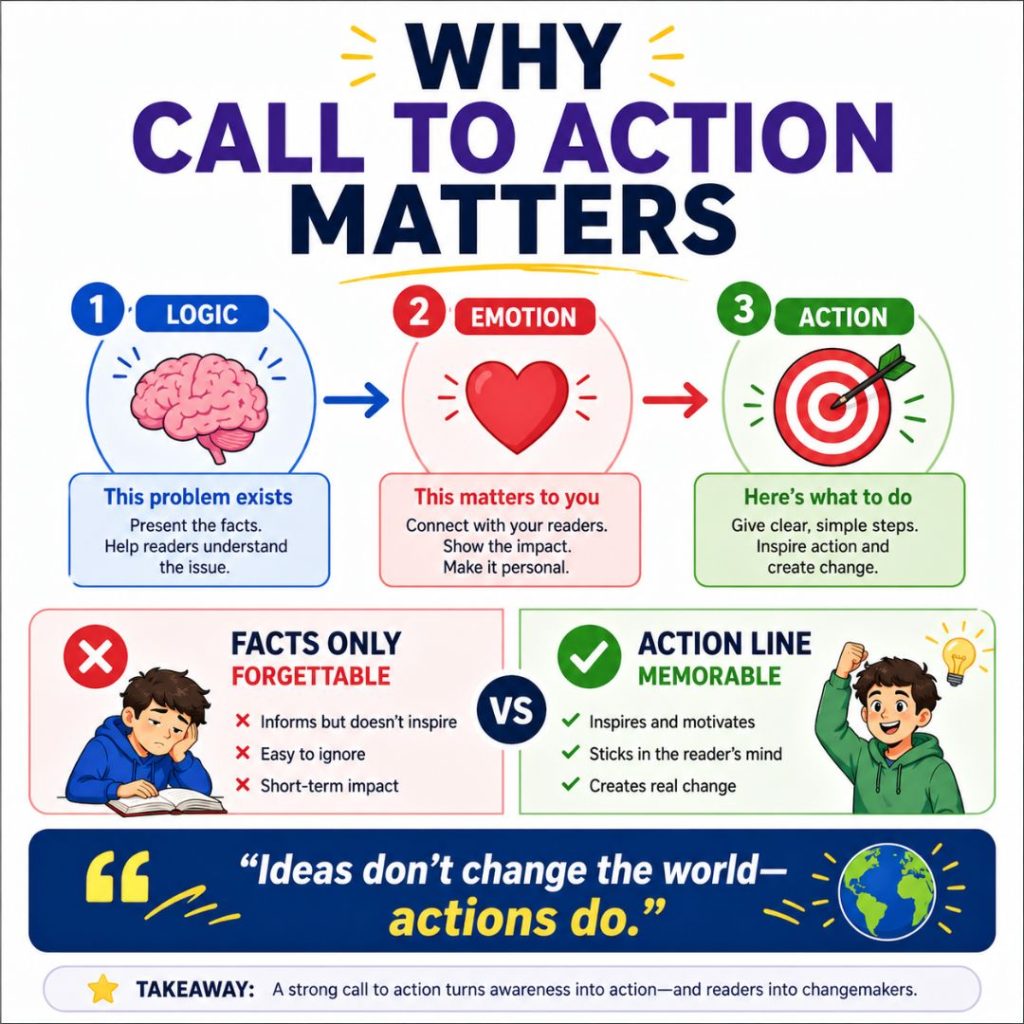
I once read an essay on climate change that ended with facts— informative, yes, but forgettable. Another ended with: “Start today— refuse single-use plastic.” That stayed with me.
That’s the difference. A call to action doesn’t just end your essay. It gives it direction. It tells your reader where to go next.
And that’s your job as a writer— not just to inform, but to move people to act.
Call to Action Paragraph Structure
Now, let’s get practical. A strong call to action paragraph structure isn’t random. It follows a clear, powerful pattern. I teach it as a simple three-step formula.
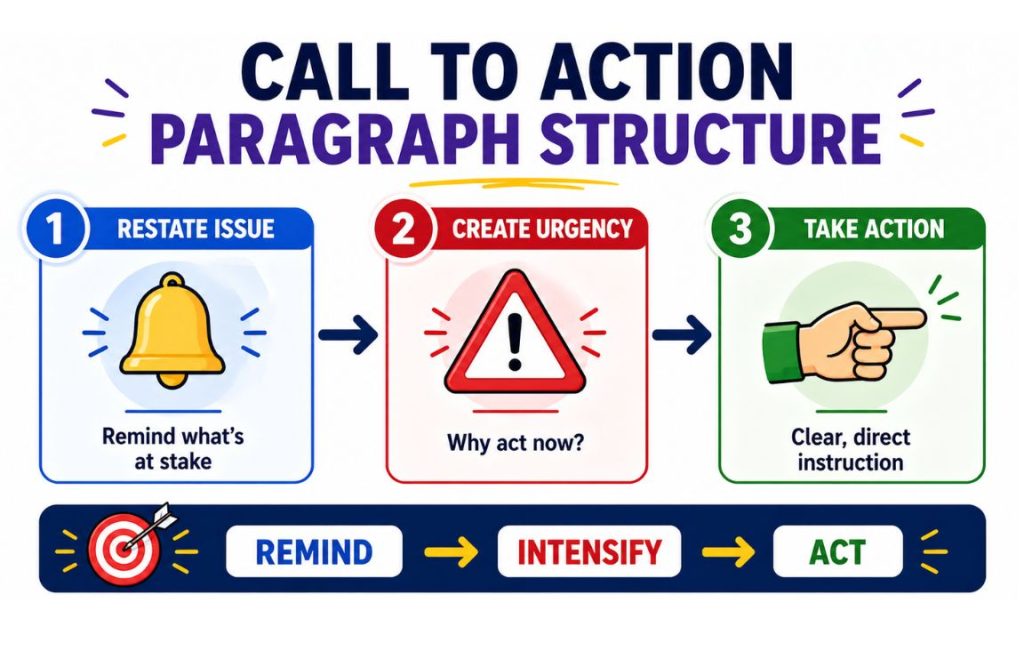
1. Restate the issue:
Begin by reminding the reader what’s at stake, but briefly. Not a full summary, just a sharp reminder.
Example: Plastic pollution is no longer a distant problem. It’s in our oceans, our cities, even our food.
2. Create urgency:
Here’s where you tighten the pressure. Why must action happen now? Use emotional or logical weight.
Example: If we continue at this rate, the damage may become irreversible within decades.
3. Tell the reader what to do:
This is the heart of your call-to-action paragraph format. Be clear, direct, and specific.
Example: Reduce plastic use, support sustainable brands, and demand change from policymakers.
In class, I compare this to a drumbeat: remind, intensify, act.
When these three steps align, your paragraph doesn’t just conclude. It commands attention. And more importantly, it leaves your reader thinking, I should do something about this.
How to Write a Call to Action Paragraph
When students ask me how to write a call to action paragraph, I usually smile and say, “You already know how— you just don’t realize it yet.” Because every time you’ve felt something should change, you’ve already started writing a call to action in your mind.
Here’s the real shift: stop writing like a reporter— start writing like a guide. Use direct, active verbs and focus on one clear action you want your reader to take.
In one class, a student ended an essay on bullying with facts— clear, logical, and… flat. I asked, “If this matters to you, what do you want us to do?” That question changed everything.
To write effectively, begin with a clear goal. Decide on the one action you want your reader to take. Then use strong, direct language that leads the reader forward. But here’s the crucial layer: connect the action to a benefit. Show your reader why it matters to them.
Avoid vague endings like “We should think about this.” That’s hesitation, not direction. Instead, imagine your reader at a crossroads— your words should point firmly ahead.
I often compare it to the final scene of a play— the message doesn’t fade; it stays. And if you’ve done it right, your reader won’t just understand your idea— They’ll feel ready to act on it.
How to Start a Call to Action Paragraph
When students ask me how to start a call to action paragraph, I tell them: don’t begin with pressure. Begin with purpose. A strong opening should feel like a natural shift, not a sudden command. Your essay has built momentum; now, redirect it toward action.
This is where call-to-action sentence starters matter. Use phrases that signal movement— “It is time to act,” “We must respond,” or “The next step is clear.” Then strengthen them with clear, active verbs and a sense of benefit.
Avoid vague or abrupt lines. Instead, lead your reader forward with intention. A powerful opening doesn’t just continue your argument. It transforms it, moving the reader from understanding to action.
Call to Action Sentence Starters
Call to Action Sentence Starters are powerful phrases that move readers toward action using clear, direct language and strong verbs.
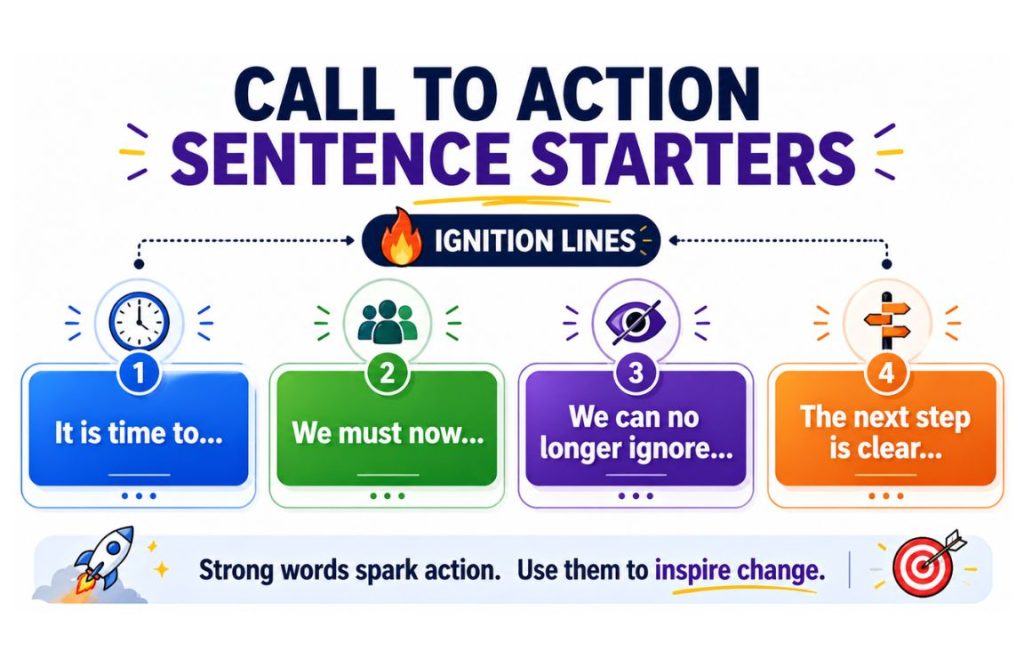
Let me give you some reliable tools— phrases I’ve seen transform average endings into powerful ones:
- It is time to…
- We must now…
- The next step is clear…
- We can no longer ignore…
- The responsibility lies with us to….
In class, I call these “ignition lines” because they spark movement.
Pair them with high-converting CTAs like Join today, Download your free guide, or Act now. But here’s the twist: don’t just use them— mean them. When used with purpose, they don’t just start sentences. They inspire action and drive real change.
Call to Action Paragraph Examples
Let’s move from theory to practice. When students see call-to-action paragraph examples, something clicks. They realize this isn’t abstract. It’s doable.
Persuasive Paragraph Example in an Essay
Imagine an essay on environmental responsibility:
Plastic pollution is destroying ecosystems and threatening future generations. If we continue ignoring this crisis, the damage will only deepen. It is time to reduce single-use plastics, support sustainable alternatives, and demand accountability from industries. Change begins with everyday choices, and those choices begin with us.
Notice what happens here. The writer doesn’t panic or preach. They direct. The action is clear, realistic, and connected to the argument.
Argumentative Paragraph Example in an Essay
Now consider a more academic call to action in an essay:
Schools have a responsibility to address student mental health proactively. Ignoring this issue risks long-term harm to both individuals and communities. Therefore, institutions must implement counseling programs, train teachers to recognize warning signs, and create safe spaces for students to speak openly. The cost of inaction is far greater than the effort required to act.
Here, the tone shifts slightly— more formal, but still direct.
In both cases, the pattern remains: issue → urgency → action.
And once you see that pattern, you begin to realize— writing a strong ending isn’t about sounding dramatic.
It’s about being purposeful.
Strong Call to Action Phrases (Academic Writing)
Strong call-to-action phrases are clear, purposeful lines that push readers toward meaningful action in response to your ideas. In academic writing, the goal isn’t to sell. It’s to direct thinking and encourage responsible action.
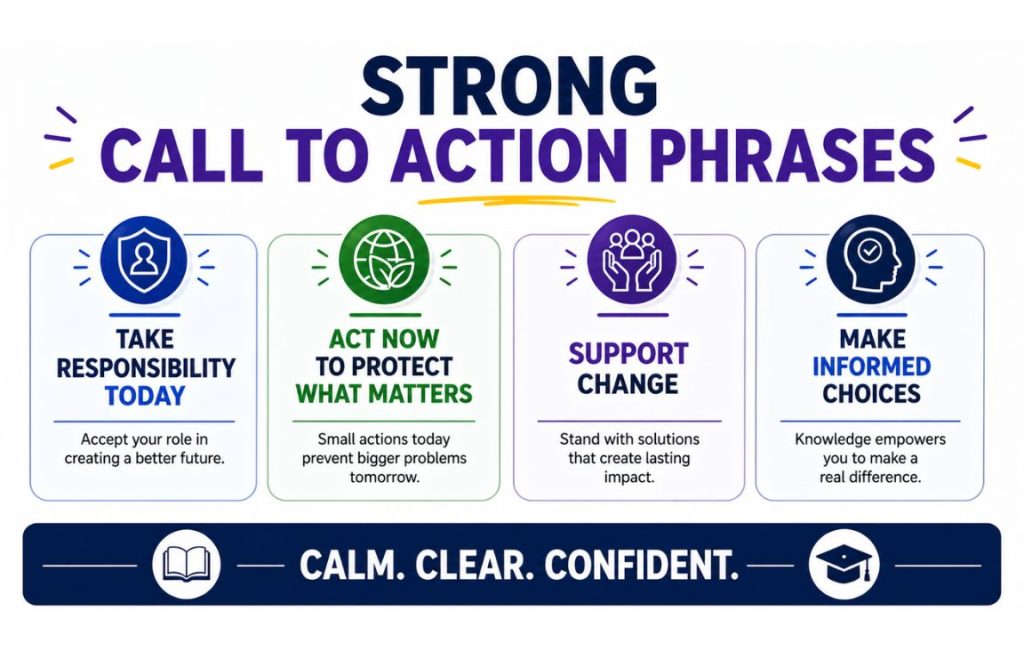
Over the years, I’ve collected what I call “power phrases”— the kind that make readers pause and think, Yes, something should be done.
A strong call to action depends on clarity and intent. Consider:
- Take responsibility for your actions
- Start making informed choices today
- Support change where it matters most
- Act now to protect what we value
Notice the difference. These don’t pressure the reader. They guide them.
But here’s the key: always connect your phrase to your topic. A good call to action isn’t generic. It grows naturally from your argument.
Also, remember this: strength doesn’t come from shouting. It comes from confidence. A calm, clear line often has more impact than an aggressive one.
In class, I tell my students— your final sentence should feel like direction, not noise. And when it does, your writing doesn’t just end… it leads.
Common Mistakes to Avoid
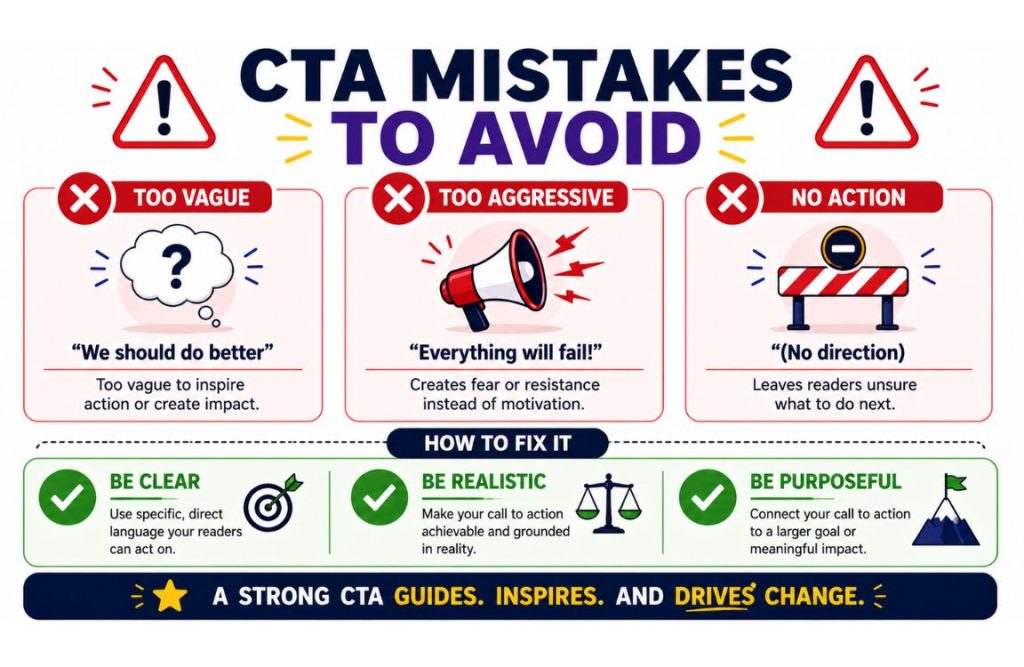
Let me save you from the mistakes I see every exam season.
First: being too vague. Saying “We should do better” tells the reader nothing. Action must be specific.
Second: being too aggressive. A call to action is not a threat. Lines like “If you don’t act, everything will fail” weaken credibility.
Third: having no clear action at all. This is the most common issue— students build strong arguments, then hesitate at the end.
My key tips for writing a call to action:
- Be clear
- Be realistic
- Be purposeful
In class, I say this bluntly: if your reader doesn’t know what to do after reading your essay, your ending has failed.
Call to Action in Conclusion Paragraph
Now let’s bring it home, literally. A call to action conclusion paragraph is where everything you’ve argued finds its purpose.
When students ask me how to end an essay with a call to action, I tell them: don’t think of it as an ending. Think of it as a beginning— for the reader.
Your conclusion should not just close your argument. It should extend its impact beyond the page.
In one memorable class, a student wrote an essay on education inequality. Their final line was simple: “Support equal access to education, because talent should never depend on privilege.” The room went quiet. That’s when I knew— they understood.
A good conclusion leaves the reader thinking. A great one leaves them ready.
So when you write your final paragraph, ask yourself: have I just finished my essay, or have I started something in my reader?
Call to Action vs Conclusion
Students often confuse this, so let’s be clear: call to action vs conclusion is not a choice. It’s a relationship.
A conclusion summarizes. A call to action activates.
Think of the conclusion as the full stop, and the call to action as the push beyond it.
Not every conclusion must include a call to action, but when it does, it transforms the ending from reflective to persuasive.
In simple terms:
- Conclusion = What we learned
- Call to action = What we do next
FAQs:
Can every essay include a call to action paragraph?
Not always. It works best in persuasive or argumentative writing, where action is relevant.
How long should a call to action paragraph be?
Usually 3-5 sentences— clear, focused, and direct.
Can a call to action be a question?
Yes, but it should still imply action, not just reflection.
Is a call to action necessary in academic essays?
Not required, but it strengthens persuasive impact.
What tone should a call to action use?
Confident, respectful, and purposeful, not emotional exaggeration.
Conclusion:
Let me leave you with something I tell every student before exams: writing is not just about ideas. It’s about impact. So when you finish your essay, ask yourself: Have I moved my reader to act?
That’s the real power of a call to action paragraph. It doesn’t just end your writing. It gives it purpose. It turns your conclusion into a direction.
You are no longer just explaining a topic. You are guiding your reader, shaping their thinking, and pushing them toward a response. And that is what separates a good writer from a memorable one.
So the next time you finish an essay, don’t simply stop at the last line. Pause. Reflect. Make sure your ending does something— leads somewhere.
Because strong writing doesn’t fade when it ends. It stays, it nudges, it moves.
👉 Start rewriting your conclusions today— turn your essays into action.