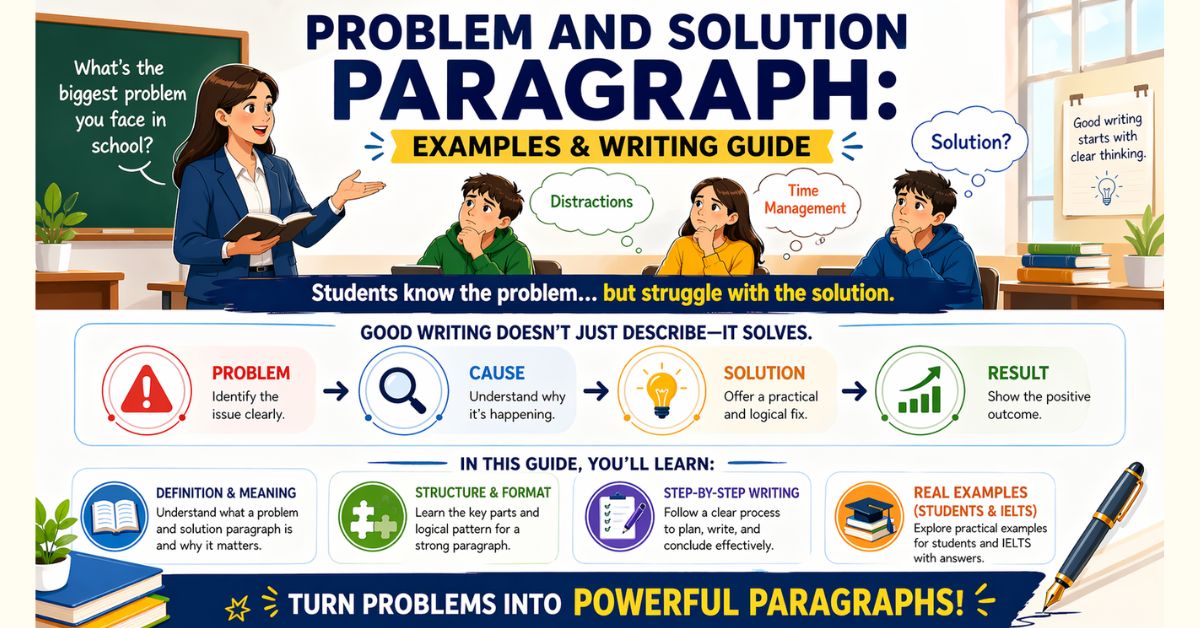
Yesterday in class, I asked my students a simple question: “What’s the biggest problem you face in school?”
One said distractions. Another said time management. But when I asked, “What’s your solution?”— silence.
That silence explains why learning how to write a problem and solution paragraph is so important.
Writing isn’t just about describing problems. It’s about solving them. Whether you’re preparing for exams, improving your essays, or developing real-life thinking skills, mastering this paragraph type sharpens both your writing and your mind.
In this guide, I’ll show you:
- What a problem and solution paragraph is
- Its structure and format
- Step-by-step writing methods
- And real examples for students and IELTS
Ready? Let’s turn problems into powerful paragraphs.
What Is a Problem and Solution Paragraph? (Definition & Meaning)
Let me explain this the way I explain it in class. A problem and solution paragraph is a piece of persuasive writing where you clearly describe an issue and then offer a logical way to solve it. Simple? Yes. Easy? Not always.
If you’re wondering what a problem and solution paragraph is, think of it as a mini life-skill exercise in writing. You’re not just stating facts. You’re analyzing and fixing.
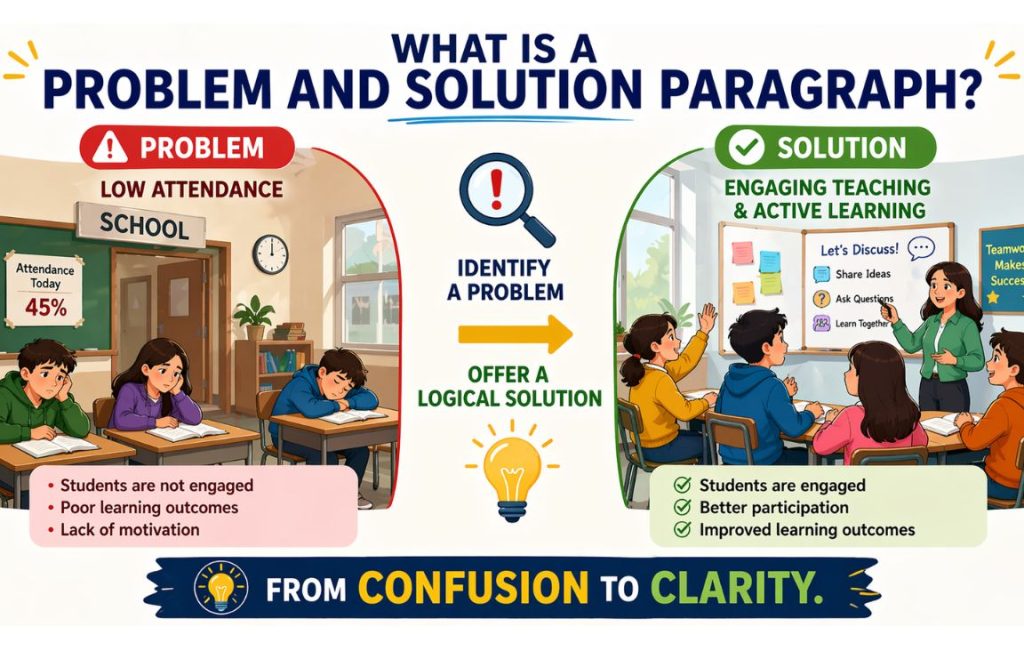
The meaning of problem and solution becomes clearer when we connect it to real life. Imagine a school with poor attendance. That’s the problem. Now, suggesting engaging teaching methods or student incentives. That’s the solution.
The purpose of this paragraph is powerful: it trains your brain to move from confusion to clarity. And honestly, that’s what good writing and good thinking are all about.
Table of Contents
Problem and Solution Paragraph Structure Explained
In this section, I’ll break down the structure step by step, like building a strong bridge. We’ll look at the key parts and the logical flow that turns a simple idea into a clear, effective paragraph.
Key Parts of a Problem Solution Paragraph
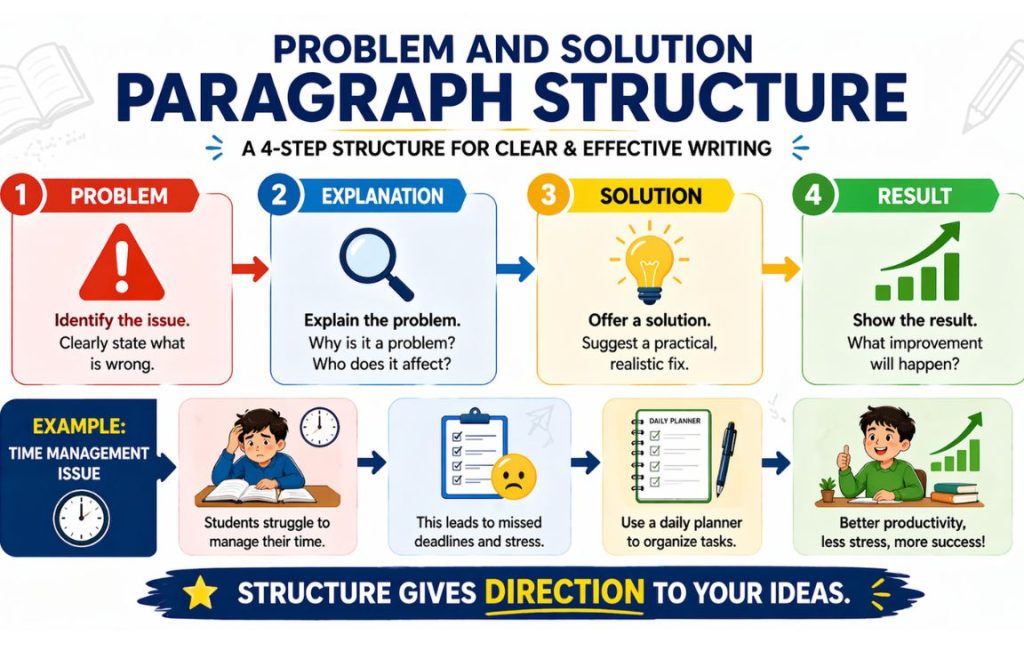
When I teach this, I tell my students: “Think of your paragraph as a story with a mission.” The problem solution structure has four key parts.
- First, the problem— clearly state what’s wrong. No confusion, no drama.
- Second, the explanation— why is this a problem? Who does it affect?
- Third, the solution— this is your moment to shine. Offer a practical, realistic fix.
- Finally, the result— what happens if your solution works?
For example, if students struggle with time management, the solution could be using a daily planner. The result? Better productivity and less stress.
Structure gives your ideas direction. Without it, even great ideas get lost.
Problem Solution Text Structure & Pattern
Now here’s where writing becomes strategy. The problem solution pattern follows a logical path: cause → effect → solution. It’s not random. It’s intentional.
I often compare this to a doctor diagnosing a patient. First, identify symptoms (problem), then understand the cause (analysis), and finally prescribe treatment (solution). That’s your organizational pattern.
For instance, if pollution increases due to excessive plastic use (cause), it harms the environment (effect). The solution? Reduce plastic consumption and promote recycling.
This flow keeps your reader engaged and convinced. Because when your ideas follow logic, your writing earns trust, and trust is everything in effective communication.
How to Write a Problem and Solution Paragraph (Step-by-Step Guide)
Now that you understand the structure, let me guide you through the actual writing process. I’ll show you how to think, build, and polish your paragraph step by step, just like I do in class.
i) Step-by-Step Writing Guide
Let’s write this together— like a live classroom moment.
Step one: Identify the problem. Be specific. Don’t say “students struggle”— say what they struggle with.
Step two: Explain the impact. Why does it matter? Who is affected? This adds depth.
Step three: Suggest a solution. This is where many students hesitate. Don’t. Your solution doesn’t have to be perfect. It just has to be logical.
Step four: Conclude clearly. Show how your solution improves the situation.
When students ask me how to write a problem and solution paragraph, I tell them: clarity beats complexity.
For example:
- Problem— students procrastinate.
- Impact— missed deadlines.
- Solution— create a study schedule.
- Result— better time management.
Writing isn’t magic. It’s a method.
ii) Transition & Signal Words
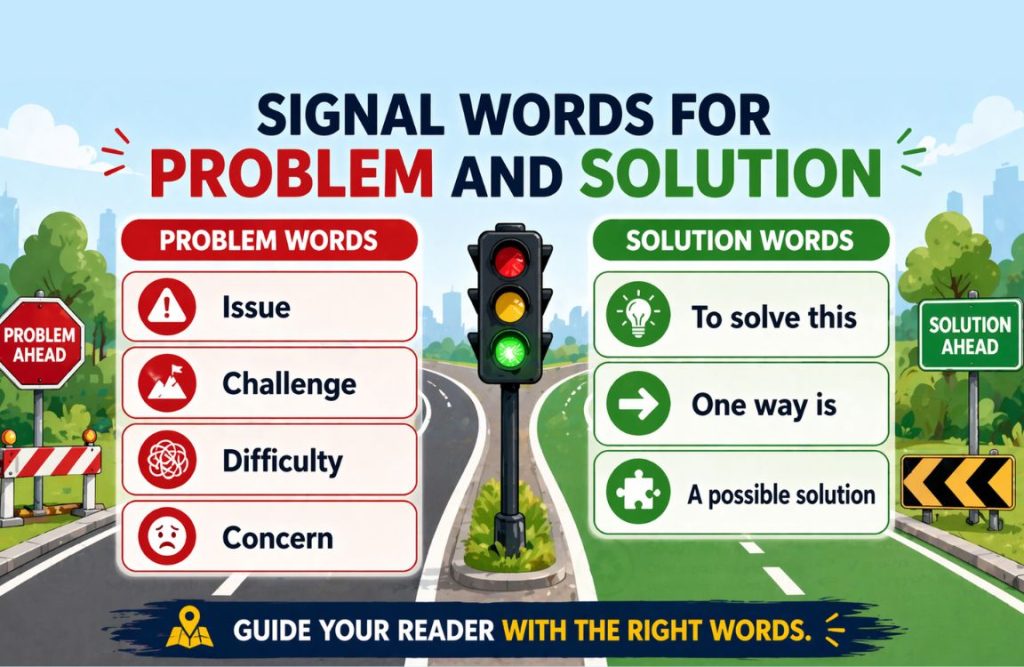
Here’s a secret I always share: good writing flows because of the right words. These are your signal words for problem and solution.
To introduce a problem, use words like: issue, challenge, difficulty, concern.
To shift toward a solution, try: to solve this, one way is, a possible solution is.
Think of these as traffic signals guiding your reader. Without them, your paragraph feels like a road with no signs, confusing and frustrating.
For example:
“There is a serious issue of air pollution. To solve this, one effective step is reducing vehicle emissions.”
Simple words. Powerful direction.
Problem and Solution Sentences Examples
Let’s look at some problem and solution sentences, because sometimes one clear sentence teaches more than a long explanation.
- Many students face the problem of poor time management, which leads to missed deadlines. To solve this, they should create a daily study schedule.
- Air pollution is a serious issue in urban areas. One effective solution is promoting public transportation to reduce vehicle emissions.
- Bullying in schools affects students’ mental health; schools can address this by implementing strict anti-bullying policies.
- Excessive screen time harms concentration; limiting device usage can improve focus and productivity.
Notice the pattern? Problem → impact → solution— all in one smooth flow.
When you master this, your paragraphs become sharper, clearer, and far more convincing. And that’s when your writing truly starts to stand out.
Problem and Solution Paragraph Examples
Now, let me show you how all this works in real writing. I’ll walk you through examples of problem and solution paragraphs, from simple to practical, just like I demonstrate live in class.
Short Paragraph (General): Poor Time Management
Many people struggle with poor time management, especially when balancing study and personal life. This problem often leads to stress and unfinished tasks. One effective solution is to create a daily schedule that prioritizes important activities. By allocating specific time slots for study, rest, and leisure, individuals can manage their time better. As a result, they become more productive and less overwhelmed. I always tell my students— time isn’t the problem; how we use it is.
Student-Level Example: The Problem of Low Participation in the Classroom
In many classrooms, students face the problem of low participation. Some feel shy, while others fear making mistakes. This reduces learning opportunities and confidence. A simple solution is for teachers to create a supportive environment where mistakes are seen as part of learning. Group discussions and interactive activities can also encourage involvement. I’ve seen quiet students transform when given the right space. The result is clear: more engagement, better understanding, and a classroom that feels alive, not silent.
Real-Life Topic: Air Pollution
Air pollution is becoming a serious problem in many cities due to excessive vehicle use and industrial emissions. This leads to health issues such as respiratory diseases and environmental damage. One practical solution is to promote public transportation and encourage the use of eco-friendly vehicles. Governments can also enforce stricter emission laws. When I discuss this in class, students often realize that change starts small. Cleaner choices today can lead to a healthier environment tomorrow.
Problem and Solution Paragraph Topics
Every time I assign writing, the first question I hear is: “Sir, what topic should I choose?” And honestly, choosing the right problem and solution paragraph topics is half the battle won.
For academic topics, you can explore issues like:
- Exam stress
- Online learning challenges
- Or a lack of concentration
These connect directly to student life.
Social topics open a wider world:
- Bullying
- Social media addiction
- Or unemployment
These aren’t just writing prompts. They’re real conversations.
Environmental topics are powerful and relevant:
- Pollution
- Climate change
- Plastic waste
These topics show awareness and responsibility.
For exam-focused learners, especially IELTS candidates, think globally:
- Urban overcrowding
- Traffic congestion
- Or education inequality
I always advise my students: choose a topic you care about. Because when you care, your writing stops being mechanical and starts becoming meaningful.
Problem and Solution Paragraph Examples (With Answers for Students & IELTS)
Here, I’ll show you how writing changes depending on your level. A problem and solution paragraph for students is simple and clear, while for IELTS, it becomes more formal and analytical.
For Students: Difficulty in Completing Homework
Many students face the problem of difficulty in completing homework on time. This happens because they get distracted by mobile phones and social media. A simple solution is to set a fixed study time and keep distractions away during that period. Parents and teachers can also guide students in managing their time effectively. I often remind my students that discipline is a habit, not a talent. With better focus, students can complete their work on time and improve their performance.
For IELTS: Digital Distractions in Education
One major issue in modern education is students’ inability to maintain focus due to digital distractions. This problem negatively affects academic performance and overall productivity. A viable solution is to implement structured study schedules and promote digital discipline among learners. Educational institutions can also provide awareness programs on effective time management. From my teaching experience, I’ve noticed that structured habits significantly improve outcomes. Therefore, addressing this issue systematically can lead to better academic success and more focused learning environments.
Template & Graphic Organizer
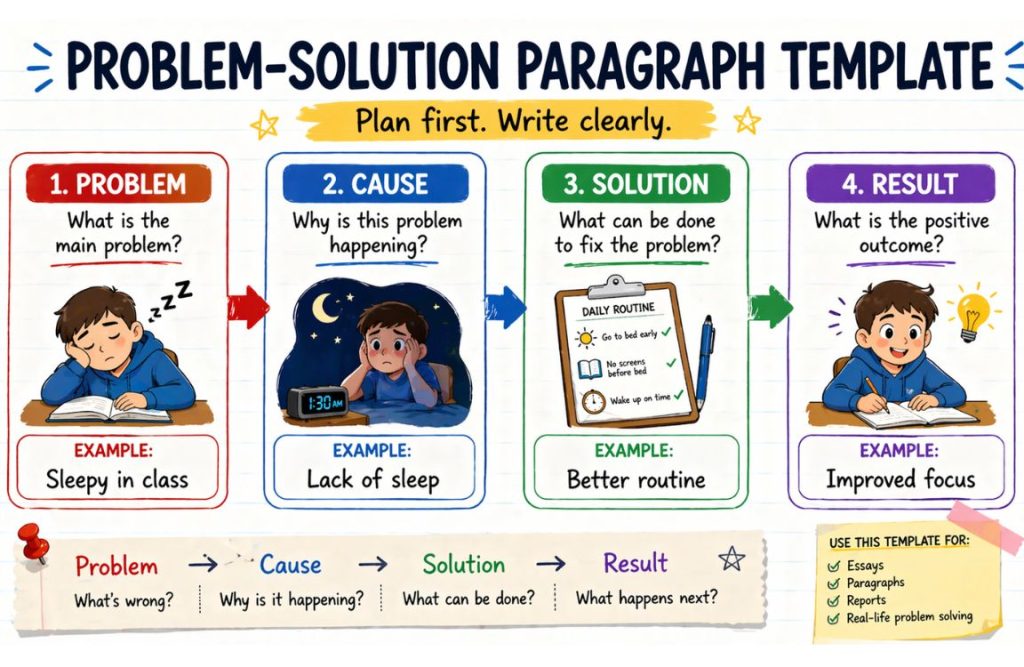
Now, let me give you something I personally use in class— a problem solution paragraph template that works like a blueprint. Think of it as your writing skeleton. Once the skeleton is strong, the body builds itself.
Here’s a simple graphic organizer you can follow:
- Problem: What is the issue? Be clear and specific.
- Cause: Why does this problem exist?
- Solution: What can be done to fix it?
- Result: What will improve if the solution is applied?
Let me give you a quick classroom trick. I ask my students to fill this out before writing the paragraph. It prevents confusion and saves time.
Example:
Problem: Students feel sleepy in class
Cause: Lack of sleep
Solution: Maintain a proper sleep routine
Result: Better focus in class
Structure first. Writing next. That’s how clarity is built.
FAQs:
What makes a strong problem and solution paragraph effective?
A strong paragraph clearly defines a specific problem, explains its impact, and offers a realistic solution. What truly makes it effective is clarity, logical flow, and relevance to real-life situations or reader concerns.
How long should a problem and solution paragraph be?
A typical problem and solution paragraph should be around 80-120 words. It needs to be long enough to explain the issue and solution clearly, but concise enough to maintain focus and readability.
Can a paragraph include multiple solutions?
Yes, a paragraph can include multiple solutions, but it’s best to focus on one strong, well-explained solution. Too many ideas can confuse the reader and weaken the clarity of your writing.
What are common mistakes in problem-solution writing?
Common mistakes include being too vague, not explaining the problem clearly, offering unrealistic solutions, and lacking logical flow. Another issue is skipping the result, which leaves the paragraph incomplete and less impactful.
How is a problem and solution paragraph different from an essay?
A paragraph is shorter and focuses on one problem and one solution, while an essay is longer, more detailed, and may include multiple problems, solutions, arguments, and supporting paragraphs.
Conclusion:
So here’s the truth: a problem and solution paragraph is more than just an academic exercise. It’s a thinking tool.
It trains you to:
- Identify real problems
- Analyze causes
- And offer logical solutions
And in a world full of problems, that’s a powerful skill.
I’ve seen students struggle at first, then suddenly, something clicks. Their writing becomes sharper, clearer, and more confident. That’s the moment I teach for.
Now it’s your turn.
Choose a topic, follow the structure, and write your own problem-solution paragraph today. Practice is the fastest way to master it.
Because the more you practice, the clearer you think, and the stronger your writing becomes.