
Your teacher says, “Write about a memorable experience,” and suddenly you have ten ideas, but no idea how to turn them into one paragraph. This is where a narration paragraph can help.
A narrative paragraph tells the story of an event or experience step by step, so the reader can follow it easily. You do not need complicated vocabulary or a dramatic plot.
A focused event, a sensible sequence, useful details, and a natural ending can turn an ordinary experience into effective narrative writing.
What Is a Narrative Paragraph?
A narration paragraph is a paragraph that tells an event, experience, or short story in a logical sequence, usually in chronological order. In simple words, it tells the reader what happened, who was involved, when and where it happened, how the event developed, and how it ended.

For example, if you write about missing your school bus, you might begin by explaining when you left home. Then you can describe running toward the bus stop, realizing that the bus had already gone, finding another way to school, and finally reaching the classroom.
In many school and ESL contexts, ‘narration paragraph’ and ‘narrative paragraph’ are used interchangeably. In broader contemporary English-writing resources, ‘narrative paragraph’ is generally the more common term. Both refer to writing that presents an event or experience as a sequence.
Narrative Paragraph Structure: Beginning, Middle & End
A narrative paragraph usually follows a simple pattern:
Beginning → Middle → End
Each part has a different purpose.

Beginning: Introduce the Event
Start by introducing the event or experience. Give the reader enough background to understand what is happening. You may mention who, when, where, and what if they are relevant to the story.
Middle: Develop the Events
Describe the important events in the order in which they happened. Use time expressions and specific details to help the reader follow the story.
End: Show the Result
Bring the story to a natural close. You can mention what happened afterward, how you felt, or what you learned. However, a moral or lesson is not always necessary.
How to Write a Narration Paragraph
Writing a narrative paragraph becomes much easier when you follow a few simple steps.

1. Choose One Clear Event
Choose one specific event instead of trying to describe an entire day, holiday, or childhood. A focused story is easier to develop because you have enough space to describe the important moments.
When students are unsure where to begin, I recommend choosing one small event and developing it well rather than trying to tell too much at once.
2. Put the Events in Time Order
Arrange your ideas according to when they happened:
First → Next → Then → Finally
Useful time expressions include:
- one morning
- a few minutes later
- after that
- suddenly
- soon
- meanwhile
- finally
- at last
These expressions act like signposts and help the reader follow the story.
3. Add Specific Details
Do not simply write:
“I had a frightening experience.”
Show the experience through specific details. Mention what you saw, heard, felt, smelled, or noticed when those details are useful.
For example:
“My hands began to shake when I heard a strange noise behind the door.”
A few well-chosen details can make simple narrative writing much more vivid.
4. Keep the Point of View Consistent
Use first person when telling your own experience:
“I opened the door and looked outside.”
Use third person when telling someone else’s story:
“Rafi opened the door and looked outside.”
Whichever point of view you choose, keep it consistent unless there is a clear reason to change it.
5. Use an Appropriate Tense
When you are recounting a past experience, past tense is usually the best choice.
For example:
“I reached the station early and waited for the train.”
Other tenses can appear when the context requires them, but avoid changing tense randomly.
6. End the Event Clearly
Do not stop immediately after the final action. Show what happened afterward or how the experience affected you. A good ending gives the reader a sense of closure.
Narrative Paragraph Examples for Students
Examples help students see how ideas become a complete narrative paragraph. When I teach narrative writing, I ask students to look at the sequence first and vocabulary second. The following examples show different approaches you can use in school assignments and exams.
Short Narrative Paragraph Example: A Late Arrival at School
Last Monday, I woke up late because my alarm clock had stopped during the night. I quickly got dressed, skipped breakfast, and ran toward the bus stop. Unfortunately, the school bus had already left. I decided to walk, but heavy rain began to fall on the way. I reached school about twenty minutes late and quietly entered my classroom. My teacher looked at me but did not scold me after hearing what had happened. I felt embarrassed but also relieved. From that day, I started checking my alarm before going to bed.
Why it works: It moves naturally from the problem to the result and ends with a useful personal reflection.
Personal Narrative Paragraph Example: The Day I Learned to Ride a Bicycle
I still remember the afternoon when I learned to ride a bicycle. My older brother took me to a quiet road near our house and told me not to be afraid. At first, I held the handlebars tightly and moved very slowly. When he let go, I suddenly lost my balance and fell onto the grass. My knees hurt, but I did not want to give up. I tried again and again. Finally, I felt the bicycle moving smoothly beneath me. The wind touched my face, and I shouted with joy. That small success made me feel much more confident.
Why it works: First-person narration, sensory detail, and emotional change make the experience easy to imagine.
Personal Narrative Paragraph Example: My First Day on a Stage
My first experience on a stage was both exciting and frightening. I had to recite a poem at our school cultural programme. Before my turn, my hands were cold, and I kept repeating the first few lines in my head. When my name was called, I walked onto the stage and looked at the large audience. For a moment, I forgot the opening line. Then I took a deep breath and remembered it. Slowly, the words came back to me, and I finished the poem without any more trouble. When the audience applauded, I smiled with relief. I learned that nervousness becomes easier to handle when we face it instead of avoiding it.
Why it works: The physical details and changing emotions make the narrator’s nervousness and relief believable.
Exam-Style Narrative Paragraph Example: A Day I Will Never Forget
Last year, I had an experience that I will never forget. I was returning home from school when I noticed a little boy crying beside the road. He had lost his mother in the crowded market. I asked him where he had last seen her and stayed with him while we looked around the market. After a few minutes, we found a woman searching anxiously through the crowd. She hugged her son and thanked me with tears in her eyes. I felt happy that I had been able to help someone. That day taught me that even a small act of kindness can make a big difference.
Why it works: The story presents a problem, the narrator’s actions, and a meaningful result in simple exam-ready language.
Narrative Paragraph Format: A Simple Template
Use this narrative paragraph format as a planning guide:
Topic sentence → Event 1 → Event 2 → Event 3 → Ending
Opening: When and where did it happen? Who was involved?
Development: What happened first, next, and after that? Include only details that support the event.
Ending: How did it end? How did you feel afterward? Add a lesson only when it suits the topic.
Ready-to-Use Template:
[When/where], I/we [introduce the event]. First, [event 1]. Then, [event 2]. After that, [event 3]. Finally, [result]. I/we felt [reaction] because [brief reflection, if suitable].
I often tell students to treat this template as a map, not a script. Once your ideas are organized, change the wording to make the paragraph sound natural.
Before you write, quickly note:
- What: What happened?
- Who: Who was involved?
- When: When did it happen?
- Where: Where did it happen?
- How: How did the event develop?
- Result: How did it end?
Common Mistakes in Narrative Paragraph Writing
Students often make these mistakes:
- Too many events: Focus on one main event.
- Wrong sequence: Keep the events in chronological order.
- Random tense changes: Use an appropriate tense consistently.
- Irrelevant details: Include details that support the story.
- Weak ending: Give the event a clear sense of closure.
- Overcomplicated vocabulary: Choose clear words that help you tell the story naturally.
Before You Submit
Ask yourself:
✓ Did I focus on one main event?
✓ Are the events in the correct order?
✓ Did I include useful details?
✓ Did I use an appropriate and consistent tense?
✓ Is my point of view consistent?
✓ Does my final sentence give the story closure?
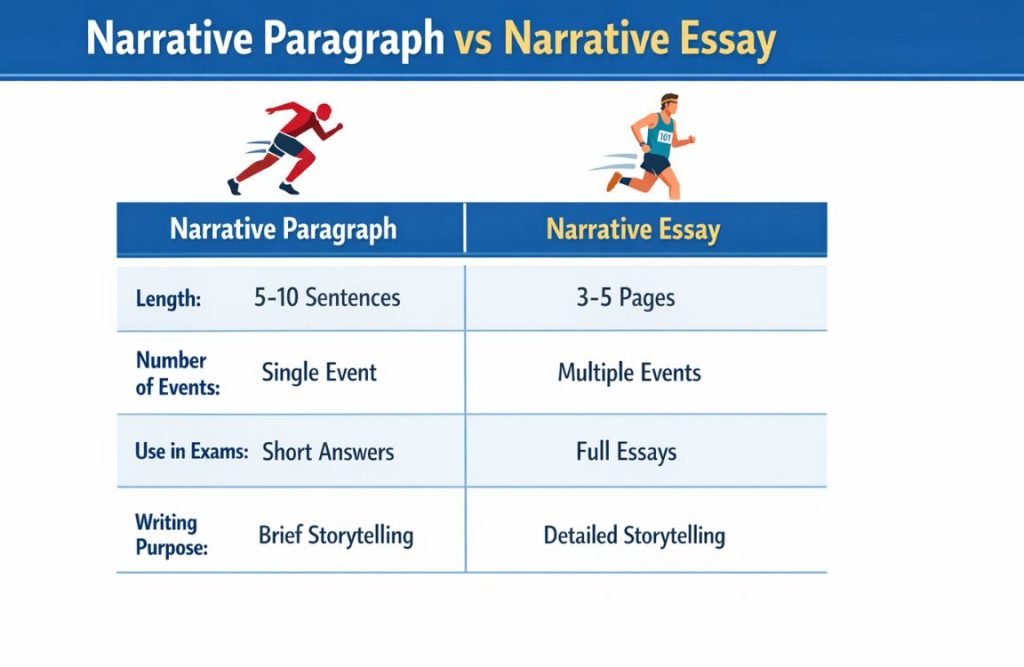
Narrative Paragraph vs Narrative Essay
| Narrative Paragraph | Narrative Essay |
| One paragraph | Multiple paragraphs |
| Usually focuses on one event or experience | Can develop a broader story or experience |
| Short and compact | Longer and more developed |
| Has a beginning, development, and ending within one paragraph | Usually has an introduction, body paragraphs, and conclusion |
A narrative paragraph is one paragraph that tells or develops a focused event or experience. A narrative essay normally contains several paragraphs and has more space for development. There is no universal fixed length for a narrative essay. Its length depends on the assignment.
Narrative Paragraph Topics for Students
Here are ten useful narrative paragraph topics:
- A Day I Will Never Forget
- My First Day at School
- A Time I Faced My Fear
- The Best Mistake I Ever Made
- A Surprising Experience
- A Rainy Day
- A Memorable Journey
- When I Helped Someone
- The Day I Met an Old Friend
- An Unexpected Incident at School
FAQs:
Is a narration paragraph the same as a narrative paragraph?
In many school and ESL contexts, the two terms are used interchangeably. Narrative paragraph is generally the more common expression in contemporary English-writing resources.
Can a narration paragraph be written in the present tense?
Yes. Present tense can be effective for dramatic storytelling or events happening in the present. However, past tense is usually preferred when recounting a past experience.
Can a narration paragraph contain dialogue?
Yes. Short dialogue can make an important moment more realistic or lively. Keep it brief and use it only when it contributes to the story.
How many sentences should a narrative paragraph have?
There is no universal fixed number of sentences. A good narrative paragraph should contain enough sentences to introduce, develop, and conclude the event clearly without adding unnecessary details.
Conclusion:
A good narrative paragraph does not need complicated vocabulary or a dramatic plot. It needs a focused event, a clear sequence, useful details, and a natural ending.
Choose one event, organize what happened from beginning to end, and add only the details that help the reader experience the moment.
Most importantly, do not try to memorize a paragraph word for word. Learn the structure, organize your ideas, and let your own words tell the story.
Also read: All Types of Paragraphs in English: In-Depth Analysis