
Have you ever read a piece of writing that felt confusing even though every sentence was correct? I ask my students this question every year, and the answer is almost always the same: the ideas are there, but they are not organised. That is exactly why paragraphs matter.
Almost everything we write- paragraphs, essays, stories, emails, reports, and even blog posts- depends on clear paragraph writing. A well-written paragraph guides readers from one idea to the next without confusion.
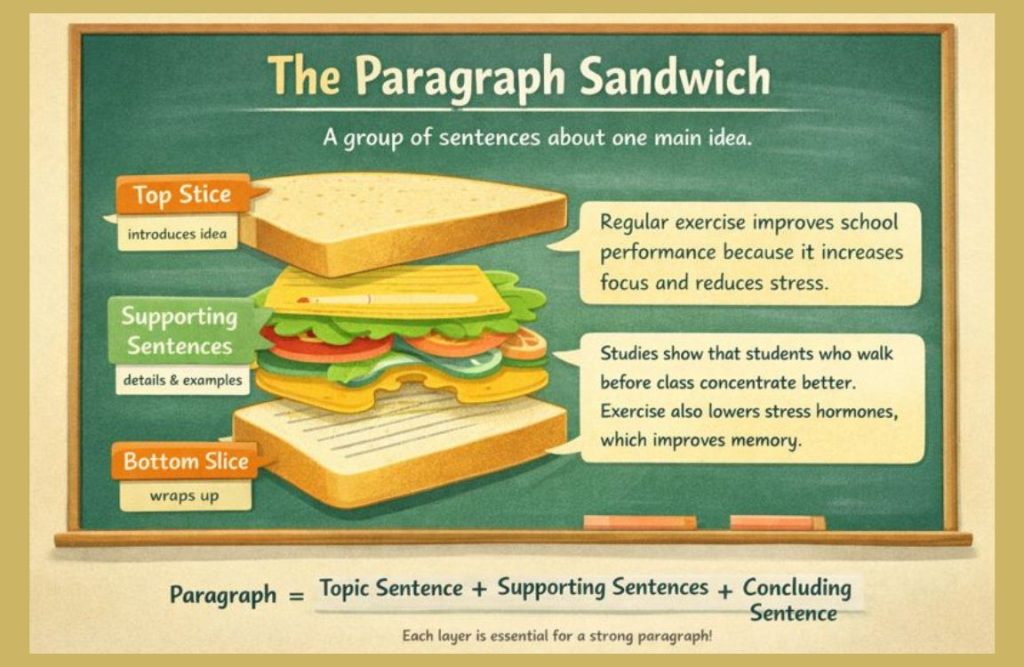
In my classroom, I often compare a paragraph to a sandwich. Just as a sandwich has different layers that work together to create one complete meal, a paragraph has different parts that work together to express one complete idea. The image below illustrates this simple comparison.
Many students ask me, “What is a paragraph?” In this guide, I’ll answer that question by explaining its meaning, structure, types, and examples in simple English that anyone can understand.
What Is a Paragraph?
A paragraph is a group of related sentences that develop one main idea. It usually begins with a topic sentence, includes supporting details, and ends with a concluding sentence. Paragraphs organise writing, improve clarity, and help readers understand ideas more easily.

Think of a paragraph as the basic building block of writing. Instead of presenting unrelated thoughts, it brings connected ideas together in one organised unit. Every sentence has a specific job, and together they explain a single point clearly.
Think about the difference between a shopping bag full of random items and a neatly arranged bookshelf. Both contain things, but only one is organised. Writing works in much the same way. A collection of unrelated sentences creates confusion, whereas a paragraph gives readers a focused path to follow.
Whether you are writing in English for school, college, examinations, or everyday communication, understanding the paragraph definition helps you express points with confidence.
Table of Contents
Why Are Paragraphs Important?
I still remember a student who wrote an entire exam answer as one huge block of sentences. The ideas were good, but the examiner struggled to follow the flow. The problem was not knowledge. It was organisation.
A paragraph is a group of related sentences that develop one main idea clearly. It gives information a proper shape and helps readers understand the writer’s message easily.
Take this example: imagine reading a book without chapters or spaces between pages. Even a great story would feel confusing. The same happens when writing has no paragraphs.
Have you ever stopped reading something because it looked like a wall of text? Poor paragraphing can hide good ideas.
Good paragraphs create order, strengthen readability, and make writing more effective. Strong writing always begins with clear organisation.
Parts of a Paragraph
Every effective paragraph contains 3 essential parts that work together to communicate one complete idea. Let’s examine each part and see how they combine to create effective, organised writing.
⬜ Topic Sentence
The topic sentence introduces the paragraph’s central point. It tells readers what the paragraph will discuss and sets the direction for everything that follows. A strong topic sentence is clear, focused, and specific.
Example:
Reading books improves vocabulary and critical thinking.
Every supporting sentence should develop this controlling idea instead of introducing something completely different.
⬜ Supporting Sentences
Supporting sentences develop the main idea by adding relevant details such as facts, examples, explanations, and evidence. They answer the reader’s questions and provide enough information to make the topic fully understandable.
For instance, after introducing the benefits of reading, supporting sentences might explain how books introduce new words, improve concentration, and strengthen imagination. Each sentence adds another layer until the idea feels complete.
⬜ Concluding Sentence
The concluding sentence brings the paragraph to a satisfying close. It briefly reinforces the main point without simply repeating the topic sentence word for word. A good conclusion reminds readers of the paragraph’s central message and creates a natural ending.
Example:
For these reasons, reading remains one of the best habits students can develop.
Quick Structure Diagram
🥪 The Paragraph Sandwich
Top Bread→ Topic Sentence (main idea)
Filling→ Supporting Sentences (details • evidence • examples • explanations)
Bottom Bread→ Concluding Sentence (final thought)
Every layer supports one complete idea.
The Structure of a Paragraph
When I teach paragraph writing, I often compare it to preparing a simple meal. Each ingredient has a purpose, and missing one part affects the final result. A paragraph also needs different parts working together.
A paragraph usually begins with a topic sentence that introduces the main idea. Supporting sentences then explain, describe, or provide examples related to that idea. Finally, a concluding sentence brings the discussion to a natural ending.
For example, a paragraph about “The Importance of Reading” should not jump between unrelated topics like exercise, technology, and travel. Every sentence should support the central idea of reading.
What happens when sentences do not connect? The paragraph becomes confusing and loses its meaning.
A well-structured paragraph has unity, coherence, and a clear purpose. Like a strong building, every sentence must support the whole structure.
Characteristics of a Good Paragraph
Not every paragraph is automatically a good paragraph. Effective writing follows a few essential principles that help ideas stay focused, connected, and easy to understand. Let’s look at the five qualities every strong paragraph should have.
Unity
Every sentence should contribute to the same focus.
✓ Good: Within the paragraph, every sentence explains the benefits of exercise.
✗ Weak: The paragraph begins with exercise but suddenly talks about holidays.
Coherence
Ideas should flow naturally from one sentence to the next.
✓ Good: Ideas are connected with logical transitions and smooth progression.
✗ Weak: Sentences feel disconnected and jump from one point to another.
Adequate Development
A topic needs enough explanation, examples, or evidence.
✓ Good: The main idea is strengthened with relevant details and supporting evidence.
✗ Weak: The paragraph ends before the subject is fully explained.
Logical Order
Arrange thoughts in the sequence readers expect.
✓ Good: Events are presented in chronological or logical order.
✗ Weak: Information appears randomly and confuses the reader.
Transitions
Transition words connect sentences smoothly.
✓ Good: For example, however, therefore, and finally guide readers.
✗ Weak: In a paragraph, every sentence begins abruptly without any clear connection.
Types of Paragraph
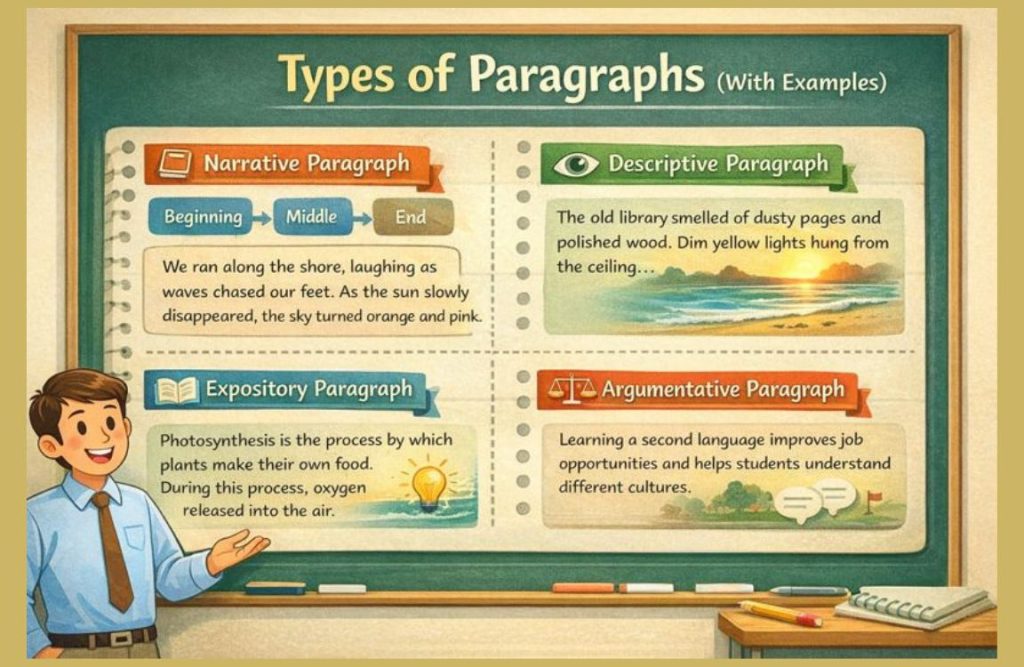
Not every paragraph serves the same purpose. Some tell stories, some describe people or places, others explain ideas, and some try to convince readers. Understanding these four common paragraph types helps you choose the right style for every writing task.
| Type | Main Purpose | Common Use |
| Narrative | Tell a story | Stories, memoirs |
| Descriptive | Create a picture | Descriptions |
| Expository | Explain or inform | Textbooks, reports |
| Persuasive | Convince readers | Essays, opinions |
i) Narrative Paragraph
A narrative paragraph tells a story or describes a sequence of events. It usually follows a clear time order and answers the question, “What happened?” Students often use narrative paragraphs to write personal experiences or short stories.
Example: Last Friday, our class visited the science museum and learned how robots work.
ii) Descriptive Paragraph
A descriptive paragraph creates a vivid picture of a person, place, object, or event. It uses sensory details so readers can imagine what they see, hear, smell, taste, or feel.
Example: The garden bloomed with colourful roses, sweet fragrance, and buzzing butterflies.
iii) Expository Paragraph
An expository paragraph explains an idea, process, or topic by presenting information clearly through examples, explanations, and factual support. Its goal is to inform rather than entertain or persuade. This type commonly appears in textbooks, articles, and examination answers.
Example: Plants produce food through photosynthesis by using sunlight, water, and carbon dioxide.
iv) Persuasive Paragraph
A persuasive paragraph presents opinions supported by reasons and evidence. Its purpose is to influence readers to accept a particular viewpoint or take action.
Example: Schools should plant more trees because they improve air quality and create a healthier environment.
Quick Comparison
| Type | Purpose | Signal Words | Used In |
| Narrative | Tell events | first, next, finally | Stories |
| Descriptive | Describe vividly | looks, smells, feels | Creative writing |
| Expository | Explain facts | because, for example | Textbooks, reports |
| Persuasive | Convince readers | should, therefore, clearly | Essays, speeches |
How to Write a Paragraph Step by Step
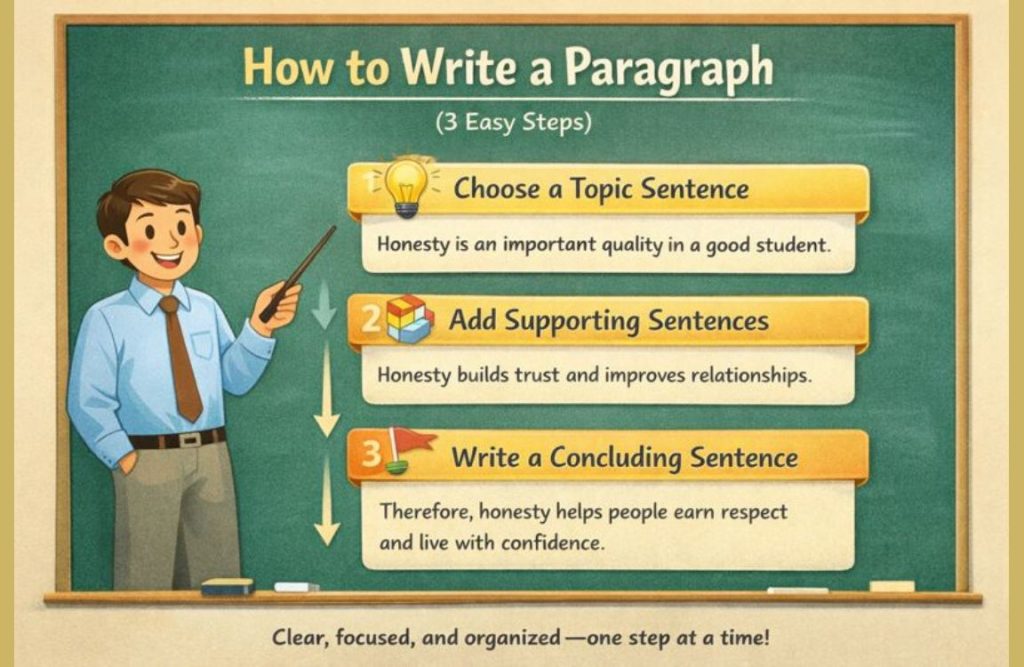
Writing a strong paragraph becomes much easier when you follow a simple process. These six steps help you organise ideas clearly and build paragraphs that are focused, logical, and engaging.
Step 1: Choose One Main Idea
Start with a single clear key point. Avoid combining several unrelated topics in one paragraph because readers can easily lose focus.
↓
Step 2: Write a Topic Sentence
Introduce your main point in the opening sentence. A clear topic sentence tells readers exactly what the paragraph will explain.
↓
Step 3: Add Supporting Details
Develop your idea with a statistic, a short example, an explanation, or even a personal observation. Every supporting sentence should strengthen the topic instead of introducing something new.
↓
Step 4: Use Transition Words
Connect your sentences with transitions such as first, for example, such as, however, and therefore. These words improve flow and make your writing easier to follow.
↓
Step 5: Write a Concluding Sentence
Finish by reinforcing your main thought. Give readers a natural ending instead of stopping the paragraph suddenly.
↓
Step 6: Revise Your Paragraph
Read your paragraph carefully. Remove repetition, develop word choice, fix grammar mistakes, and check that all sentences support the same idea.
Paragraph Example
Below is a simple paragraph showing how all the parts work together.
Topic Sentence
Reading books every day is one of the best habits students can develop.
Supporting Details
Books introduce new vocabulary, improve grammar, and strengthen reading comprehension. They also increase general knowledge and encourage creative thinking. Students who read regularly often become more confident writers because they learn how experienced authors organise ideas and express them clearly. Reading for even fifteen or twenty minutes each day can gradually sharpen language skills and academic performance. It also develops concentration, imagination, and critical thinking, making learning more enjoyable.
Concluding Sentence
For these reasons, daily reading remains one of the most valuable habits for lifelong learning.
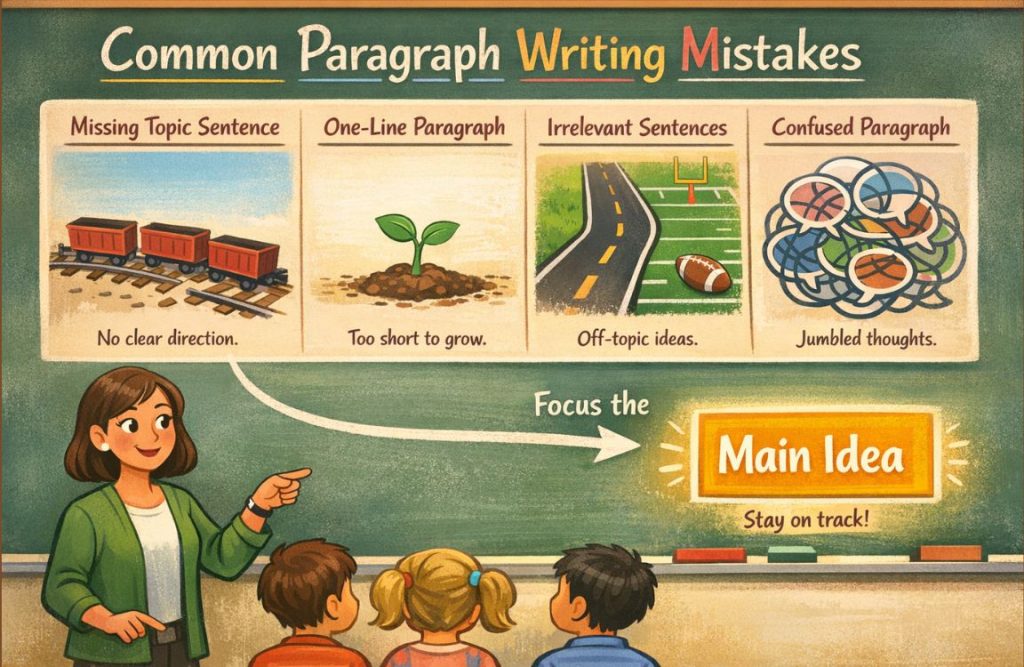
Common Paragraph Writing Mistakes
Many students understand the basic structure but still make mistakes that weaken their writing.
- ❌ Mixing several ideas into one paragraph
- ❌ Starting without a clear topic sentence
- ❌ Forgetting transition words between ideas
- ❌ Repeating the same words or points unnecessarily
- ❌ Writing paragraphs that become too long and difficult to follow
- ❌ Using a single-sentence paragraph in formal writing when additional development is needed
Checking these common problems before submitting your work can make a noticeable difference.
Quick Tips for Writing Better Paragraphs
- ✔ Focus on one main idea.
- ✔ Begin with a strong topic sentence.
- ✔ Support your ideas with examples or evidence.
- ✔ Use transition words naturally.
- ✔ Remove unnecessary repetition.
- ✔ Keep your sentences connected.
- ✔ Read your paragraph aloud before finishing.
- ✔ Revise for clarity, grammar, and flow.
FAQs:
How many sentences should a paragraph have?
There is no fixed number of sentences. Most paragraphs contain three to eight sentences, depending on the topic, purpose, and audience. The goal is to develop one idea clearly rather than meet a specific sentence count.
Can a paragraph contain only one sentence?
Yes, a one-sentence paragraph is acceptable in creative or journalistic writing when used deliberately for emphasis. In academic writing, however, paragraphs usually need several sentences to explain the main idea fully.
What is the difference between a paragraph and an essay?
A paragraph develops one main idea, while an essay combines multiple paragraphs to explore a broader topic. In other words, paragraphs are the building blocks that work together to create a complete essay.
How long should a paragraph be for school students?
For most school assignments, a paragraph of five to seven well-developed sentences is usually appropriate. The focus should always be on explaining one idea clearly instead of reaching a particular length.
What are the most common mistakes students make when writing paragraphs?
Students often mix different ideas, skip the topic sentence, provide too few supporting details, overuse repetition, ignore transition words, or finish without a proper concluding sentence. Revising carefully helps avoid these common mistakes.
Conclusion:
At the beginning of this guide, I compared a paragraph to a sandwich. By now, you’ve seen why that comparison works. When every layer is in place, your writing becomes stronger, clearer, and much easier to read.
Master this one skill first, and every essay, report, email, or story you write will immediately improve.
Want to explore more? Read an in-depth guide on Types of Paragraphs to build your confidence.