
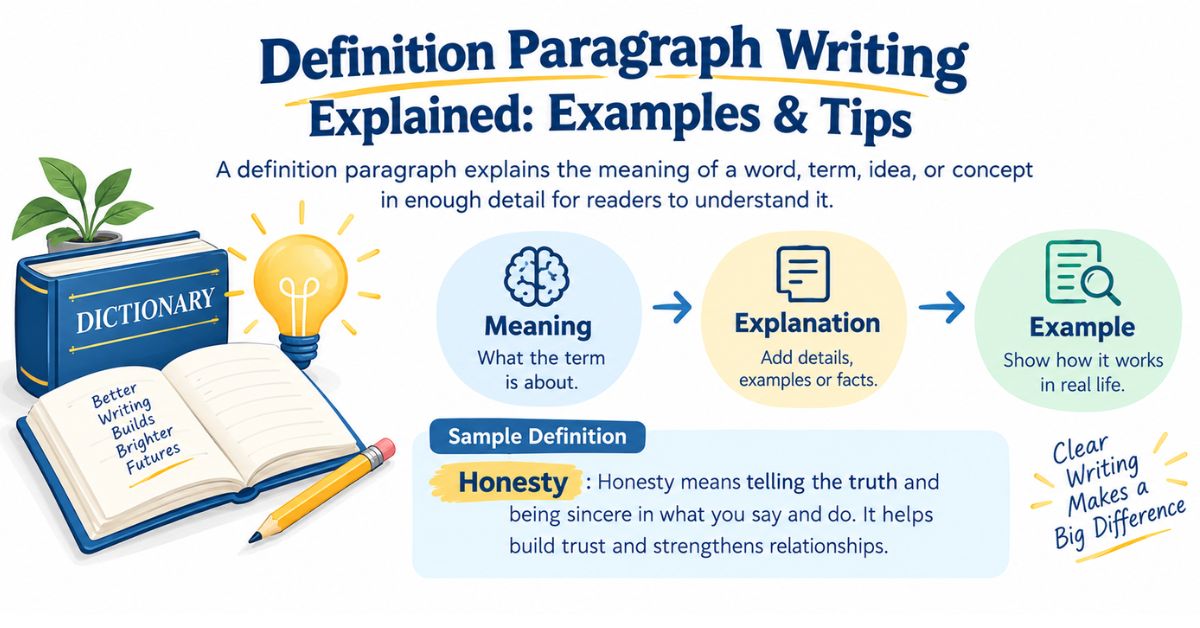
Definition paragraph writing helps writers explain the meaning of a word, term, idea, or concept in enough detail for readers to understand it.
A dictionary offers a brief meaning, while a paragraph can show how that meaning applies in real situations. Defining honesty, for example, may involve explaining why telling the truth matters after making a mistake.
What Is a Definition Paragraph?
A definition paragraph is a form of expository writing that explains what a term means. It usually begins by naming the term and giving its basic meaning. The remaining sentences clarify the idea through explanations, examples, comparisons, facts, or other relevant details.
Consider responsibility. A paragraph can explain the concept by showing a student completing an assignment, admitting a missed deadline, and trying to correct the problem.
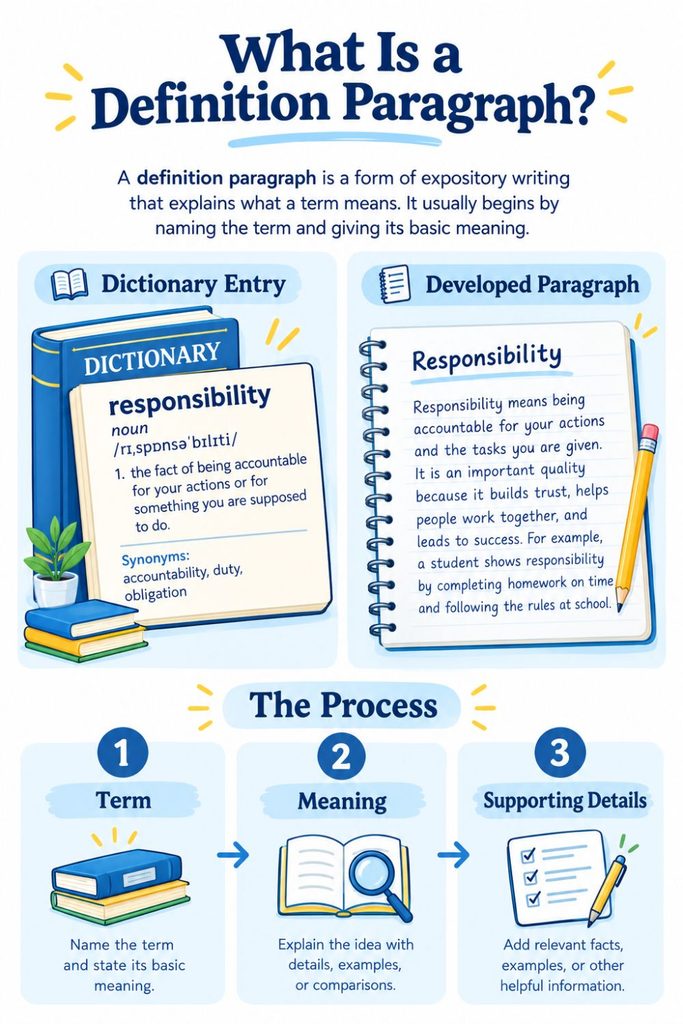
Table of Contents
Purpose of a Definition Paragraph
Writers use definition paragraphs when a brief explanation is not enough. Freedom, for instance, may refer to personal choice, political rights, or release from control.
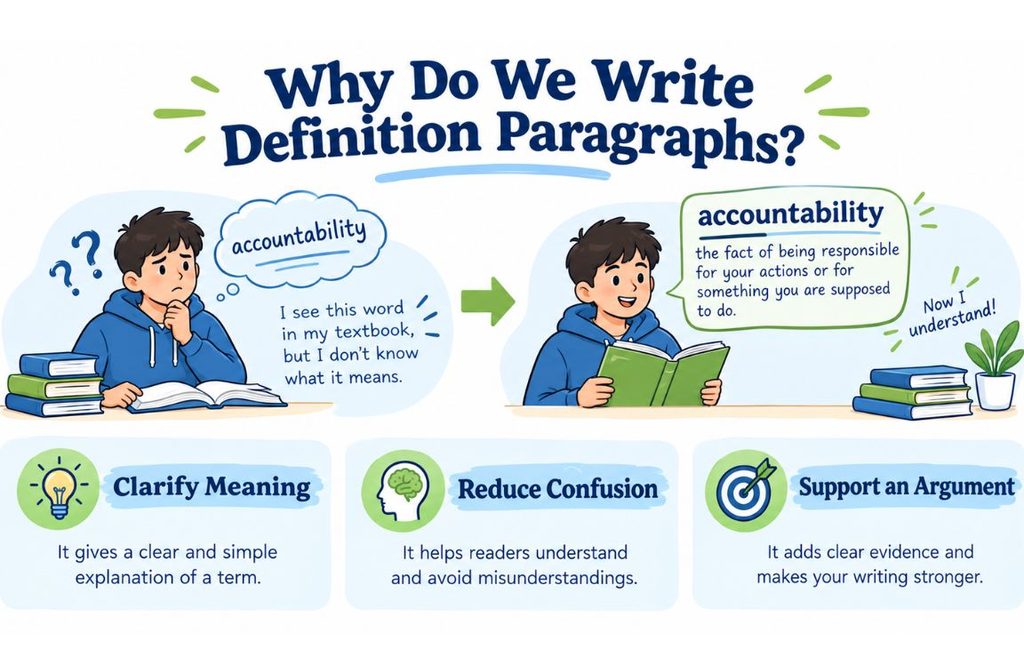
In essay writing, defining a key term also helps readers follow the argument. A precise explanation reduces confusion and establishes a clear meaning for the discussion.
Structure of a Definition Paragraph
A useful classroom model has three parts. This is a guide, not a rule that every paragraph must follow exactly.
1. Topic sentence: Introduce the term and state its basic meaning. Readers should understand the subject from the opening.
2. Supporting sentences: Explain the term in greater depth. Choose details that help readers understand the idea instead of repeating the first sentence.
3. Concluding sentence: Bring the explanation to a natural close. You might emphasize the concept’s importance or summarize the main point.
Arrange sentences logically. Transitions such as for example and in other words can connect ideas, but use them only when they improve clarity.
How to Write a Definition Paragraph
Use these flexible steps to plan your paragraph.
Step 1: Choose a Suitable Term
Choose a term that needs explanation, such as courage, success, or digital privacy. Consider what readers might misunderstand about it.
Step 2: Write a Clear Topic Sentence
Start with a direct explanation. For example: “Digital privacy concerns how personal information is collected, used, stored, and shared, as well as the control people have over that information.”
This definition covers more than keeping personal information secret.
Step 3: Develop the Meaning
Add an example, comparison, or clarification. I ask students what readers need to know next. In my classes, I also model how to remove details that do not explain the term.
Step 4: Write a Suitable Conclusion
Reinforce the main point or explain why it matters. Remove unrelated details and avoid introducing a new subject at the end.
Common Approaches to Definition
Writers can clarify meanings in different ways. Some approaches focus on the level of detail or formality, while others use specific techniques to explain a term.
Formal definition: Gives a precise meaning, often in academic writing.
Informal definition: Explains a term in everyday language for general readers.
Extended definition: Develops a complex idea through explanation, examples, comparisons, and other relevant details.
Definition by negation: Clarifies a concept by stating what it is not. Responsibility involves more than obeying instructions. It includes accepting the results of one’s choices.
Definition by classification: Places a term in a wider category. Renewable energy, for example, comes from sources that are naturally replenished.
These approaches can overlap. An extended definition, for instance, may use classification and negation to make a concept easier to understand. Choose the techniques that best explain your subject.
Definition Paragraph vs. Descriptive Paragraph
A definition paragraph explains what a term means. A descriptive paragraph helps readers imagine a person, place, object, or event through sensory details.
A description of a storm might mention rain striking the roof and thunder shaking the windows. A definition explains what a storm is. The two forms may overlap, but their main purposes differ: one builds a picture, while the other clarifies a concept.
Definition Paragraph vs. Expository Paragraph
Expository writing explains or informs. A definition paragraph is one type of expository writing because it explains the meaning of a term. Other expository paragraphs may explain a process, examine causes and effects, or compare subjects.
For example, explain how photosynthesis works in a process paragraph, or define photosynthesis in a definition paragraph.
Definition Paragraph Examples
These examples show how supporting details develop a definition.
Example 1: Honesty
Honesty means telling the truth and being sincere in what you say and do. It becomes especially important when admitting a mistake might lead to criticism. A student who accidentally damages a classroom book, for instance, can explain what happened instead of blaming a classmate. This response allows the problem to be addressed fairly. Honesty does not mean speaking without care. It means avoiding deception and being truthful about the facts. It can help people build relationships based on trust.
Why it works: The definition, classroom example, and final point explain the concept’s value.
Example 2: Responsibility
Responsibility means recognizing a duty and taking appropriate action to fulfil it. For a student, this may involve preparing for class, submitting work on time, or telling a teacher when an assignment cannot be completed. Responsible behaviour also includes acknowledging a mistake instead of making excuses. A person may not always succeed but can still respond thoughtfully to a problem and try to correct it. Responsibility involves more than following rules. It requires taking ownership of one’s actions.
Why it works: The paragraph moves from meaning to a practical example and its wider implications.
Example 3: Cultural Identity
Cultural identity is a person’s sense of connection to a cultural group or tradition. Language, family practices, food, history, and community experiences may shape that connection, although no single factor defines everyone. Someone who moves to another country may keep familiar traditions while also adopting new customs. Another person may feel connected to several cultural communities at once. Cultural identity can change as people encounter new experiences and reconsider how they understand their cultural belonging.
Why it works: It explains an abstract concept while recognizing that cultural experiences differ from person to person.
Common Mistakes to Avoid
A paragraph is weak when it copies a dictionary entry without adding explanation. Repetition wastes space, while unrelated examples distract readers.
Difficult vocabulary does not automatically make writing academic. Clear language is usually more effective.
I encourage learners to ask whether each sentence explains the term. If not, revise or remove it. The conclusion should follow from the explanation rather than introduce a new claim.
Definition Paragraph Topics for Practice
Choose a topic you can explain in your own words.
Abstract concepts: Love, freedom, success, happiness, friendship, honesty, identity, responsibility.
Social and ethical ideas: Justice, equality, leadership, discipline, courage.
Science and technology: Climate change, artificial intelligence, digital privacy, the internet.
Education and personal growth: Education, critical thinking, respect, adolescence, good manners.
Write the meaning of your chosen term and select two details that clarify it. Use a familiar example, organize your ideas logically, and follow the assigned word limit.
FAQs:
How long should a definition paragraph be?
About 100-150 words is a useful classroom guideline, but follow your assignment’s word limit.
Can a definition paragraph include examples?
Yes. Relevant examples clarify unfamiliar or abstract ideas and help readers understand how a term applies in practice.
Is a definition paragraph the same as a dictionary definition?
No. A dictionary entry gives a brief meaning, while a definition paragraph develops that meaning through explanation and context.
Where does a definition paragraph appear in an essay?
It may appear in an introduction or body paragraph whenever readers need a clearer understanding of an important term.
Conclusion:
A definition paragraph explains a term through a clear meaning, relevant details, and examples. Choose a concept that needs clarification, develop its meaning in simple language, and check that every sentence contributes to the explanation.
With practice, you can write focused paragraphs that help readers understand unfamiliar ideas.