I still remember a student staring at me during an exam and whispering, “Sir, I know the answer, but I don’t know how to explain it step by step.” That’s exactly where a process paragraph becomes your secret weapon in exams and academic writing.
A process paragraph explains how something happens through clear, ordered steps. Think of it as guiding someone across a bridge. You must show every step, or they will fall into confusion.
In this guide, I’ll walk you through the structure, the writing process, and practical examples that actually work in real exams. By the end, you won’t just write. You’ll guide your reader with confidence, like a teacher in your own words.
What is a Process Paragraph (Definition & Meaning)
Let me give you a crisp, exam-ready answer first: A process paragraph is a type of expository paragraph that explains a series of steps in a logical, chronological order to show how something is done or how something happens. It is often called a “how-to” paragraph.
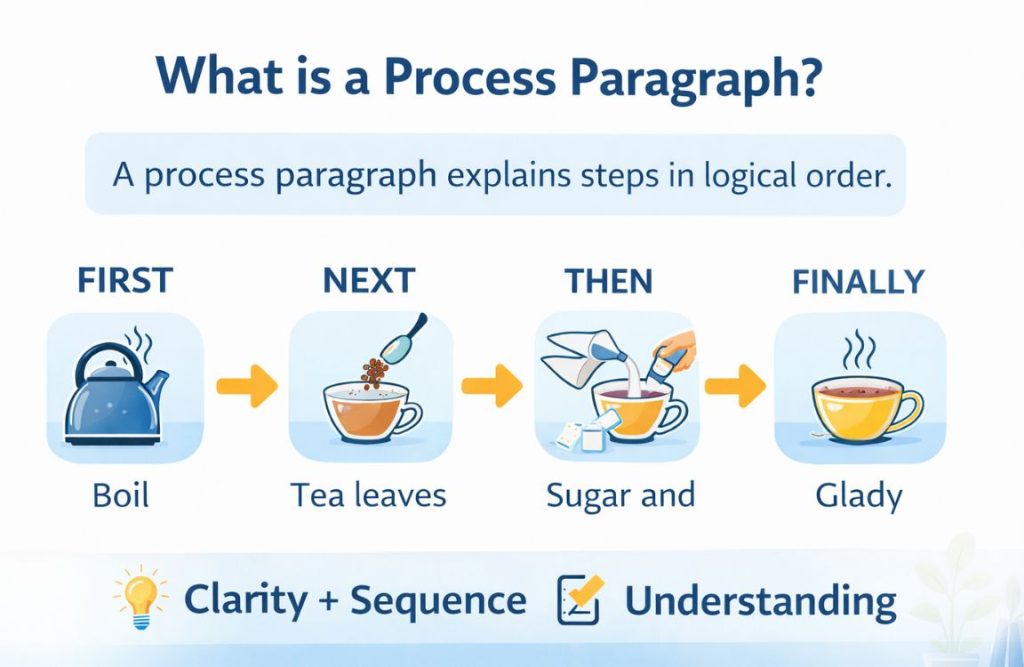
Now, as I tell my students, imagine you’re teaching a friend how to make tea. If you say, “Boil water… oh wait, add tea leaves first… no, sugar later,”- you’ve already confused them! That’s why a process paragraph must follow a clear sequence.
Its purpose is simple but powerful: to guide the reader step by step without confusion. You’ll find it everywhere- in exams, textbooks, and daily instructions.
Here’s a quick example:
First, boil water. Next, add tea leaves. Then, pour milk and sugar. Finally, serve hot.
See? Clean, logical, and easy to follow, with clear transitions and a satisfying conclusion. That’s the magic of a well-written process paragraph.
Table of Contents
Process Paragraph Structure & Format
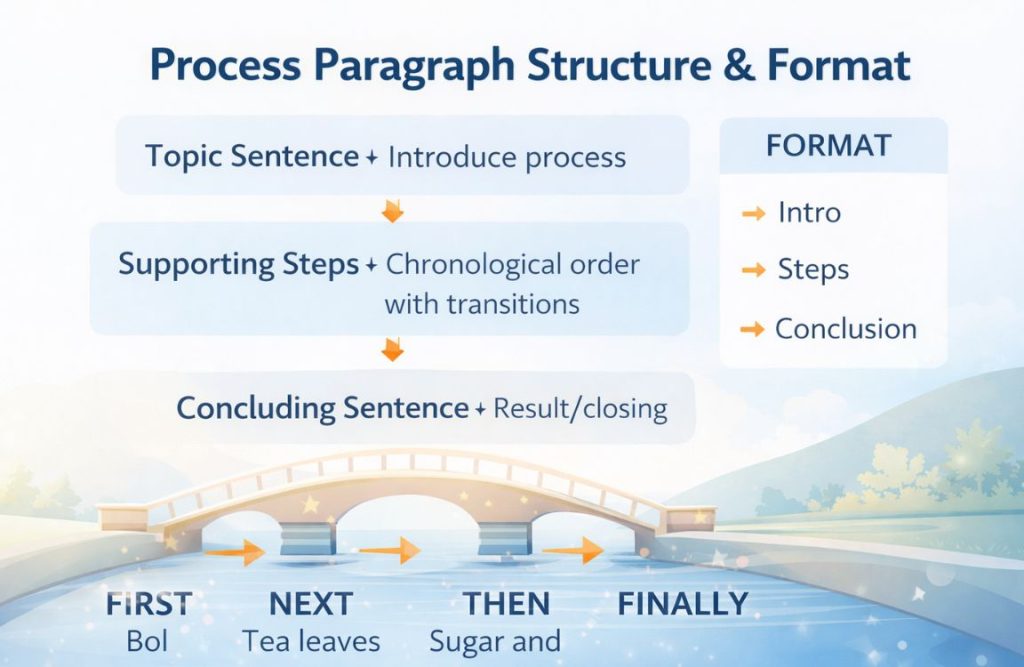
Before my students write, I always pause and say: “A good paragraph is like a well-built bridge- miss one pillar, and everything collapses.” Here, we’ll explore the process paragraph structure and the exact format students can rely on in exams.
Basic Structure of a Process Paragraph
Let me show you how I explain the process paragraph structure in class. I often advise my students to imagine guiding someone blindfolded- clarity becomes everything.
First comes the topic sentence. This introduces the process and sets the goal, like a “how-to” promise to the reader.
Next are the supporting steps, the heart of the paragraph. These must follow a clear, chronological order, using transitions like first, next, then, and finally. Each step should be detailed enough, sometimes including tools or materials, so the reader can follow easily.
Finally, the concluding sentence wraps things up by summarizing the result or offering a final thought.
Think of it as a journey: introduce the path, guide each step clearly, and arrive smoothly at the destination.
Process Paragraph Format for Students
Now, when it comes to the process paragraph for students, I keep it beautifully simple- because under exam pressure, simplicity wins.
Start with a short introduction (1 sentence), then move into clear steps, and end with a neat conclusion. That’s your formula: intro → steps → conclusion.
But here’s the twist: I tell my class- structure alone isn’t enough. Your paragraph must have unity and coherence. Every sentence should stick to the same process, like teammates passing the ball smoothly.
For instance, if you’re describing “how to plant a tree,” don’t suddenly jump to cooking rice! Stay focused.
A well-formatted paragraph doesn’t just inform. It feels effortless to read. And that’s where real writing confidence begins.
How to Write a Process Paragraph Step by Step
When my students ask me how to write a process paragraph, I smile and say, “Think like a guide, not a genius.” Writing is not magic. It’sa step-by-step journey. If you follow the right steps in the process of writing, the entire paragraph writingprocess becomes surprisingly simple and even enjoyable.
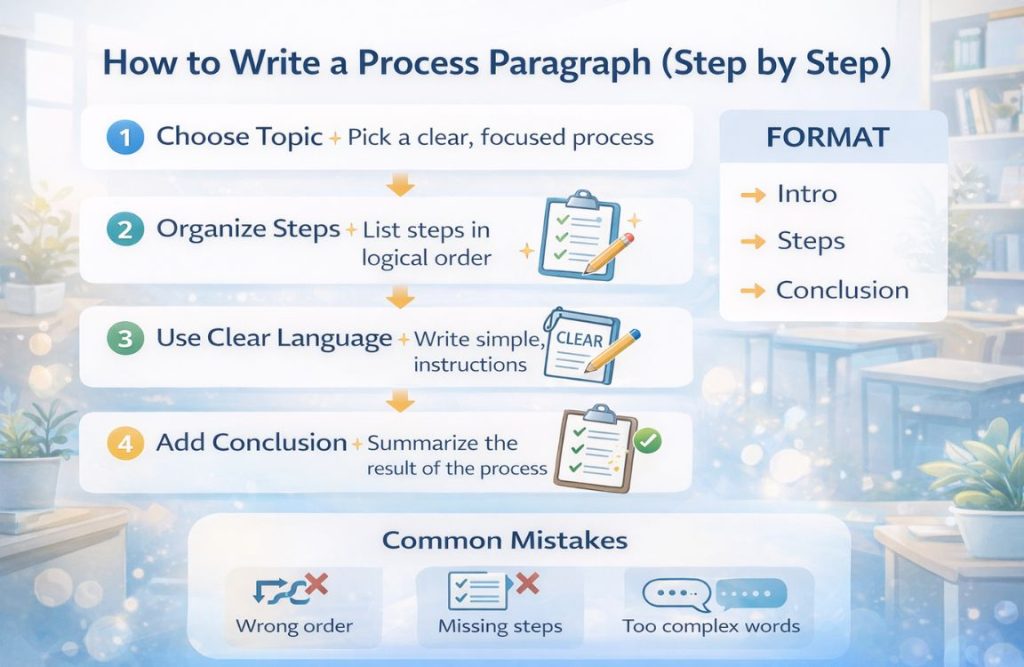
Step 1: Choose a Topic
I usually explain to my class: “If your topic confuses you, it will confuse your reader twice as much.” So, pick familiar process paragraph topics- making tea, planting a tree, or even preparing for an exam. A clear topic gives your writing direction and confidence.
Step 2: Organize Steps Logically
Here’s where many students stumble. A logical sequence process paragraph is like a recipe. You cannot fry before you cut! Arrange your ideas in natural order. I often ask, “Can a beginner follow this without asking questions?” If yes, you’re on the right track.
Step 3: Use Clear Language
While describing a process, simplicity is your superpower. Avoid fancy words that impress no one but confuse everyone. I often tell my students, “Clarity beats creativity in exam writing.” Use short sentences, direct verbs, and make every step easy to follow.
Step 4: Add a Concluding Sentence
Never just stop abruptly. That’s like leaving a story unfinished. A concluding sentence wraps up the process neatly. It may highlight the result or restate the importance, giving your paragraph a sense of completion.
Common Mistakes to Avoid
Now, let me share a classroom moment. I once read a student’s paragraph where step three appeared before step one. It felt like watching a movie in reverse! These are classic process writing mistakes.
First, avoid missing steps. Even one skipped instruction can break understanding. Second, don’t mix unrelated ideas- stay loyal to your topic. Third, overusing complex words can bury your meaning.
And my favorite warning: never assume your reader “already knows.” Write as if you’re explaining to a beginner.
Good writing is not about showing off. It’s about being understood.
Transition Words for Process Paragraph
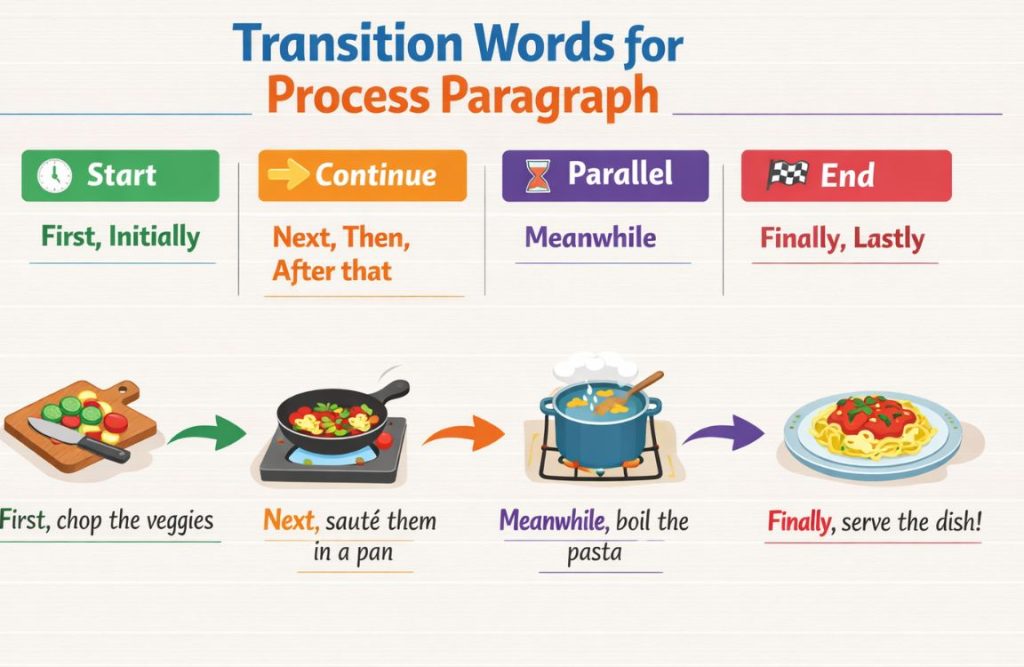
In my classroom, I often say, “Steps alone don’t guide the reader- connections do.” That’s where process paragraph transition words come in. These linking words for process paragraphs act like signposts, while transitional markers in process paragraphs ensure your ideas flow smoothly from one step to the next.
List of Common Transition Words
Let me give you a quick, exam-ready list I share with my students. Think of these as your writing toolkit:
First, initially, to begin with (to start)
Next, then, after that (to continue)
Meanwhile, at the same time (for parallel actions)
Finally, in the end, lastly (to conclude)
For example: First, heat the pan. Next, add oil. Then, fry the ingredients.
Notice how the paragraph moves like a guided tour- no confusion, no chaos.
How to Use Transition Words Effectively
Now here’s a little secret I expose to my students: transition words are powerful, but overusing them is like adding too much salt- your writing suffers. Use them naturally, not mechanically.
Always match the word with the step’s position. Don’t say “finally” in the middle- that’s like ending a story halfway!
A well-placed transition doesn’t just connect sentences. It quietly leads your reader forward, step by step.
Process Paragraph Examples (Simple & Practical)
In class, I’ve noticed something magical- students understand faster when they see writing in action. So here, I’ll walk you through a few samples of a process paragraph, so you can observe how ideas unfold naturally.
Example 1: How to Make Tea
Let me begin with a familiar classroom favorite- a tea-making process paragraph:
First, take a clean pot and pour one cup of water into it. Then, place the pot on the stove and allow the water to boil. Next, add one teaspoon of tea leaves and let it simmer for a minute. After that, pour in milk and add sugar according to taste. Stir the mixture gently and let it boil for another minute. Finally, strain the tea into a cup and serve it hot.
I usually explain to my students, “If your reader can taste the tea through your words, you’ve written it well.” Notice how each step flows smoothly without confusion.
Example 2: How to Make a Cake
Now let’s look at a slightly richer example- a how-to make a cake process paragraph:
To bake a simple cake, begin by preheating the oven to the required temperature. First, take a bowl and mix flour, sugar, and baking powder. Next, add eggs, milk, and butter, and whisk the mixture until it becomes smooth. Then, pour the batter into a greased baking pan. After that, place the pan inside the oven and bake for about thirty minutes. Meanwhile, check occasionally to ensure it does not burn. Finally, remove the cake, let it cool, and serve.
Here’s what I point out in class: good writing is like baking- precision matters. One missing step, and the whole “cake” collapses!
Example 3: Washing Clothes Process Paragraph
Finally, let’s consider a daily-life task- the process of washing clothes paragraph:
First, sort the clothes according to color and fabric type. Then, fill a bucket or washing machine with water and add detergent. Next, soak the clothes for a few minutes to loosen dirt. After that, scrub or run the machine to clean them thoroughly. Then, rinse the clothes with clean water to remove soap. Finally, wring out the excess water and hang them to dry.
I often smile and say, “Writing, like washing clothes, is about removing confusion and leaving clarity behind.”
Process Paragraph Topics for Practice
In my classroom, I often see students pause- not because they can’t write, but because they don’t know what to write. So, here are practical process paragraph topics for students to spark ideas and build confidence.
- How to prepare for an exam
- How to plant a tree
- How to cook rice
- How to write a good paragraph
- How to use a computer for study
- How to clean your study desk
- How to make a school presentation
- How to improve English speaking skills
- How to recycle waste at home
- How to stay healthy daily
I always advise my students, “Pick a topic you’ve lived, not just learned.” When you know the process from experience, your writing naturally becomes clearer and more convincing.
Process Analysis Paragraph (Advanced Concept)
Now, let me take you one step deeper- something I introduce to my advanced learners: the process analysis paragraph.
A process paragraph explains how something is done, while a process analysis paragraph explains how and why each step works.
Here’s the difference I highlight in class. A basic process paragraph is like giving directions: “First do this, then do that.” But a process analysis paragraph goes further. It answers the curious question: “Why this step?”
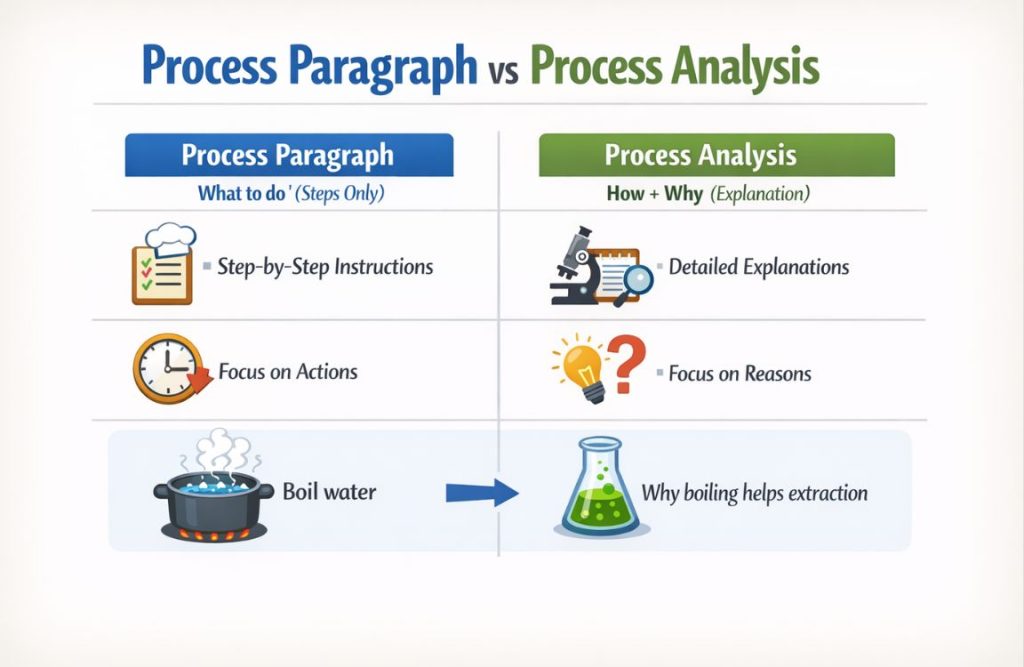
For example, in a simple paragraph, you might say: “Boil water before adding tea leaves.” But in a process analysis, you explain: “Boiling water first helps release the flavor of the tea leaves effectively.”
See the shift? One instructs; the other explains.
I often compare it to science. A process paragraph is a recipe, but a process analysis is the chemistry behind it.
A strong process analysis paragraph doesn’t just guide. They deepen understanding. And when students reach this level, I tell them, “You’re no longer just writing. You’re teaching through your words.”
FAQs:
What makes a process paragraph different from other paragraphs?
A process paragraph focuses on action and sequence. Unlikedescriptive paragraphor narrative writing, it guides the reader through steps. Its strength lies in clarity and order, making it especially useful in instructions, exams, and academic explanations.
Can a process paragraph be written in passive voice?
Yes, but I advise caution. Passive voice (“the water is boiled”) can sound formal, but active voice (“boil the water”) feels clearer and more direct, especially for beginners and exam writing.
How long should a process paragraph be in exams?
In most exams, I recommend 100-150 words. It’s long enough to explain steps clearly but short enough to stay focused. Quality matters more than length. Clarity always wins over complexity.
Can I use personal experience in a process paragraph?
Absolutely! In fact, I encourage it. Writing from experience makes your steps more realistic and easier to follow. It also adds a natural flow that textbook-style writing often lacks.
What tense should I use in a process paragraph?
Generally, use the present tense. It creates a sense of immediacy and instruction. For example: “First, mix the ingredients.” This keeps your writing direct, clear, and engaging.
Conclusion:
If I could leave my students with one thought, it would be this: process paragraph writing is not just about steps. It’s about clarity of thinking. From understanding the definition to mastering structure, from following steps to exploring process paragraph examples, you’ve now seen how simple ideas can be shaped into powerful writing.
I’ve watched many students struggle at first, only to gain confidence through practice. Writing improves not overnight, but paragraph by paragraph. So, don’t just read, start writing. Choose a topic, follow the steps, and trust the process.
Because in the end, the best way to learn writing… is to write. So pick one topic above and write your first process paragraph right now.