Let me start with a classroom confession. Every year, a student raises a hand and says, “Sir, what is a narrative paragraph, really?” And I smile, because that question opens the door. A narrative paragraph is a short story, but one with purpose. It tells one event in a clear order, using details that help the reader see, feel, and experience what happened.
In exams, narrative paragraph writing isn’t about decorating the page with drama. It’s about showing control of sequence, detail, and meaning. Think of it as a mini-movie: one scene, one focus, no unnecessary characters wandering in late.
Once students grasp what a narrative paragraph is, their writing stops rambling and starts working. And that’s when marks and confidence begin to rise.
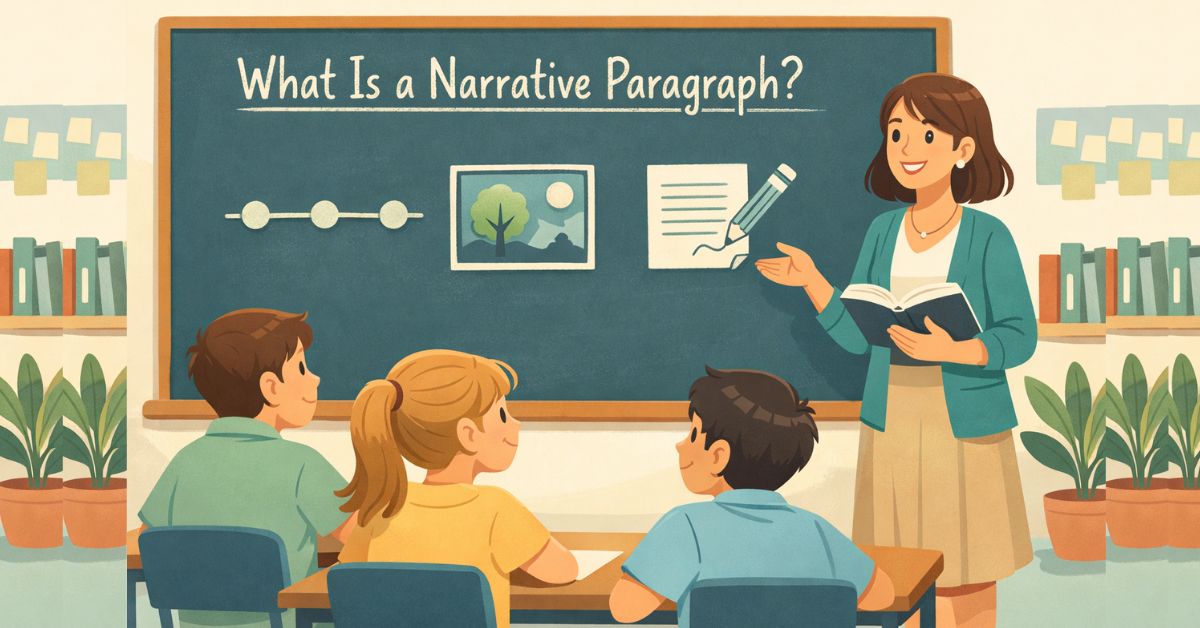
What Is a Narrative Paragraph?
When I explain this in class, I usually pause, lower my voice a little, and say: “Alright, imagine I’m about to tell you something that happened to me, but I only get one paragraph.” That’s the moment students lean in. Because the definition of a narrative paragraph is beautifully simple: it is one paragraph that tells one short event or experience in the order it happened.

Not a full-blown story with side plots. Not a list of facts. Just one clear slice of life.
A narrative paragraph works like a straight road, not a maze. First, something happens, then something else, and finally, it ends. This chronological order is its backbone. If events jump around, the reader stumbles, and in exams, that stumble costs marks. I often joke that a narrative paragraph hates time travel. No flashbacks unless you really know what you’re doing.
You’ll see narrative paragraphs everywhere once you know how to spot them. They appear in essays, where one paragraph narrates an incident. They show up in exams, asking you to recount an experience or event. They live in stories, quietly doing the hard work of moving the plot forward. And they shine in personal writing, where one moment- embarrassing, joyful, painful- gets the spotlight.
The magic is focus. One event. One direction. One purpose. When students grasp this, their writing stops wandering like a lost tourist and starts walking confidently from beginning to end. And that’s when a paragraph stops being “just writing” and becomes a story worth reading.
Read Also, “What Is a Paragraph? Types, Structure & Examples Explained“
Table of Contents
Simple Definition of a Narrative Paragraph for Students
Here’s how I define it on the board when I see confused faces staring back at me. To define a narrative paragraph, I say this: it is one paragraph that tells a single event like a short story, step by step. No fancy words, no overthinking.
A narrative paragraph for students is simply writing what happened first, what happened next, and how it ended- just like telling a friend about your day, but on paper. If your reader can follow the moment without getting lost, you’ve done it right.
What Does a Narrative Paragraph Do?
When I ask my class what the purpose of a narrative paragraph is, someone inevitably says, “To explain something.” That’s my cue to shake my head and smile. A narrative paragraph doesn’t explain. It invites. It opens a door and says, “Come with me. This happened.”

Its job is to tell and engage, not lecture. Instead of breaking ideas apart like a science experiment, it strings moments together so the reader feels the movement of time and emotion. Think of it as the difference between reading a recipe and tasting the food. One informs; the other lingers.
When students understand this, their writing shifts. They stop reporting events like newsreaders and start recounting experiences like storytellers. And that emotional connection? That’s what makes a paragraph memorable- long after the last sentence ends.
Key Features of a Narrative Paragraph
When I teach this part, I tell my students, “If a narrative paragraph were a machine, these would be its working parts.” These features are not decorative extras. They are the narrative paragraph elements examiners quietly look for. Learn them, remember them, and your writing suddenly looks confident, controlled, and intentional- exactly the narrative writing characteristics that earn marks.
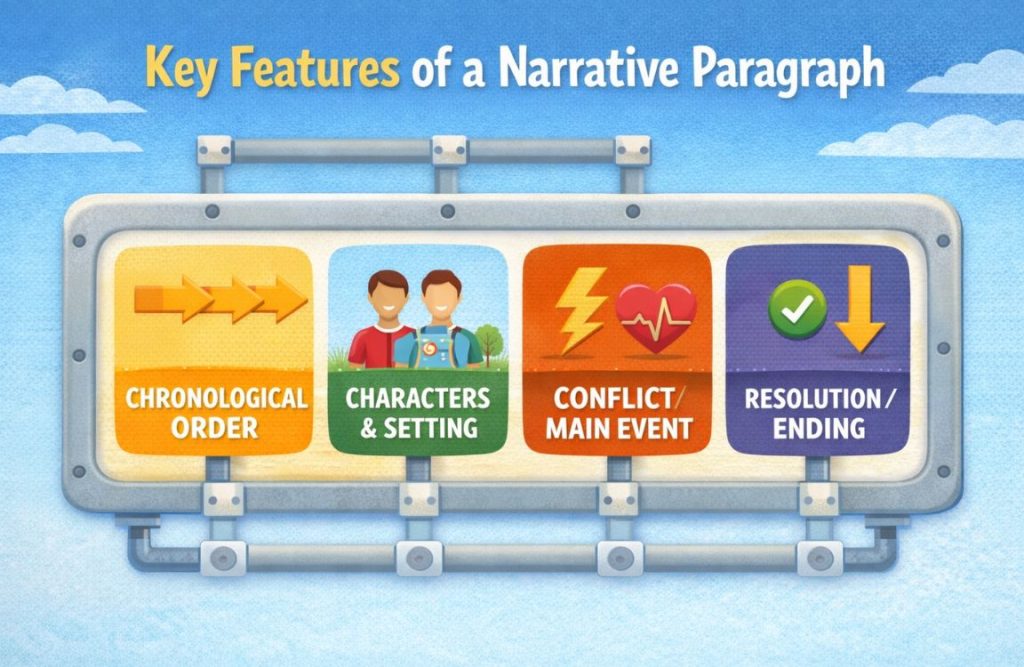
i) Chronological Order (Time Sequence):
This is where I draw an invisible line across the classroom and say, “Your paragraph must walk forward, not sideways.” In a chronological order paragraph, events unfold the way time unfolds- step by step. Readers should never have to stop and ask, “Wait… when did this happen?”
Time words like first, then, later, and finally act like signposts, gently guiding the reader along. When students follow the sequence carefully, their writing feels smooth, logical, and effortless, even though it rarely is.
ii) Characters, Setting, and Action:
At this point, I usually ask, “Who is in your paragraph, and where are they standing?” A strong narrative paragraph introduces characters briefly, places them in a clear setting, and lets action happen there.
These narrative details help the reader picture the moment without drowning them in description. The setting in a narrative paragraph isn’t background wallpaper. It shapes the mood. A crowded bus, a silent exam hall, a rainy street- each quietly changes how the event feels.
iii) Conflict or Main Event:
Every good narrative paragraph has a heartbeat- a moment where something shifts. This is the conflict in a narrative paragraph, whether it’s a mistake, a surprise, or a sudden realization.
I tell students: if nothing happens, there’s no story. This doesn’t mean drama and explosions. Sometimes, the conflict is internal, small, or quietly uncomfortable. But it must matter, because this moment gives the paragraph its reason to exist.
iv) Resolution or Ending:
Finally, I remind my students that readers hate being abandoned mid-thought. The resolution in a narrative paragraph shows how the moment ends, or what it leads to. It provides emotional closure, not a summary.
A strong ending leaves the reader feeling settled, thoughtful, or slightly changed. When a paragraph ends well, it doesn’t just stop. It lands.
Narrative Paragraph Structure & Outline (Step-by-Step)
When students ask me how to build a narrative paragraph, I tell them this isn’t free-fall writing. It’s scaffolding. A clear narrative paragraph format gives your story shape, while the narrative paragraph form keeps it standing during exams, deadlines, and moments of panic. Once you know the structure, storytelling becomes intentional, not accidental.

i) Topic Sentence in a Narrative Paragraph:
I always say the topic sentence is where your paragraph takes its first breath. The topic sentence of a narrative paragraph sets the scene and hints that something is about to happen. It doesn’t explain everything; that would ruin the suspense, but it gently opens the door.
In class, I compare it to the opening shot of a film: we see where we are and sense movement coming. A strong topic sentence introduces the event, places us in the moment, and prepares the reader emotionally. If this sentence is clear, the rest of the paragraph knows where it’s going. If it’s weak, everything that follows starts wandering.
ii) Supporting Sentences (Story Development):
This is where students start enjoying themselves, and sometimes getting carried away. Supporting sentences develop the story through action and detail. I tell my class, “This is where your paragraph lives.”
A strong paragraph with imagery allows the reader to see, hear, or feel the moment without being overwhelmed. The key is balance. Each sentence should push the event forward while adding a meaningful description. These details of the narrative paragraph should feel purposeful, not decorative.
I remind students that good storytelling isn’t about saying more. It’s about choosing what matters. When done well, these sentences pull the reader through the experience, one moment at a time.
iii) Concluding Sentence:
I like to say the concluding sentence is your paragraph’s quiet exit. The conclusion of a narrative paragraph doesn’t shout or explain. It settles. It shows what changed, what ended, or what the moment meant. In class, I ask students, “After this happened, where are you now?”
A strong ending leaves the reader with closure or reflection. It makes the paragraph feel complete, not cut short. When the conclusion works, the story doesn’t just stop. It stays with the reader.
How to Write a Narrative Paragraph (Step-by-Step Guide)
Whenever students ask me how to start writing narrative paragraphs, I tell them this isn’t magic. It’s a method. Think of this as your exam-day survival guide. Follow these steps, and suddenly that scary question, how do you write a narrative paragraph? starts feeling manageable, even familiar.

Step 1: Choose a Clear Event
I stop my class right here and ask, “What is the one thing that actually happened?” Not a whole day. Not a lifetime story. One clear event. A narrative paragraph thrives on focus. If you try to squeeze in too much, the paragraph collapses under its own weight.
I tell students to imagine shining a flashlight in the dark- only one moment should be lit. Choosing a clear event answers the silent exam question: What is this paragraph really about? When that answer is sharp, everything else falls into place.
Step 2: Organize Events in Order
This is where planning saves marks. I often draw arrows on the board and say, “Your paragraph must move forward, not hop around like popcorn.” Once the event is chosen, list what happened first, next, and last. This order becomes your roadmap.
Students who skip this step usually end up confused, and so do their readers. Organizing events before writing turns panic into control. Suddenly, the paragraph knows where it’s going, and you’re no longer guessing your way through it.
Step 3: Use Descriptive Language
Now comes the part students enjoy, but must handle carefully. A paragraph using imagery brings the moment to life, but only when details are chosen wisely. I tell my class: “Show me what matters.”
Good narrative details help the reader see a face, hear a sound, or feel a reaction. Too many details slow the story; too few make it dull. The goal isn’t decoration. It’s a connection. When description serves the moment, the paragraph starts breathing.
Step 4: End with Meaning
I always remind students that a paragraph deserves a proper goodbye. Ending with meaning doesn’t mean summarizing. It means showing what the moment is left behind. A feeling, a thought, a quiet realization. I ask, “After this happened, what changed?”
When students answer that honestly, the paragraph feels complete. The best endings don’t explain everything. They let the reader feel the weight of the moment and carry it forward.
Narrative Paragraph Examples & Topics (With Explanation)
This is the moment my students wait for, the “Show me how it actually looks” moment. Reading examples of narrative paragraphs is like watching a solved math problem after struggling alone. Each narrative paragraph sample below shows how one focused moment becomes clear, controlled writing when done right.
i) Short Narrative Paragraph Example (for Students)
The bell rang just as I reached the classroom door, and I froze, knowing I was late. Inside, every head turned toward me, and the silence felt louder than the bell itself. I mumbled an apology, slipped into my seat, and avoided eye contact. For the rest of the period, my heart beat faster than the ticking clock on the wall.
Why this works:
This is one of those effective short narrative paragraph examples because it captures a single moment without explanation or extra background. The event moves quickly, and each sentence adds to the same feeling, embarrassment, without drifting away.
ii) Personal Narrative Paragraph Example
I still remember the day I learned to ride a bicycle without help. My father let go of the seat, and for a second, the road felt endless and terrifying. I wobbled, nearly fell, then suddenly found my balance. When I stopped, my hands were shaking, but I was smiling wider than ever before.
Why this works:
A strong personal narrative paragraph focuses on experience, not commentary. The emotions come from the moment itself, not from explaining how important it was. The paragraph trusts the reader to feel the victory.
iii) Exam-Style Narrative Paragraph
The classroom was unusually quiet as the question paper landed on my desk. I scanned the first line, felt my confidence slip, and took a deep breath. Slowly, I reread the question and began writing, one sentence at a time. By the end of the exam, the fear that had followed me in was replaced by relief.
Why this works:
This is ideal narrative paragraph writing for students, especially at the exam level. It stays focused, follows a clear sequence, and ends with emotional closure. These are exactly the qualities examiners look for in narrative paragraph examples for high school students.
Narrative Paragraph Writing Topics to Try
- The best mistake I ever made
- A time I faced my fear
- My proudest school memory
- A day that changed my mind
- When I realized I had grown up
Choose one and write your narrative paragraph like you’re reliving it, not reporting it.
Narrative Paragraph vs Narrative Essay
This is the moment in class when someone squints at the board and asks, “Sir… isn’t this the same thing?” And that’s my cue to rescue a lot of confused notebooks. A narrative paragraph and a narrative essay belong to the same family, but they are very different in size and responsibility.
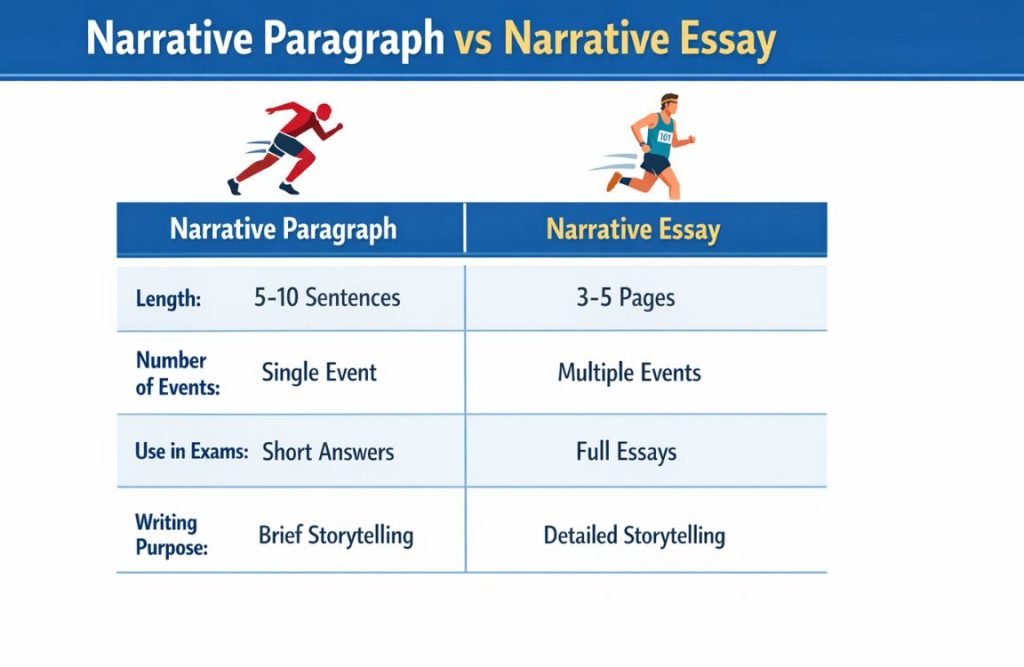
A narrative paragraph is a sprinter. It runs one short distance, tells one focused event, and stops. A narrative essay, on the other hand, is a marathon. Students often ask how many paragraphs are in a narrative, and that’s where the difference becomes clear.
A narrative essay uses multiple narrative paragraphs, each handling a different part of the story: introduction, rising action, key moments, and conclusion. Here’s how I usually explain it on the board:
| Narrative Paragraph | Narrative Essay |
| One paragraph | Multiple paragraphs |
| One event or moment | Several connected events |
| Short and focused | Fully developed story |
| Common in short answers | Common in full essays |
When students see it this way, the confusion disappears. A paragraph tells a moment. An essay tells a journey. And once they know which one the question demands, their writing finally stops overshooting or falling painfully short.
Common Mistakes in Narrative Paragraph Writing
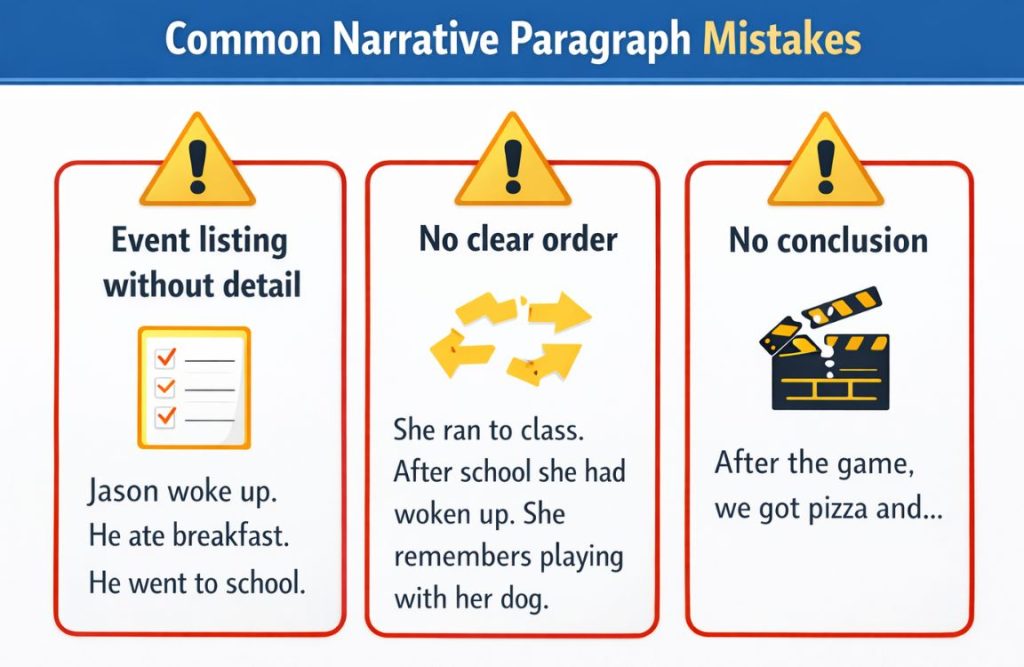
This is the part of the lesson where I gently say, “Let me show you how marks quietly slip away.” Most narrative paragraph mistakes don’t come from a lack of effort. They come from misunderstanding the rules of narrative writing.
The first mistake I see is listing events without detail. Students write what happened, but the paragraph reads like a timetable: this happened, then that happened, and then the end. I often tell them, “You’re reporting, not narrating.” A narrative paragraph needs moments to breathe. Without selective detail, the story never comes alive.
The second mistake is losing order. When events jump around, the reader feels like they’ve missed a page. In exams, confusion is expensive. I remind my class that a narrative paragraph is not the place for clever experiments with time. Clarity beats creativity here.
The final mistake is ending without an ending. No conclusion means the paragraph simply stops, like a film cutting to black mid-scene. Readers need closure, even a quiet one. When students fix these three errors, their writing instantly looks calmer, clearer, and far more confident.
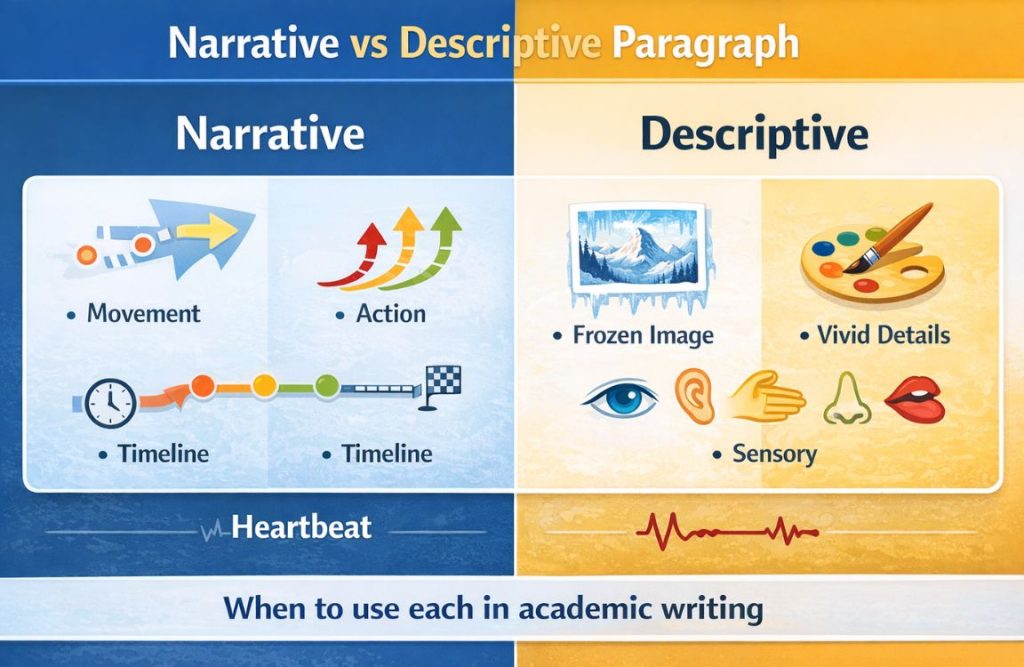
Narrative vs Descriptive Paragraph: Key Differences Explained
Let’s settle this classic confusion once and for all. I often ask my students, “If your paragraph could walk or dance, what kind would it be?” Cue the laughter, but it works. Because that’s the essence: a narrative paragraph moves, while a descriptive paragraph poses beautifully for the camera.
Think of narrative writing as your favorite movie; something happens. There’s movement, tension, emotion, a before and after.
Now, descriptive writing is a painting- nothing really happens, but every brushstroke (or adjective) makes you see and feel the world differently.
In a narrative paragraph, we chase the action: someone decides, fails, wins, or learns. It’s alive with time transitions and emotions.
In a descriptive paragraph, time freezes. We zoom in on color, texture, smell– the way sunlight spills across an old notebook.
Both matter. But only the narrative paragraph makes your reader feel the heartbeat of a story.
When to Use Each Type in Academic Writing
Here’s the cheat code I give my students:
i) Use narrative paragraphs when you’re telling a story- a personal reflection, lab experience, or a life-changing moment in an essay.
ii) Use descriptive paragraphs when you want your readers to see an idea- describing a setting, character, or scene in vivid detail.
In short? Use narrative to show growth, and descriptive to show beauty. One moves, the other mesmerizes, and every great writer learns to dance between them.
Grammar & Tense Tips for Writing a Smooth Narrative Paragraph
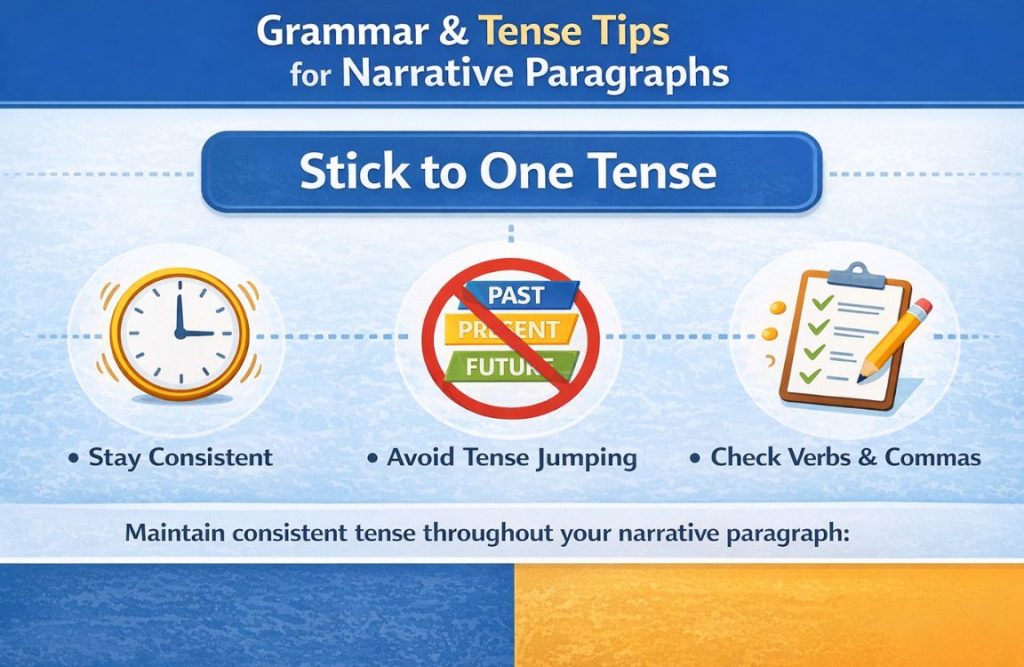
Let me share a little classroom secret. Grammar is the invisible glue that keeps your story from falling apart. You can write the most heartwarming scene, but if your verbs start time-traveling- one moment in the past, next in the present- your reader gets motion sickness.
So, here’s the golden rule: stick to one tense, usually the past. Start with “I walked into the room,” not “I walk into the room and was shocked.” Keep your sentences crisp, your subjects active, and your commas disciplined. They’re not confetti to toss for fun. When grammar behaves, your story shines effortlessly.
Smooth Transitions: The Secret Pathways of a Narrative Paragraph
Time words are the GPS of your story. They steer your reader through each moment with ease. Words like first, then, afterward, suddenly, and finally keep your paragraph moving like a well-planned road trip.
Without them, your story drifts off like a car with no steering wheel. But here’s my golden advice: don’t let “then” do all the driving! Mix up your transitions to keep your rhythm fresh and natural.
Let your readers feel like they’re walking beside you, not bumping through a timeline full of speed breakers.
Ideal Length of a Narrative Paragraph for School and College Writing
When students ask, “Sir, how long should my narrative paragraph be?” I always smile and say, “Long enough to tell the story, but short enough to keep me awake!”
For school or college writing, 150–200 words is the sweet spot. Think of it as a five-beat rhythm: introduction, rising action, climax, falling action, and conclusion.
That’s long enough to capture a meaningful moment but short enough to keep every sentence purposeful. Remember, a good narrative paragraph doesn’t drag. It dances.
Formatting Style and Point of View Examples
Formatting a narrative paragraph is like dressing your story for success- neat, consistent, and full of character.
You can write in the first person (“I couldn’t believe my eyes when…”) to make readers feel every heartbeat, or in the third person (“She opened the letter slowly…”) for a more cinematic touch.
Whichever you choose, stay consistent. The magic lies in details- sensory words, real emotions, and that tiny twist at the end that makes your reader whisper, “Wow, I felt that.”
10 Narrative Paragraph Topics for Students
i) “The Day Everything Went Wrong”
Write about a day that started normally but turned into chaos. (Focus: sequence of events + sensory detail)
ii) “A Lesson I Learned the Hard Way”
Tell about an experience that taught you something valuable. (Focus: reflection in the concluding sentence)
iii) “The Unexpected Guest”
Describe a moment when someone surprisingly showed up- at home, school, or an event. (Focus: building suspense + smooth transitions)
iv) “Lost but Not Alone”
Write about a time you got lost, physically or emotionally, and how you found your way back. (Focus: emotional tone + clear structure: beginning, middle, end)
v) “My First Victory”
Recount your first small win, maybe your first speech, first goal, or first compliment that mattered. (Focus: specific event + sensory detail)
vi) “The Time I Took a Risk”
Describe an experience when you tried something new, even though you were afraid. (Focus: personal growth + vivid verbs)
vii) “A Rainy Day I’ll Never Forget”
Turn an ordinary rainy day into a meaningful or funny memory. (Focus: showing vs. telling + descriptive language inside a narrative)
viii) “When I Helped Someone (and It Changed Me)”
Write about a time you helped someone and how it affected you. (Focus: cause and effect within narrative structure)
ix) “An Embarrassing Moment That Taught Me Something”
Everyone has one! Share a cringe-worthy experience that ended up teaching you a life lesson. (Focus: tone + reflection + smooth transitions)
x) “If I Could Relive One Day…”
Describe a day you’d want to live again, good or bad, and why. (Focus: emotional depth + strong concluding insight)
FAQs:
What makes a good narrative paragraph?
A good narrative paragraph has a clear event, vivid details, smooth time transitions, and a meaningful ending. It doesn’t just tell what happened. It shows how it felt and why it mattered.
How long should a narrative paragraph be for school writing?
While most school tasks expect 100–200 words, focus on clarity over length. As long as your story has a beginning, middle, and end with a reflection, it’s the right length.
Can a narrative paragraph include dialogue?
Yes! Short bits of dialogue can make your story lively and realistic. Just don’t overuse them. Your main focus is still the event and its meaning.
Can I write a narrative paragraph in the third person?
Absolutely. While most school assignments prefer first person (“I”), third person (“he,” “she,” “they”) can add distance and flexibility, especially in creative writing.
How can I make my narrative paragraph more emotional or engaging?
Use sensory language (“the chill of the wind,” “the taste of victory”), inner thoughts, and real emotions. Readers connect most with honesty and small, human moments.
Is it okay to end a narrative paragraph with a question?
Yes, if the question reflects your insight or emotion. For instance: “Maybe failure isn’t the end. Maybe it’s the start of learning?” It leaves your reader thinking, which is powerful.
Final Thought:
A narrative paragraph isn’t just a box to tick on your writing syllabus. It’s your voice finding its rhythm on paper. Every story you write, no matter how small, carries a spark of truth that can move hearts, teach lessons, or make your teacher quietly proud.
So don’t just write to finish, write to feel. Let your verbs dance, let your sentences breathe, and let meaning shine through every line. Because that’s what storytelling really is– turning simple words into emotion, and a single paragraph into something alive. Keep writing bravely, keep revising wisely, and who knows? The next unforgettable story might just be yours.
Also read, All Types of Paragraphs in English: In-Depth Analysis