
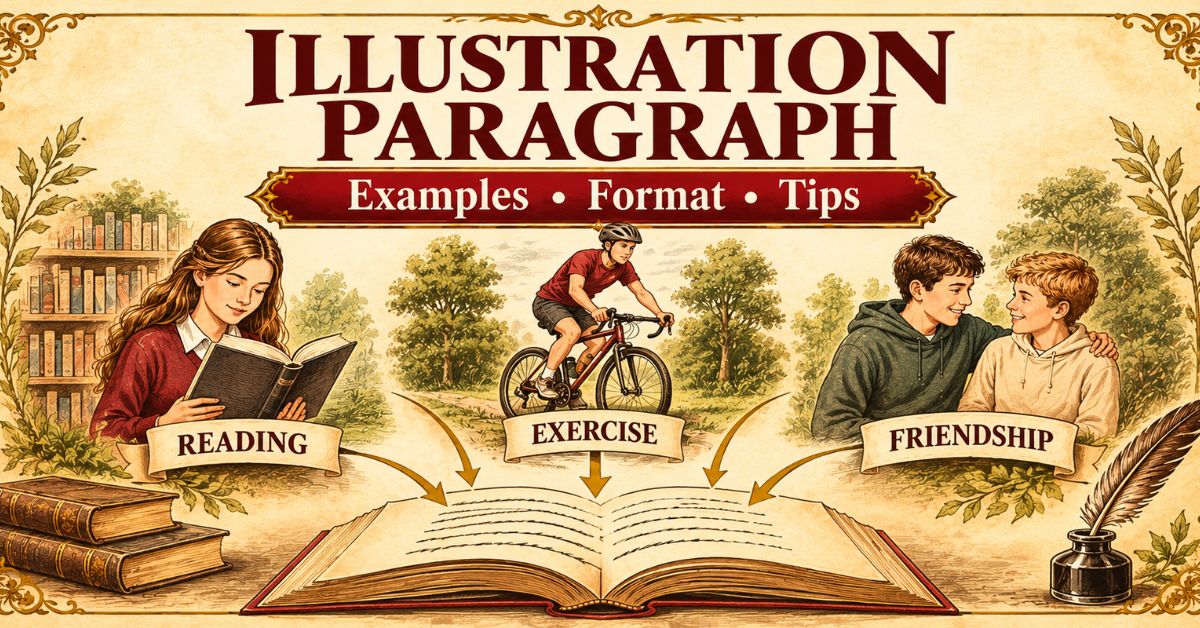
A student may know that reading improves vocabulary but struggle to explain how. A story introduces unfamiliar words, while nearby sentences offer clues to their meanings in context.
An illustration paragraph develops a main idea through specific examples. In illustration writing, the aim is to show readers what a general claim looks like in practice.
What Is an Illustration Paragraph?
An illustration paragraph explains a general idea with specific examples. If the main point is “Exercise is beneficial,” walking can add movement to a daily routine, while cycling offers another way to stay active.
These examples demonstrate the claim instead of merely repeating it. Illustration means clarifying a point through relevant instances, not drawing a picture. Writing to illustrate makes a general statement more concrete for readers.
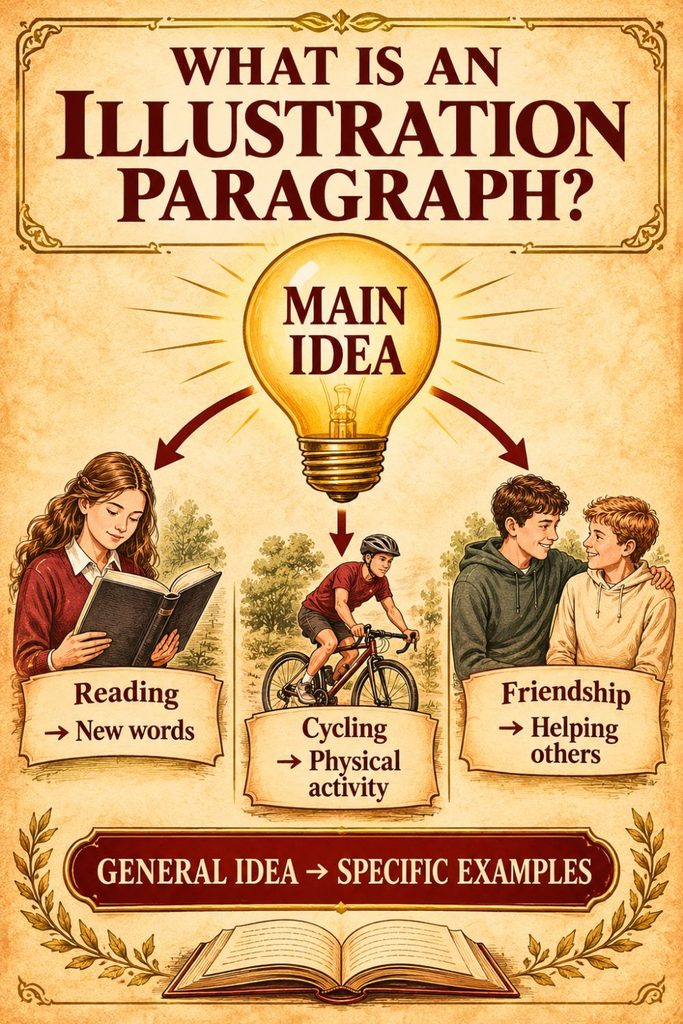
Table of Contents
What Are the Main Features of an Illustration Paragraph?
An effective paragraph usually has four qualities:
- One clear main idea: Every sentence supports the same central point.
- Specific examples: Particular instances develop the claim.
- Relevant explanations: The writer shows how each example supports the point.
- Logical progression: Ideas appear in an order readers can follow.
Writers may develop one example in depth or use several shorter ones. Each detail should clarify the central idea. In my classes, I encourage students to choose examples for their relevance, not simply because they sound interesting.
What Is the Format of an Illustration Paragraph?
An illustration paragraph often contains three parts:
Topic sentence: Introduces the main idea.
Supporting sentences: Give examples and explain what they show.
Concluding sentence: Reinforces the point when a closing sentence is useful.
Topic sentence → Example → Explanation → Additional example → Explanation → Concluding sentence
This pattern is a guide, not a fixed rule. One developed example may be enough; a complex idea may need several. Choose a structure that suits the idea.
How to Write an Illustration Paragraph Step by Step
Step 1: Choose a focused topic
Select a subject narrow enough for one paragraph. “How reading helps students” is manageable; “education” is too broad.
Step 2: Write a clear topic sentence
State one point you can demonstrate. For example: “Reading regularly helps students become more confident language users.”
Step 3: Select suitable examples
Brainstorm instances such as learning words, gaining knowledge from articles, or meeting different perspectives in stories. Keep the strongest examples.
Step 4: Explain the connection
Explain why each example matters. A story may introduce a word in context; a book about another community may introduce unfamiliar customs.
Step 5: Organise and revise
Arrange examples logically and remove distracting details. I ask students, “Does this sentence help prove the topic sentence?” If not, revise or remove it.
A list such as “vocabulary, knowledge, and imagination” names benefits but does not demonstrate them. Explain how a story introduces words or an article teaches a fact.
Illustration Paragraph Examples and Analysis
Example 1: The Importance of Reading
Reading benefits students in several ways. Stories and articles introduce unfamiliar words in context. Nearby sentences may help a student work out a new word’s meaning, and meeting it again can help the student remember it. Reading also builds knowledge. An article about space, for instance, may explain how planets move around the sun and provide a fact to discuss in class. A story about a child growing up in another country may introduce unfamiliar customs and viewpoints. Reading can therefore strengthen language, expand knowledge, and broaden perspectives.
How it works: The opening sentence states the main idea. The examples show how reading can support vocabulary, knowledge, and understanding of other perspectives. The final sentence gathers these benefits together.
Example 2: The Benefits of Regular Exercise
Regular exercise can add movement to everyday life. A student might walk part of the way to school or take an evening stroll with family. Cycling offers another example: riding a bicycle to a nearby shop combines travel with physical activity. Team sports provide a different illustration. During a football match, players communicate, follow rules, and coordinate their efforts. Each activity demonstrates the point differently: walking can fit a daily routine, cycling can make a short journey active, and sport can encourage cooperation.
A weak version says, “Walking, cycling, and football are forms of exercise.” A stronger version explains how each activity illustrates the point.
Example 3: The Qualities of a Good Friend
A good friend shows care through small actions. A friend who listens while you explain a problem helps you feel understood instead of rushing to judge you. Keeping promises matters, too. If a classmate agrees to share notes before a test and remembers to bring them, that action shows reliability. A friend may also help with an assignment by explaining a confusing step and encouraging you to try the next one. These moments show that friendship involves more than having fun. Together, they demonstrate understanding, reliability, and practical support.
Illustration Paragraph Template
Use this template to organise your ideas:
- Topic sentence: State the main idea.
- Example: Give a specific instance.
- Explanation: Show how it supports the point.
- Another example: Add one if needed.
- Closing sentence: Reinforce the main idea if useful.
Adapt the prompts to your topic. Develop one strong example rather than adding a weaker one.
Illustration Paragraph Topics for Practice
Try writing about one of these topics:
- Benefits of reading
- Importance of time management
- Qualities of a good friend
- Ways technology helps students
- Benefits of teamwork
- Characteristics of a responsible student
Choose a focused point and explain how examples support it.
Common Mistakes to Avoid
Four common mistakes weaken illustration paragraphs:
- Listing examples without explanation: Readers may not see how the examples support the point.
- Adding irrelevant details: Interesting information can distract from the topic.
- Repeating one idea: Sentences should develop the point, not simply restate it.
- Using unrelated evidence: Every example should connect to the topic sentence.
Weak: Reading improves vocabulary.
Stronger: Stories introduce unfamiliar words in context, helping readers understand how those words are used.
During revision, check that every supporting detail contributes something useful.
Useful Transition Words for Illustration
Useful transitions include for example, for instance, to illustrate, specifically, in particular, and another example is. Use them to clarify the relationship, not mechanically in every sentence.
Illustration vs. Explanation Paragraph
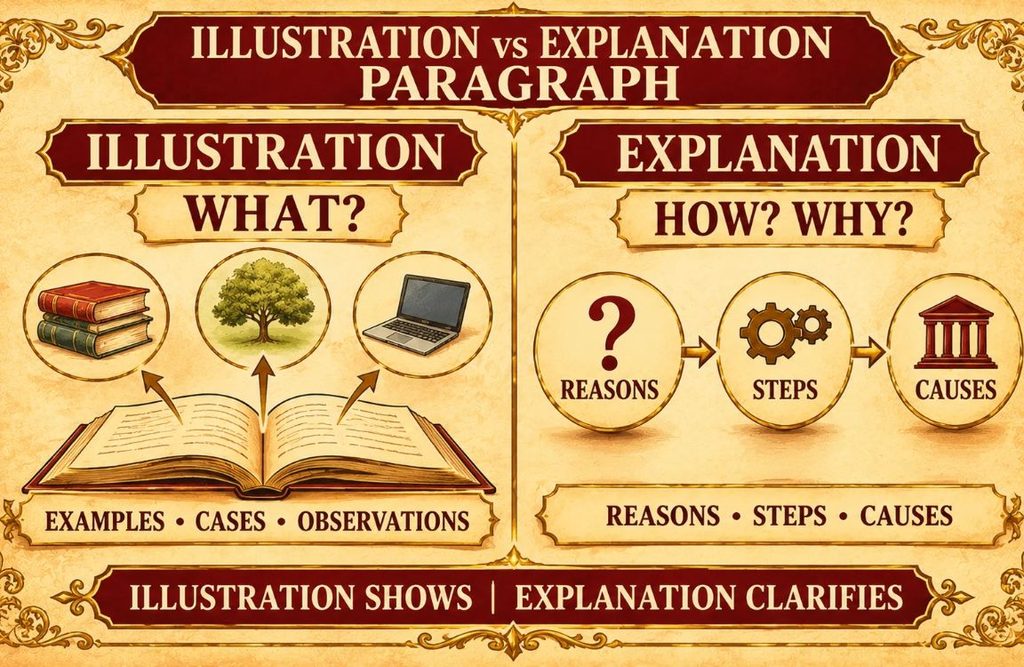
An illustration paragraph mainly demonstrates an idea through examples. An explanation paragraph mainly clarifies how or why something happens. The methods can overlap: an illustration often needs explanation to show why an example matters, and an explanation may use examples to clarify a process.
| Feature | Illustration Paragraph | Explanation Paragraph |
| Main purpose | Demonstrates a point through examples. | Clarifies how or why something happens. |
| Main question | What are some examples? | How does it work, or why does it happen? |
| Common support | Specific cases, observations, or anecdotes. | Reasons, steps, and cause-and-effect links. |
| Example | Stories help students encounter new words. | Context helps readers infer a word’s meaning. |
In the PIE model (Point–Illustration–Explanation), illustration supplies an example; explanation shows why it supports the point.
FAQs:
Can an illustration paragraph contain only one example?
Yes. One example is enough when it is specific and developed enough to demonstrate the main idea.
Does every illustration paragraph need a concluding sentence?
No. A closing sentence can reinforce the point, but a paragraph may end naturally after its final supporting detail.
Can personal experience be used in an illustration paragraph?
Yes. Personal experience works when it is specific, relevant, and suitable for the assignment.
Are illustration paragraphs always persuasive?
No. Examples can clarify an idea without trying to change readers’ opinions.
What is the difference between an illustration paragraph and an illustration essay?
A paragraph develops one point; an illustration essay develops a broader idea across several paragraphs.
Conclusion:
An illustration paragraph works when examples clarify a general idea. Choose relevant instances, explain their significance, and remove distracting details. Practice turns a simple claim into a clear, well-supported paragraph.