
I’ve seen it happen countless times. A student understands the reason behind a problem, but when asked to write it clearly, the ideas scatter like puzzle pieces across the page. That’s the real struggle in academic writing: organizing logic. When teachers assign cause-and-effect tasks, confusion often creeps in. Is it a paragraph? Is it an essay? How much should I explain?
This is where mastering the cause and effect paragraph changes everything. It teaches you how to think logically, connect ideas smoothly, and express reasoning with clarity instead of chaos.
In this guide, I’ll walk you through the structure, format, practical topics, and real cause and effect paragraph examples- plus a simple, step-by-step method you can actually use in exams.
Let’s break it down clearly and confidently.
What Is a Cause and Effect Paragraph?
Let me start with the answer I give in class when someone asks, “Can you define a cause and effect paragraph?”
A cause and effect paragraph is a focused piece of writing that explains why something happens (the cause) and what happens as a result (the effect), using logical connections and clear transitions to show the relationship between ideas.
That’s the exam-ready definition. But let’s breathe life into it.
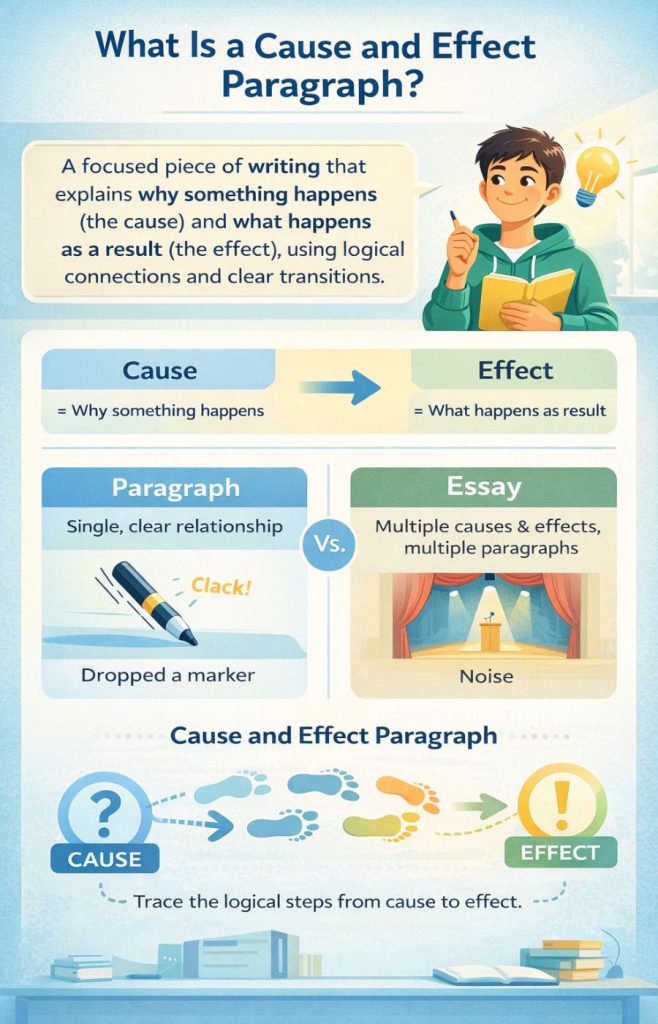
In one memorable class, I dropped a marker on the floor. Clack. Everyone looked up. I asked, “What caused that sound?” A student replied, “You dropped it.” “And the effect?”- “The noise.” Exactly. Cause is the reason. The effect is the result. Simple in life. Often messy in writing.
Cause and effect in writing works the same way. You’re not just telling what happened. You’re explaining why it happened and what followed. It’s like tracing footprints backward and forward at the same time.
Now here’s where students often stumble: they confuse a cause-and-effect paragraph with a cause-and-effect essay. A paragraph develops one clear relationship in a unified structure. An essay expands into multiple causes, multiple effects, and multiple paragraphs. Think of the paragraph as a single spotlight. The essay is the entire stage production.
Master the paragraph first. Control one idea. Then expand the universe.
Also Read, “Compare and Contrast Paragraph Writing: Tricks & Examples“
Structure & Writing Pattern
When I teach this in class, I tell my students: structure is not a cage. It’s a skeleton. Without it, your ideas collapse. With it, they stand tall. If you understand the format of a cause-and-effect paragraph, you stop guessing and start building logically.
1) Cause and Effect Paragraph Structure
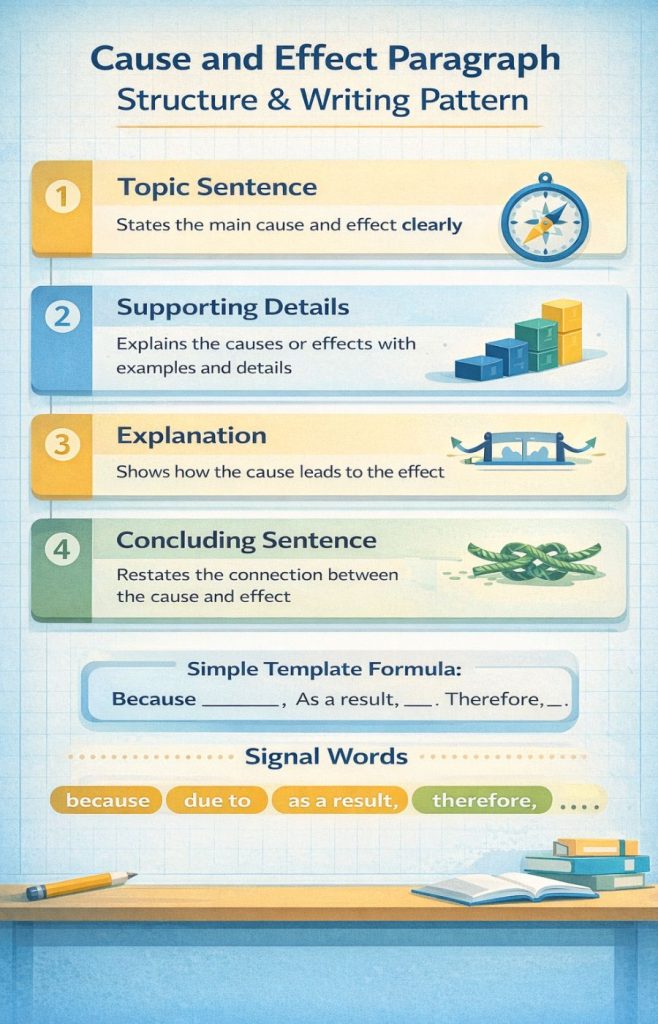
Let me give you the classroom version first, the one I write on the board every year. A strong paragraph has four essential parts:
i) Topic Sentence:
This is your compass. It clearly states the main cause and its effect (or vice versa). No drama. No wandering. Just clarity. For example: “Excessive smartphone use affects students’ academic performance in several negative ways.”
ii) Supporting Details (Causes or Effects):
Here, you expand. If your focus is on one cause, explain multiple effects. If your focus is on one effect, explain multiple causes. This is where your cause and effect paragraph outline becomes visible.
iii) Explanation
Don’t just state ideas, connect them. I often tell students, “Your reader is intelligent but not psychic.” Show how one idea leads to another.
iv) Concluding Sentence
End by reinforcing the relationship. Think of it as tying a knot so your paragraph doesn’t unravel.
When students follow this structure, their writing suddenly breathes.
2) Cause and Effect Paragraph Template (Simple Formula)
Sometimes students ask, “Can you just give us a formula?” Fair enough. Here’s a simple way of organizing the cause-and-effect paragraph:
Topic Sentence: One clear cause/effect statement.
Body Sentence 1: One major cause/effect + explanation.
Body Sentence 2: Another related cause/effect + explanation.
Body Sentence 3 (optional): Further development.
Concluding Sentence: Restate the connection logically.
Fill in the blanks like this:
“Because ___, ___ happens. As a result, ___. Therefore, ___.”
Think of it as a blueprint before you build the house.
3) Cause and Effect Signal Words & Transition Words
Now here’s the magic glue. Without transitions, your ideas feel disconnected. With them, your paragraph flows.
Words like because, due to, as a result, consequently, and therefore act as bridges. They guide the reader through your logic.
For example:
“Due to poor time management, students procrastinate. As a result, their performance declines.”
A well-written cause and effect paragraph with signal words feels smooth, almost inevitable- like dominoes falling in perfect order.
And once you control that flow, writing stops feeling like confusion and starts feeling like power.
How to Write a Cause and Effect Paragraph (Step-by-Step Guide)
Every year, a student asks me, “I understand the idea, but how do I actually write it?” That question is gold. Writing isn’t guessing; it’s building. So let me walk you through this the way I do in class- step by step, logically, confidently, and without panic.
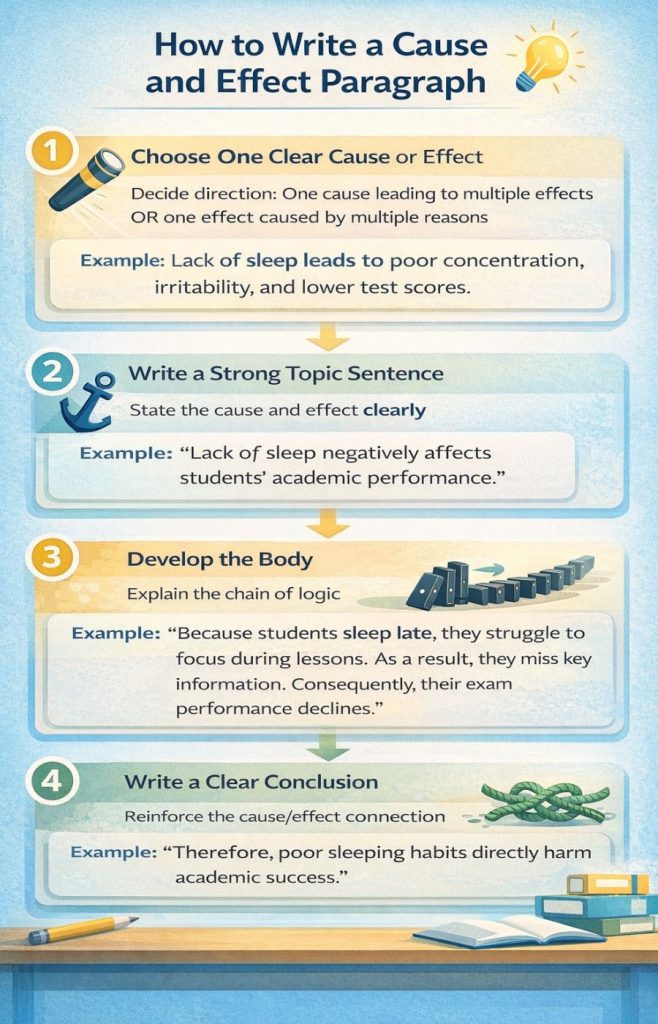
Step 1: Choose a Clear Cause or Effect
The biggest mistake I see? Students try to explain everything. Don’t do this. Focus is power.
First, decide: are you explaining one cause with multiple effects, or one effect with multiple causes? Choose one direction. If your topic is “poor time management,” decide whether you’re exploring what causes it or what it leads to.
In class, I say to my students: Imagine a flashlight in a dark room. Your paragraph is that beam. It cannot light up the entire building. It must shine on one clear relationship.
Clarity at this stage prevents confusion later. Writing improves dramatically when thinking becomes precise.
Step 2: Write a Strong Topic Sentence
Now comes the anchor. If you’ve ever wondered how to write a topic sentence for a cause and effect paragraph, here’s my rule: state the relationship clearly and confidently.
Weak: “There are many problems in school.”
Strong: “Lack of sleep negatively affects students’ academic performance.”
Notice what happens? The cause and effect are both visible. No mystery. No fog.
I often tell my students, “Your topic sentence is a promise.” It tells the reader what logical journey they’re about to take. Avoid vague phrases. Avoid storytelling here. Be direct. A clear topic sentence turns scattered thoughts into a guided path.
Step 3: Develop the Body Paragraph
This is where your reasoning must breathe. When writing the body of a cause-and-effect paragraph, each sentence should logically grow from the previous one.
Let’s say your cause is lack of sleep. What are the effects? Poor concentration. Irritability. Lower test scores. Now don’t just list them, explain them.
“Because students sleep late, they struggle to focus during lectures. As a result, they miss key information. Consequently, their exam performance declines.”
See the chain? Cause → Immediate effect → Extended consequence.
I remind my students: your reader is following footprints. If one step is missing, they stumble. Logical flow matters more than fancy vocabulary. Build the connection carefully, sentence by sentence.
Step 4: Write a Clear Concluding Sentence
Finally, close the loop. When writing a cause and effect paragraph, your conclusion should reinforce the connection—not introduce something new.
Simple cause and effect paragraph sentence starters help:
“Therefore, …” “As a result, …” “For this reason, …”
Common mistake? Repeating the exact topic sentence or adding a new idea. Don’t.
Think of your concluding sentence as tying a knot at the end of a thread. Once secured, your paragraph feels complete, logical, and satisfying to read.
Cause and Effect Paragraph Examples (With Analysis)
Students always tell me, “Examples help more than rules.” And they’re right. Structure is the skeleton, but examples are the heartbeat. So let me show you real cause and effect paragraph examples, then dissect them like we would in class.

Example 1: Climate Change Cause and Effect Paragraph
Here’s a climate change cause-and-effect paragraph I often analyze with my students:
Climate change is primarily caused by excessive greenhouse gas emissions from human activities. When industries burn fossil fuels, large amounts of carbon dioxide are released into the atmosphere. As a result, heat becomes trapped, raising global temperatures. Consequently, glaciers melt, sea levels rise, and extreme weather events become more frequent. Due to these environmental shifts, many communities face food shortages and displacement. Therefore, human-driven pollution directly contributes to global climate instability.
Now pause. Notice the clarity? One main cause: greenhouse gas emissions. Multiple effects: rising temperatures, melting glaciers, extreme weather.
In class, I remind my students that this paragraph works because it follows a domino pattern. Push the first tile, industrial pollution, and everything else logically falls. No emotional exaggeration. No random statistics. Just cause → effect → extended consequence.
That’s the secret behind strong cause and effect paragraph examples: controlled expansion, not scattered panic.
Example 2: Road Accident Cause and Effect Paragraph
Now let’s look at a paragraph on the major causes of road accidents and their effects:
Reckless driving is a major cause of road accidents. When drivers ignore speed limits, they reduce their reaction time. As a result, sudden obstacles become impossible to avoid. Consequently, collisions occur more frequently, leading to injuries and loss of life. Therefore, careless driving directly increases the risk of fatal accidents.
When I read this aloud in class, I ask: “Where does the logic break?” It doesn’t. The paragraph stays focused on one cause- reckless driving. It doesn’t suddenly talk about bad roads or weather. That discipline matters.
Students often want to include everything. But remember what I say: one flashlight, one direction. A strong road accident cause and effect paragraph doesn’t wander. It builds pressure logically, step by step.
Example 3:Drug Addiction Cause and Effect Paragraph
Here’s a paragraph on the main causes and consequences of drug addiction:
Peer pressure is a significant cause of drug addiction among teenagers. When young people seek acceptance, they may experiment with harmful substances. As a result, occasional use can turn into dependency. Consequently, addiction damages health, weakens family relationships, and disrupts education. Therefore, social influence plays a critical role in the development of substance abuse.
When I teach this, the classroom grows quiet. Because this topic is real. Emotional. Human.
And that’s important: strong writing doesn’t mean dramatic writing. It means logical progression. Notice again, one cause (peer pressure), multiple effects (dependency, health damage, family issues).
The chain is clear. The message is powerful.
Short Example for Grade 5
Now, for younger learners, simplicity wins. Here’s one of my favorite cause-and-effect paragraph examples for grade 5:
Because Tom forgot to water his plant, it began to dry. As a result, the leaves turned brown. Therefore, Tom learned to take better care of his garden.
See? Even short cause and effect paragraph examples follow the same rule: clear cause, visible effect, logical ending.
Whether you’re in Grade 5 or preparing for exams, the principle never changes. Writing is not magic. It’s the cause. It’s the effect. And when you control the connection, you control the paragraph.
Cause and Effect Paragraph Topics for Students (Clear & Exam-Ready)
Every exam season, I see the same expression- half panic, half hope.
“What are the best cause and effect paragraph topics?”
And I say what I always say: don’t chase fancy. Chase logic. The best topics are the ones where one action clearly leads to another. If you can already see the domino effect, you’re on the right track.
Let me organize this the way I do in class- clean, practical, and ready for exams.
What Are Cause and Effect Paragraph Topics?
Cause and effect paragraph topics are subjects that allow students to explain why something happens (cause) and what happens as a result (effect). A strong topic clearly connects actions and consequences in a logical chain.
If you struggle to find at least three effects, the topic may be too narrow.
1. Social Cause and Effect Paragraph Topics
Social issues work beautifully because society itself runs on cause and consequence. Students rarely struggle to find effects. They usually find too many.
- Why prices rise and how it affects daily life
- The root causes and consequences of drug addiction
- What leads to unemployment and its social impact
- How poverty begins and what it results in
- The cycle of corruption and its long-term effects
- The reasons behind cyberbullying and its emotional damage
- Teenage crime: causes and social outcomes
- Social media addiction and its academic consequences
- How online education influences student performance
- Overpopulation and its pressure on resources
Social problems rarely have just one result. One cause multiplies into many effects, and that makes for a strong paragraph.
2. Environmental Cause and Effect Paragraph Ideas
Nature is the ultimate chain reaction. One human action can trigger a series of environmental responses.
- Climate change: major causes and global consequences
- The connection between global warming and extreme weather
- Deforestation and its ecological impact
- Air pollution and its effects on public health
- How water pollution damages ecosystems
- Plastic waste and its long-term environmental cost
- What causes flooding in urban areas
- Drought and its impact on agriculture
- Biodiversity loss and why it matters
- Urbanization and environmental imbalance
Environmental topics almost teach the structure themselves. Human action. Natural reaction. Clear logic.
3. Personal and Family Cause and Effect Paragraph Topics
Now we move closer to home, where writing becomes personal and thoughtful.
- Family conflicts: underlying causes and emotional effects
- Poor communication and relationship breakdowns
- Time mismanagement and academic decline
- Excessive screen time and its psychological impact
- Sleep deprivation and reduced productivity
- Parental pressure and student anxiety
- Financial stress and its effect on family harmony
- Sibling rivalry and long-term relationships
- Unhealthy lifestyles and their physical consequences
- Strong study habits and improved academic performance
These topics feel real. And when a topic feels real, your writing becomes clearer.
How to Choose the Best Cause and Effect Paragraph Topic
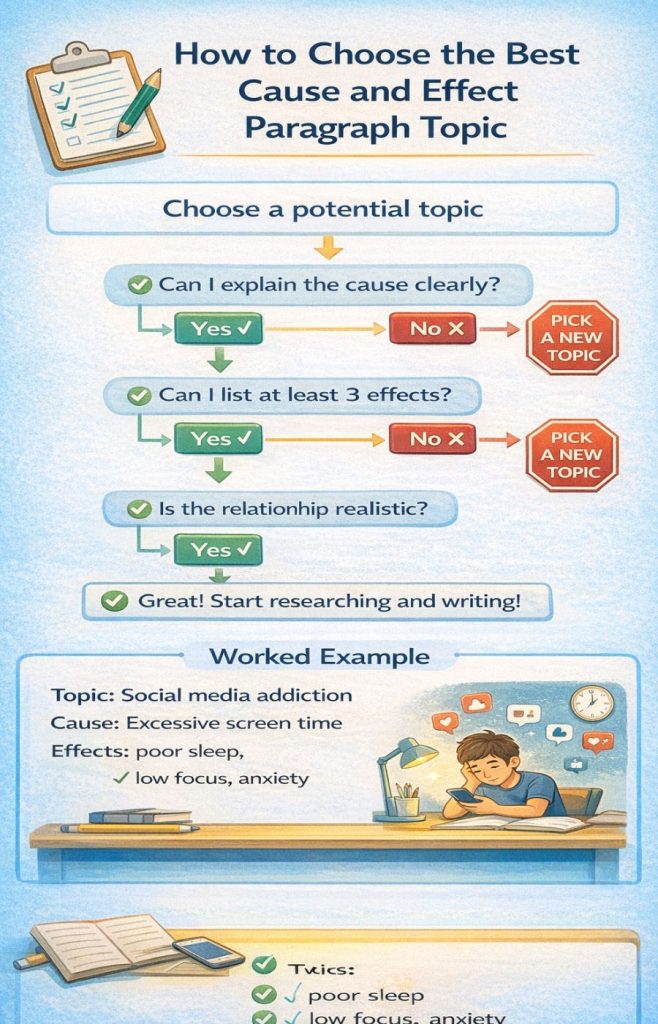
When choosing from these cause and effect paragraph topics, ask yourself:
- Can I clearly explain the cause?
- Can I identify at least three logical effects?
- Is the relationship realistic and easy to prove?
If the answer is yes, you have a strong exam-ready topic.
Quick Example (How to Think Before You Write)
Topic: Causes and effects of social media addiction
Cause:
- Excessive daily screen time
Effects:
- Reduced concentration
- Poor sleep habits
- Increased anxiety
See how the chain builds naturally? That’s what examiners look for- clear logic, not complicated vocabulary.
Strong writing begins with strong thinking. Choose a topic where the cause sparks visible consequences, and your paragraph will practically build itself.
Cause and Effect Paragraph for Different Academic Levels
One truth I remind every batch: expectations grow as you grow. A cause and effect paragraph for high school is not judged the same way as one in college. The structure stays- but depth, clarity, and analysis must level up.
i) Cause and Effect Paragraph for High School
In high school, clarity is king. Examiners look for one clear cause, logical effects, and proper transitions.
Example:
Lack of regular study habits affects students’ performance. When students procrastinate, they fail to revise lessons properly. As a result, they feel unprepared during exams. Therefore, inconsistent study routines lead to lower academic achievement.
Notice, simple vocabulary, direct logic. That’s what a cause and effect paragraph for high school should do: show control, not complexity.
ii) Cause and Effect Paragraph for Secondary Level
Now at the secondary level or high school, examiners expect slightly deeper reasoning and stronger cohesion.
Example:
Excessive social media use reduces students’ concentration. Because students spend hours scrolling, their study time decreases. Consequently, they struggle to retain information and perform poorly in examinations. Thus, digital distraction significantly impacts academic success.
Here, a cause and effect paragraph for secondary level must feel mature- clear, focused, and logically developed.
iii) Cause and Effect Paragraph for College
College demands analysis, not just explanation.
Example:
Economic inflation widens social inequality. As living costs rise, low-income families experience financial instability. Consequently, access to education and healthcare declines, reinforcing long-term disparity. Therefore, inflation functions not only as an economic issue but as a social catalyst.
A cause and effect paragraph for college must show layered thinking. Same structure. Deeper insight.
Common Mistakes in Writing a Cause and Effect Paragraph
Every year, I collect answer scripts and see the same pattern. Students understand the idea, but the execution trips them.
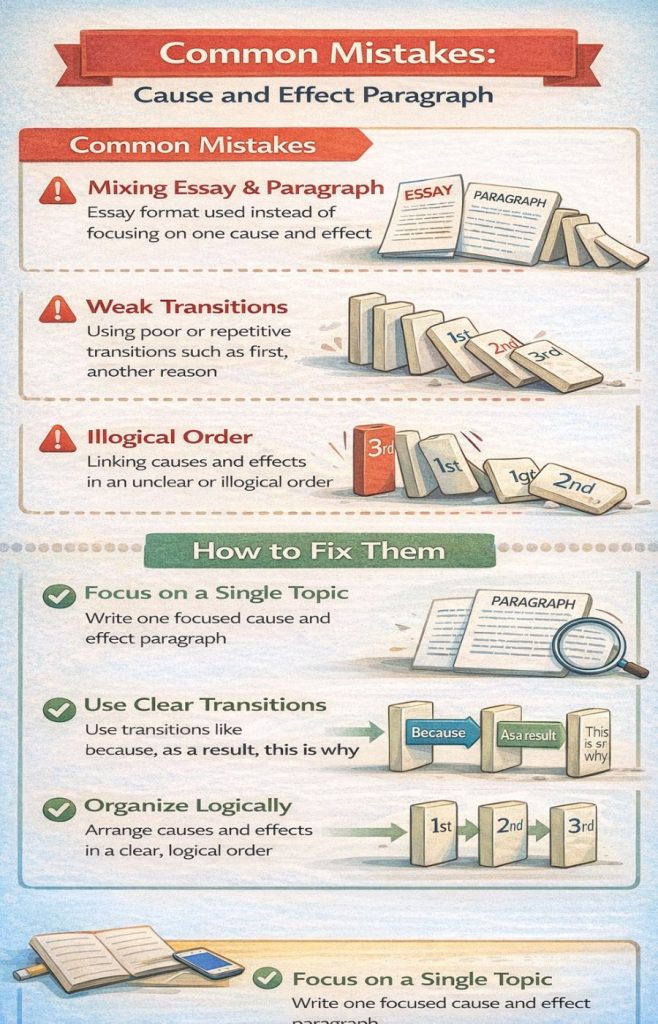
First mistake? Mixing essay structure with paragraph structure. A paragraph is a focused unit. When students start adding multiple unrelated causes, like they’re writing a full essay, the logic collapses. Remember the cause and effect pattern: one clear direction, carefully developed.
Second mistake? Weak transitions. Without words like “because,” “as a result,” or “therefore,” your ideas feel like disconnected islands. Even a good cause-and-effect writing example loses power without bridges.
Third mistake? No logical order. If effects appear before causes, or explanations skip steps, the reader gets lost. Writing should feel like dominoes falling, not puzzle pieces scattered.
FAQs:
How many sentences should a cause-and-effect paragraph have?
A strong cause and effect paragraph usually has five to seven sentences. One topic sentence, two or three supporting explanations, and one concluding sentence. It’s not about length. It’s about clarity, focus, and showing one logical relationship completely and convincingly.
What is the difference between a cause and effect essay and a paragraph?
A cause and effect paragraph focuses on one clear relationship in a single, unified section. A cause and effect essay expands that idea into multiple paragraphs, exploring several causes, several effects, or both, with a full introduction and conclusion.
What are good cause and effect paragraph topics?
Good cause and effect paragraph topics show a clear chain reaction. Choose subjects like social media addiction, climate change, poor study habits, or reckless driving- topics where one cause naturally leads to logical, visible consequences you can explain clearly.
Final Thought:
I tell my students this every year: mastering the cause and effect paragraph is not just about passing exams. It’s about learning to think clearly.
Academically, it sharpens analytical writing. Logically, it trains your mind to see relationships between actions and consequences. Practically, it strengthens every other form of structured writing you’ll attempt.
When students learn to control cause and consequence on paper, something shifts. Their arguments become sharper. Their explanations become convincing. And slowly, writing stops feeling like guesswork and starts feeling like power.