A compare and contrast paragraph examines two subjects to identify meaningful similarities and differences, helping readers analyze relationships rather than simply list traits.
Now, if I had a coin for every time a student asked, “Sir, do I just write similarities and differences?” I’d have funded my own library by now. Because here’s the truth: it’s more than a list. It’s a thinking exercise in disguise.
When we practice compare and contrast in writing, we place two ideas side by side and ask a sharper question: What do these similarities and differences actually mean? That’s the turning point. In my classroom, pencils pause mid-air right there.
Comparing is like holding two mirrors up to each other- you start noticing details you’d miss alone.
In this guide, I’ll walk you through the definition, the purpose, and the structure of a compare and contrast paragraph, with clear examples and practical classroom tools. We’ll move from confusion to clarity, from listing to analyzing.
So, don’t rush. Read like a detective….
Table of Contents
What Is a Compare and Contrast Paragraph?
A compare and contrast paragraph is a focused piece of writing where I examine two subjects side by side to reveal meaningful similarities and differences, helping readers understand ideas more clearly, not just notice surface-level traits.
i) Simple Definition for Students:
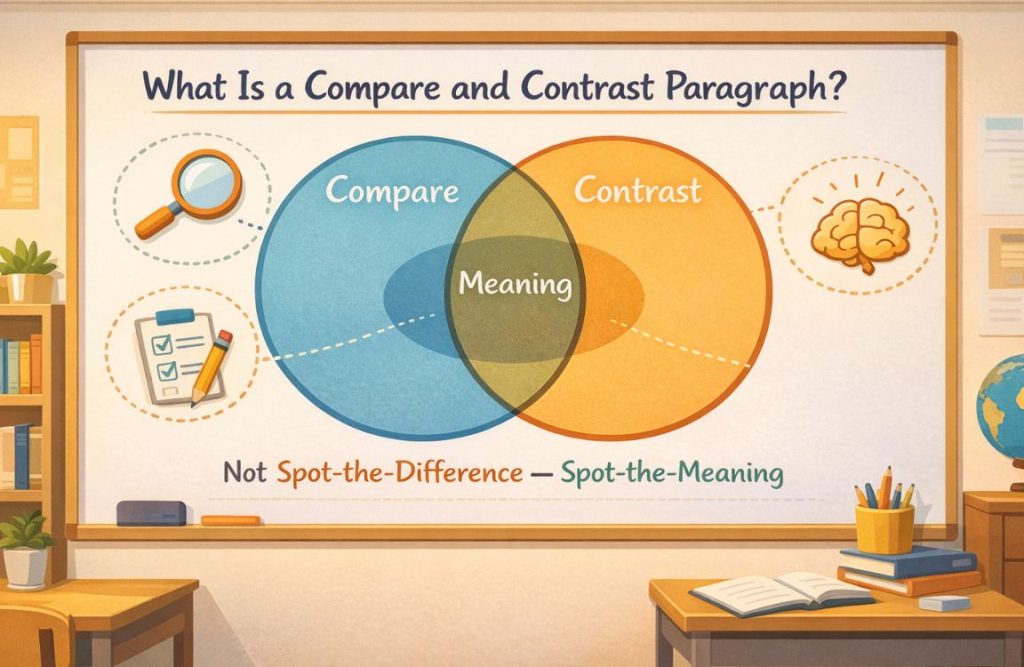
When I explain this in class, I say: “You’re not playing spot-the-difference. You’re playing spot-the-meaning.” The definition of a compare and contrast paragraph is simple: it’s a paragraph that shows how two things are alike (compare) and how they are different (contrast).
The meaning of comparison and contrast lies in thinking, not listing. Comparing is like circling what overlaps. Contrasting is like underlining what stands apart.
In one sentence, here’s my classroom version: Compare and contrast writing helps us decide, judge, or understand by placing ideas under the same spotlight. When done right, your paragraph doesn’t just show differences. It explains why they matter.
Read Also, “All Types of Paragraphs in English: In-Depth Analysis“
ii) Compare vs Contrast Explained with Examples:
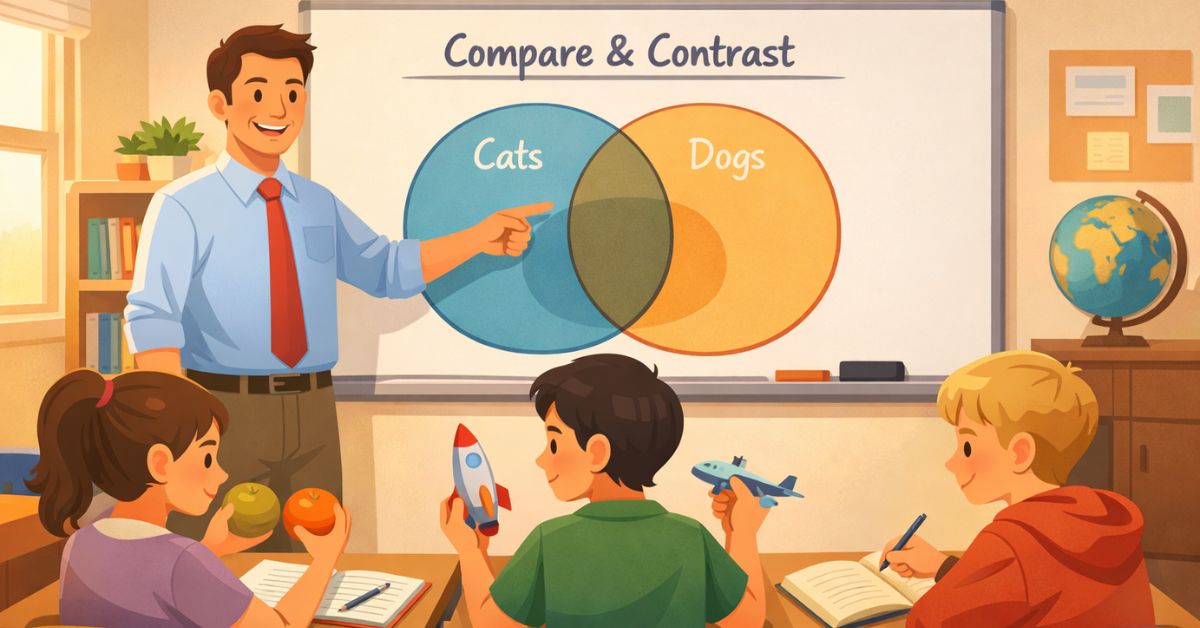
Here’s the moment in class when I draw two circles on the board and watch faces light up. Compare and contrast is not a tug-of-war. It’s a balancing act. When I compare, I look for similarities and differences that connect ideas- shared habits, purposes, or traits.
When I contrast, I zoom in on the differences that create tension and meaning. Think cats and dogs. Both are pets, both demand food at inconvenient times. That’s a comparison.
But cats negotiate affection like diplomats, while dogs offer it like fireworks. That’s contrast. I tell my students: comparing builds bridges; contrasting shows borders. Strong writing uses both. If you only compare, everything blurs. If you only contrast, nothing relates. The magic happens when you let both speak.
Compare vs. Contrast Paragraph: Quick Difference Table
| Uses words like “however,” “on the other hand.” | Contrast |
| Shows similarities | Shows differences |
| Builds connections | Highlights distinctions |
| Uses words like “similarly,” “likewise” | Uses words like “however,” “on the other hand” |
Purpose of a Compare and Contrast Paragraph Writing
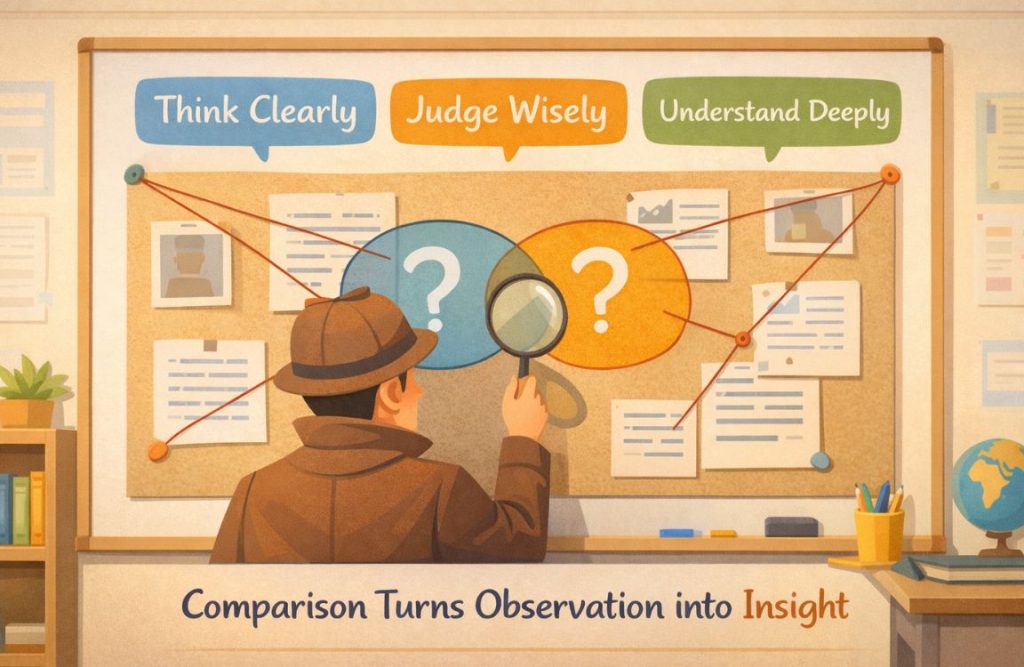
The purpose of the compare and contrast paragraph is simple but powerful: it helps writers examine similarities and differences to think clearly, judge wisely, and understand ideas more deeply. It turns observation into insight, not lists.
i) Why Writers Use Compare & Contrast:
In my classroom, this is where thinking gets sharper. Writers use comparison and contrast the way detectives use clues. By weighing similarities and differences, they analyze ideas instead of memorizing them. Suddenly, choices appear: Which is better? Why does this matter?
I tell students it’s like holding two mirrors- each subject reflects the other more clearly. Comparing and contrasting helps us untangle confusion, clarify opinions, and make thoughtful judgments rather than vague statements. Good writing loves clarity.
ii) Academic & Exam Importance:
Let me be honest- teachers assign this because it reveals how students think. Examiners love it for the same reason. A strong compare-and-contrast paragraph shows control, logic, and balance. Where do students lose marks?
Usually, by listing similarities and differences without explaining why they matter. I remind them: exams don’t reward spotting differences; they reward meaningful comparison. Insight earns marks, not bullet points.
Structure of a Compare and Contrast Paragraph
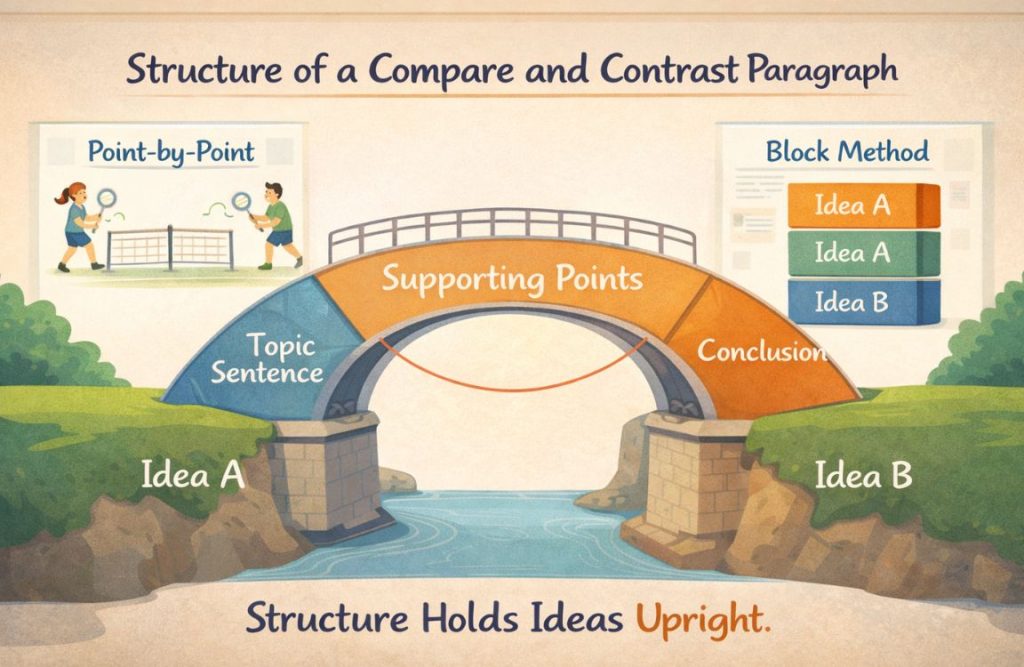
The compare and contrast paragraph structure gives your ideas a backbone. Without it, even smart comparisons collapse. With it, your thoughts stand upright, balanced, and convincing- like a well-built bridge connecting two ideas.
i) Basic Paragraph Structure Explained:
In my classroom, I call this the “spine” of thinking. A strong compare and contrast paragraph format begins with a topic sentence that clearly names what’s being compared and hints at the insight ahead.
Then come the supporting points, where each similarity or difference is explained with focus, not fluff. I often pause mid-lesson and ask, “Does this sentence earn its seat?”
Finally, the concluding sentence ties the comparison together, showing what we’ve learned- not just what we listed. Without this structure, paragraphs ramble like students before the bell. With it, they walk out confident.
ii) Point-by-Point Method:
The point-by-point compare and contrast paragraph is my go-to when ideas need balance. Here, you compare one feature at a time across both subjects.
For example, when comparing online classes and classroom learning, you discuss interaction in both, then flexibility in both. I tell students it’s like a tennis match- idea goes over the net, comes right back.
This method works best when subjects are closely related, and the reader needs clarity. In exams, this structure shines because it keeps comparisons tight and prevents accidental drifting into storytelling mode.
iii) Block Method Explained:
The block method of compare and contrast paragraphs groups ideas by subject instead of features. You discuss everything about Subject A first, then move fully to Subject B.
This works beautifully when differences are big or when one subject needs context. But here’s the classic student trap I see every year: forgetting to compare. They describe, describe, describe, and forget to connect.
I warn them: a block method without clear contrasts is just two mini-paragraphs wearing a trench coat. The magic lies in the transitions that remind readers why the comparison matters.
Topic Sentence & Transitions
If structure is the skeleton, the topic sentence for compare and contrast is the heartbeat. This is where your paragraph promises insight. Transitions, meanwhile, guide readers gently- like classroom cues that say, pay attention, this part matters.
i) Writing a Strong Topic Sentence:
I always tell my students: a good topic sentence doesn’t whisper. It leads. It clearly names the two subjects and signals how they’ll be examined. In class, I’ll write a weak version first:
Cats and dogs are different animals.
Yawn. That’s a roll call, not thinking.
Now the upgrade:
Although both cats and dogs are popular pets, they differ sharply in independence and daily care.
Suddenly, we know where we’re going. A strong topic sentence frames the comparison, hints at judgment, and sets boundaries so the paragraph doesn’t wander.
When students revise, I ask them one question: Does your topic sentence make me curious enough to keep reading? If not, rewrite.
ii) Transition Words for Compare & Contrast:
Transitions are the traffic signals of comparison. Without them, ideas crash. For similarities, I train students to reach for words like similarly, likewise, and in the same way.
For differences, we slow down and pivot with however, on the other hand, or in contrast. Here’s my favorite live-teaching moment: I read a paragraph aloud and stop every time a transition is missing.
The silence gets awkward, fast. That’s when students feel why transitions matter. My quick classroom tip? Circle your transitions after writing. If you see none, your comparison is probably hiding instead of speaking.
How to Write a Compare and Contrast Paragraph
When students ask me how writing a compare and contrast paragraph actually works, I smile. It’s less about fancy language and more about smart decisions- like choosing the right lens before you start looking closely.
i) Step-by-Step Writing Process:
In my classroom, this is the moment where pens hover, and panic sets in. So I slow it down. First, choose two subjects that genuinely connect- apples and oranges work; apples and airplanes do not.
Next, decide your focus. Are you highlighting similarities, differences, or both? Without that decision, your paragraph will zigzag.
Then, plan your structure. I tell students to sketch before sprinting. A quick outline saves a rewrite later. After that, write your topic sentence, the promise you make to your reader. If the promise is unclear, the paragraph will break it.
Now comes the work: add details. Each sentence should earn its place by supporting the comparison. Facts, examples, and explanations are your evidence, not decoration.
Finally, conclude with intention. A good ending doesn’t repeat; it reveals. When students follow these steps, something magical happens. Their thinking becomes visible, and confidence replaces confusion.
ii) How to Start a Compare and Contrast Paragraph:
Starting is where students freeze. I get it- first sentences feel like spotlights. I teach a few hooks that actually work. You can begin with a surprising contrast: Both phones connect us, but only one controls our attention.
Or try a shared similarity before the split: At first glance, online and in-person classes seem alike. You can even open with a gentle judgment, hinting at where the paragraph is heading.
The key to starting a compare and contrast paragraph is direction. If your first line points somewhere meaningful, the rest of the paragraph will follow- like students lining up once the bell rings.
Examples of Compare and Contrast Paragraphs
This is the moment my students wait for- the “show me” part. Examples turn theory into something touchable. When you see a paragraph working, you stop guessing and start thinking, Oh… I can do this.
i) Simple Example (Elementary Level)
Cats and dogs are both popular pets, but they are different in many ways. Both animals can be friendly and fun to have at home. However, cats are usually quiet and like to be alone, while dogs enjoy playing and need more attention. Cats clean themselves and stay indoors, but dogs often go outside for walks. Because of these differences, cats are easier to care for, while dogs are better for people who like active pets.
(In class, this is where students nod- clear, simple, and focused.)
ii) Intermediate Example (Middle School)
Online learning and classroom learning both help students gain knowledge, but they offer different experiences. In both settings, students attend lessons and complete assignments. However, online learning allows flexibility, while classroom learning provides face-to-face interaction. Online students work independently, whereas classroom students benefit from immediate feedback. These differences show that learning style and discipline play an important role in choosing the right environment for success.
(Here, I point out how ideas are grouped- not random, but purposeful.)
iii) Advanced Example (High School)
Leadership and authority may appear similar, but they function differently. Both involve guiding others toward goals. However, leadership inspires through trust and example, while authority relies on position and power. A leader motivates willingly, whereas authority often demands obedience. This contrast suggests that influence lasts longer when respect, not control, drives action. Understanding this distinction helps explain why some figures are followed, and others merely obeyed.
(This is where analysis quietly enters the room.)
iv) Annotated Sample Paragraph
Topic Sentence: Books and movies tell stories differently, even when they share the same plot.
Comparison Points: Both entertain audiences and communicate themes. Books rely on imagination, while movies use visuals and sound. Books explore inner thoughts deeply, whereas movies show emotions through action and dialogue.
Conclusion: These differences explain why stories feel richer on the page but faster on the screen.
(I tell students: once you can label it, you can control it.)
By the end of this section, students don’t just read paragraphs. They see the bones beneath the skin. And that’s when writing stops being scary and starts becoming strategic.
Compare and Contrast Essay vs Paragraph
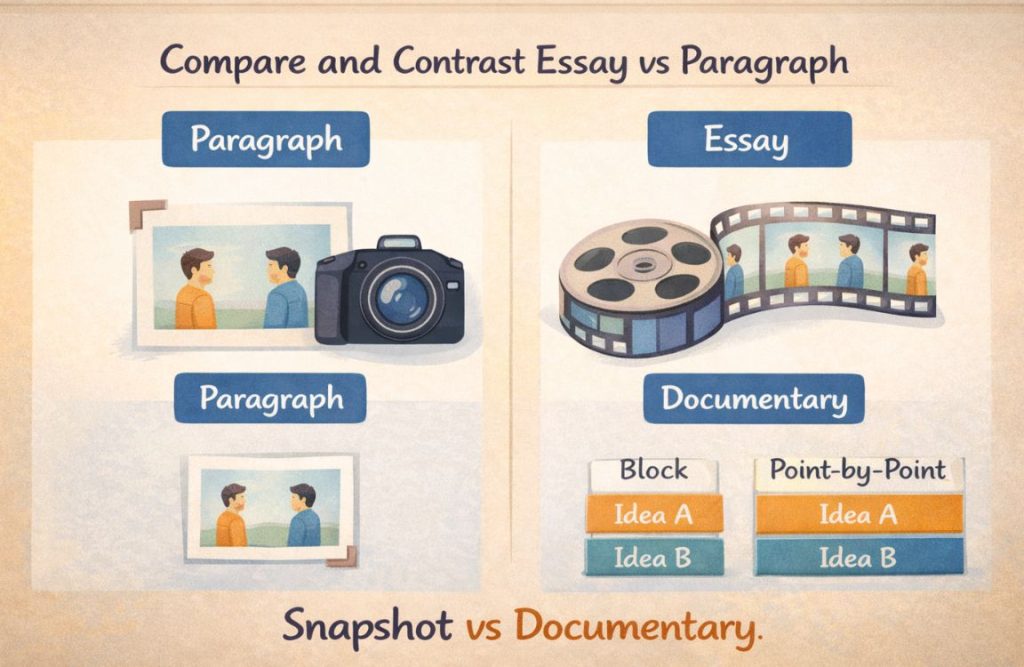
A compare and contrast paragraph develops one focused point in a single paragraph, while a compare and contrast essay expands the comparison into multiple structured paragraphs with a clear introduction, body, and conclusion.
A block essay discusses all points about Subject A first, then Subject B. An alternating (point-by-point) essay compares both subjects side by side for each criterion.
Now, let me say this the way I tell my class: a paragraph is a snapshot; an essay is a full documentary. When I ask students to compare two characters, some give me one chunky paragraph. That’s fine- if the task is small. But an essay? That’s architecture. It needs rooms.
In a block essay, you finish everything about A before moving to B. In an alternating essay, you juggle both like a skilled performer- point by point. Choose wisely. Structure is not decoration; it is meaning.
Common Mistakes (And How I Catch Them)
Students often list similarities without analysis- like grocery items with no recipe. Others compare unrelated subjects (apples and algebra?).
Weak topic sentences blur direction. No transitions make writing jumpy. And worst of all? Forgetting to explain why the comparison matters. I always ask: So what? If you can’t answer that, the comparison collapses.
FAQs:
Can a Compare and Contrast Paragraph Be Only Similarities or Only Differences?
Yes, but it must still analyze meaning. A paragraph may focus mainly on similarities or mainly on differences, as long as it maintains a clear purpose and insight.
How Long Should a Compare and Contrast Paragraph Be?
Typically, 8-12 well-developed sentences. It should include a strong topic sentence, 2-3 comparison points, an explanation, and a concluding insight.
What is the difference between block and point-by-point method?
The block method discusses one subject fully before moving to the other, while the point-by-point method compares both subjects side by side under shared criteria. I tell my students: block feels like two mini-essays; point-by-point feels like a conversation.
How many points should a compare and contrast paragraph include?
A strong compare and contrast paragraph usually includes two to three meaningful points of comparison. In my classroom, I remind students: depth beats quantity. It’s better to analyze two strong similarities or differences than to list five weak ones.
What are good topics for compare and contrast paragraphs?
Good compare and contrast topics involve two subjects with meaningful similarities and differences, such as online vs. traditional learning or city life vs. village life. I always advise students: choose topics that allow analysis, not just obvious comparisons.
Conclusion:
Every time I wrap up this lesson, I see the same spark- the moment students realize they’re not just listing facts. They’re thinking. A compare and contrast paragraph is really a pair of glasses: it helps you see ideas more clearly by placing them side by side.
When you learn to balance insight with structure, your writing stops wandering and starts arguing. I always tell my class: this skill isn’t just for exams or essays. It’s for life.
We constantly weigh options, judge choices, and notice patterns. Write thoughtfully, guide your reader gently, and let your comparisons do the quiet convincing. That’s when a paragraph stops being homework and starts being power.