
Have you ever opened your English book or read an article and felt like the page looked more like a forest than a lesson? Everything feels jumbled together- no space, no breaks, just a jungle of words.
That, my dear students, is what happens when writing forgets to breathe- when it appears without paragraphs.
A paragraph is the oxygen of your writing. In simple terms, a paragraph is a group of related sentences that focus on one main idea. It gives your ideas a home, your thoughts a direction, and your reader a place to pause before moving on. Thus, the paragraph makes reading interesting and enjoyable. Without them, writing would be like a marathon with no water breaks!
So, as your friendly neighbourhood English teacher, let’s answer a simple but powerful question: what is a paragraph?
In this lesson, you’ll learn:
- The definition of a paragraph
- The structure of a paragraph
- The main types of paragraphs
- How a paragraph is developed, with simple examples
Now take a deep breath- just like a good paragraph does- and let’s dive in together.
Who Is This Guide For?
This guide is for school students, ESL learners, and anyone who wants to understand paragraph writing without fear or confusion. If you’ve ever stared at a blank page wondering where to begin, this lesson is for you- clear, simple, and taught the way I teach in class.

What is a Paragraph in English? (Definition for Students)
Alright, here’s the simple truth: a paragraph is a group of sentences that focus on one single idea. Just one. Not two, not three- one. Think of it like a classroom. If everyone starts talking about different subjects- math, cricket, K-pop- the class turns into chaos.
A paragraph in English works the same way. Every sentence must connect to the same main idea. That’s what makes it clear, focused, and easy to read.
In a textbook paragraph, this idea is usually organized in a simple structure. It begins with a topic sentence, which acts like the leader of the group and tells the reader what the paragraph is about. Next come the supporting sentences. These explain the idea, give examples, or add details. Finally, there is a concluding sentence, a neat wrap-up that brings the idea to a close.
In short:
A paragraph = Topic Sentence + Supporting Sentences + Concluding Sentence.
So, what does a paragraph look like? On the page, it appears as a small block of related sentences, separated from others by space or indentation. This separation helps readers pause, understand one idea clearly, and then move on.
Now, many students ask me, “Sir, how long should a paragraph be?” Think of it like a plate of biryani- enough to satisfy, not so much that it feels heavy. In general writing, there is no fixed length for a paragraph. Usually, 3 to 7 lines or 80-120 words work perfectly. But, in advance writing, the idea decides the paragraph length.
If you like clear answers at a glance, here’s a simple classroom table I often draw on the board.
| Purpose | Ideal Length |
| School exam writing | 5–7 sentences |
| ESL practice | 4–6 sentences |
| Academic writing | Idea-based |
Table of Contents
Paragraph Writing at a Glance
Alright, pause with me for a moment. This is your quick classroom recap. If paragraphs ever feel confusing, come back to this box and breathe.
i) A paragraph focuses on one clear main idea (no multitasking allowed).
ii) It follows a simple structure: topic sentence → supporting sentences → concluding sentence.
iii) In school writing, a paragraph usually has 5–7 sentences– balanced and exam-friendly.
iv) Paragraphs keep writing clear, readable, and organized, so your ideas don’t trip over each other.
Think of this as your paragraph cheat sheet– short, sharp, and always reliable when your brain goes blank in an exam.
What Does a Paragraph Look Like? (Structure Explained)
When students ask me, “Sir, what does a paragraph look like?” I give a simple, visual answer: it looks like a small, organized block of sentences, clearly separated from others by space or indentation. That space matters. It tells the reader, pause here, one idea at a time.
A well-written paragraph in English isn’t random or messy. It follows a clear structure used in textbooks, exams, and real writing. Once students see this structure, paragraph writing stops feeling confusing and starts feeling manageable. To explain the paragraph parts, I use a classroom favourite- something students never forget.
Parts of a Paragraph: The Paragraph Sandwich
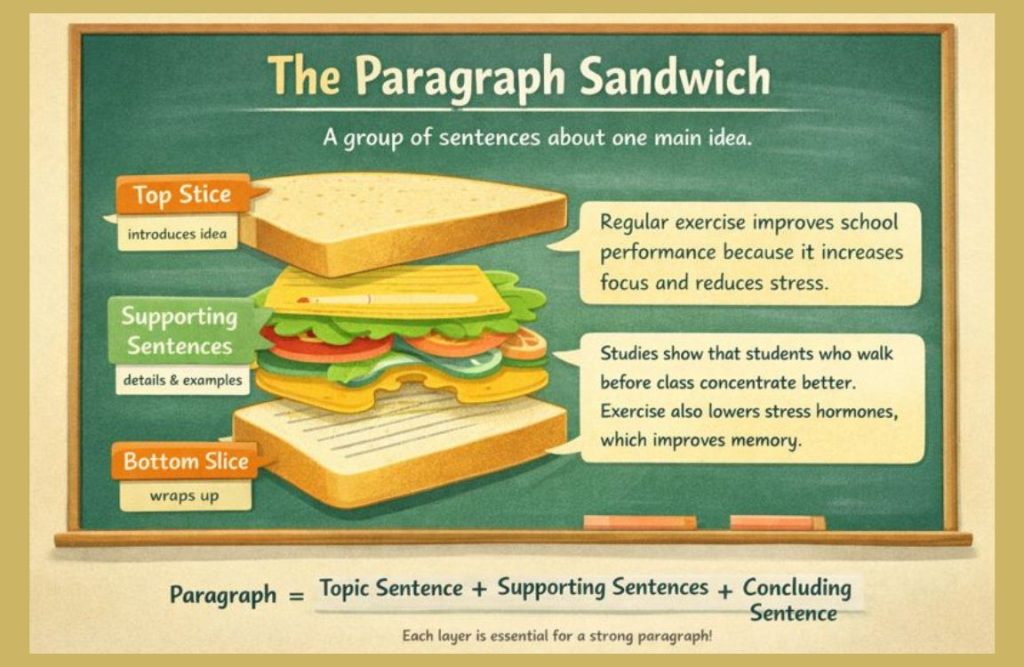
Ah, now we’re getting to one of my favourite teaching tools- the paragraph sandwich. Yes, a sandwich that makes the structure of a paragraph simple. Because a good paragraph, like a good sandwich, needs a proper top, a delicious middle, and a neat bottom. Miss one, and your writing collapses like a soggy burger bun.
Let me walk you through it, teacher to student- imagine I’m drawing a sandwich on the board while half the class is already thinking about lunch.
i) The Topic Sentence- The Top Slice
Every paragraph begins with a topic sentence. This is the top slice of bread. It introduces the main idea of the paragraph and tells the reader what to expect. I always tell my students, “If someone reads only your first line, they should still understand what your paragraph is about.”
Example: “Regular exercise improves school performance because it increases focus and reduces stress.”
See how clear that is? The topic is exercise, and the point is that it helps school performance. Boom- top slice done!
ii) The Supporting Sentences- The Filling
This is the heart of the paragraph- the body of a paragraph. Here, you explain, describe, or give examples to support your main idea. Use linking words like for example, also, however, and therefore to keep your ideas connected.
Example: “Studies show that students who walk before class concentrate better. Exercise also lowers stress hormones, which improves memory.”
Now that’s a filling paragraph- neat, balanced, and satisfying.
iii) The Concluding Sentence- The Bottom Slice
The concluding sentence neatly wraps up the idea or gently leads to the next paragraph. Think of it as a clean finish after a good meal.
Example: “So, adding exercise to the school day helps students learn more effectively.”
And there you have it- your paragraph sandwich, ready to serve and impossible to forget.
How to Write a Paragraph for Beginners: Step by Step
Alright, my dear learners, grab your pens. This is where paragraph writing truly begins to make sense. Many students think writing a paragraph is easy until they actually try it. Then suddenly, ideas wander, sentences lose direction, and confusion takes over. Writing a paragraph is a lot like making a cup of tea: simple when you follow the steps, disappointing when you don’t.
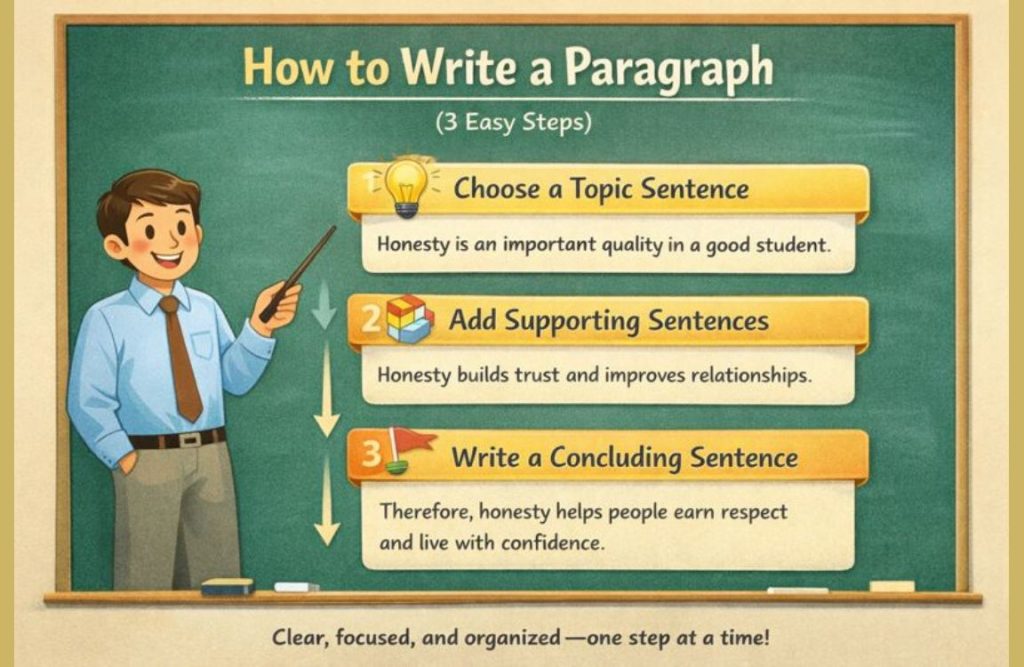
A good paragraph doesn’t appear by accident. It is built carefully, step by step, with clarity and purpose. If you follow the three steps below, you’ll know exactly how to start a paragraph, how to develop it, and how to end it like a pro.
Step 1: Choose a Clear Topic Sentence
The first and most important step is choosing a clear topic sentence. This sentence introduces the main idea of your paragraph and tells the reader what the paragraph will discuss. Think of it as the headline of a news article- short, focused, and informative.
If you’re wondering how to start a paragraph, start by asking yourself one simple question: What is the one thing I want to say here? Your answer becomes your topic sentence.
Good topic sentences are specific, not vague.
Topic sentence examples:
- “Honesty is an important quality in a good student.”
- “Regular exercise improves both physical and mental health.”
When the topic sentence is clear, the rest of the paragraph becomes easier to write. Without it, your paragraph feels lost before it even begins.
Step 2: Develop the Paragraph with Supporting Sentences
Once your topic sentence is ready, it’s time for the real work- developing a paragraph. This stage is called paragraph development, and it forms the body of your writing. Supporting sentences explain, describe, or give examples related to the topic sentence.
Think of this step as adding flesh to the bones. Each supporting sentence should strengthen the main idea, not distract from it. Use reasons, facts, examples, or short explanations to help your reader understand your point clearly.
For example, if your topic sentence is about honesty, your supporting sentences might explain how honesty builds trust, improves relationships, or brings peace of mind. This process of developing paragraphs requires focus. Never jump to unrelated ideas midway—yes, even if your favorite food suddenly comes to mind!
Good paragraph development keeps your writing logical, connected, and meaningful.
Step 3: Write a Strong Concluding Sentence
The final step is writing a strong concluding sentence. This sentence brings your paragraph to a smooth and satisfying end. It may restate the main idea or give a final thought that leaves a clear impression on the reader.
A concluding sentence is what turns an ordinary paragraph into a good paragraph. It signals that your idea is complete and prepares the reader to move on. Think of it as closing the lid on a lunchbox- everything neat and in place.
Example:
“Therefore, honesty helps people earn respect and live with confidence.”
When all three steps work together, you create a perfect paragraph- clear, focused, and easy to read.
How Many Sentences Is a Paragraph?
This is the question I hear every single year, usually right before an exam, and always with a worried face:
“Sir, how many sentences make a paragraph?”
I smile, put the marker down, and say, “Relax. Writing is not a maths problem with one fixed answer.” And just like that, half the class exhales.
Here’s the honest truth I tell my students: there is no fixed rule for how many sentences are in a paragraph. If anyone ever tells you there is one magical number, they’re oversimplifying writing, and writing doesn’t like cages.
Now, let’s talk reality. In school-level writing, especially in exams, teachers usually expect a 3-7-sentence paragraph. Why? Because it’s safe. It gives you space for one topic sentence, a few supporting sentences, and one neat conclusion. It shows control. It shows balance. And yes, it keeps examiners happy.
So, how many sentences are in a paragraph for school exams?
👉 Usually, 3 to 7 sentences work beautifully.
At this point, someone always raises a hand and asks, “Sir, is four sentences a paragraph?”
And my answer is: Yes, if those four sentences do the job well. Quality beats counting every time. A focused four-sentence paragraph is far better than a messy seven-sentence one that wanders off like a distracted tourist.
But here’s where things change. In academic or higher-level writing, paragraphs grow or shrink based on ideas, not rules. One idea might need six sentences. Another might need ten. The question becomes not how many sentences should be in a paragraph, but whether I have explained my idea clearly.
So, here’s my exam-friendly advice, straight from the classroom:
- In school exams: aim for 5-7 sentences
- In practice writing: focus on clarity, not counting
- In advanced writing, let the idea decide the length
Remember, a paragraph isn’t judged by its size. It’s judged by how clearly it speaks. And if your paragraph speaks clearly, it has done its job- no calculator required.
Types of Paragraphs (With Examples)
When I teach paragraph writing, I always remind my students of one simple truth: not all paragraphs behave the same way. Some tell stories, some paint pictures, some explain facts, and some argue like confident lawyers.
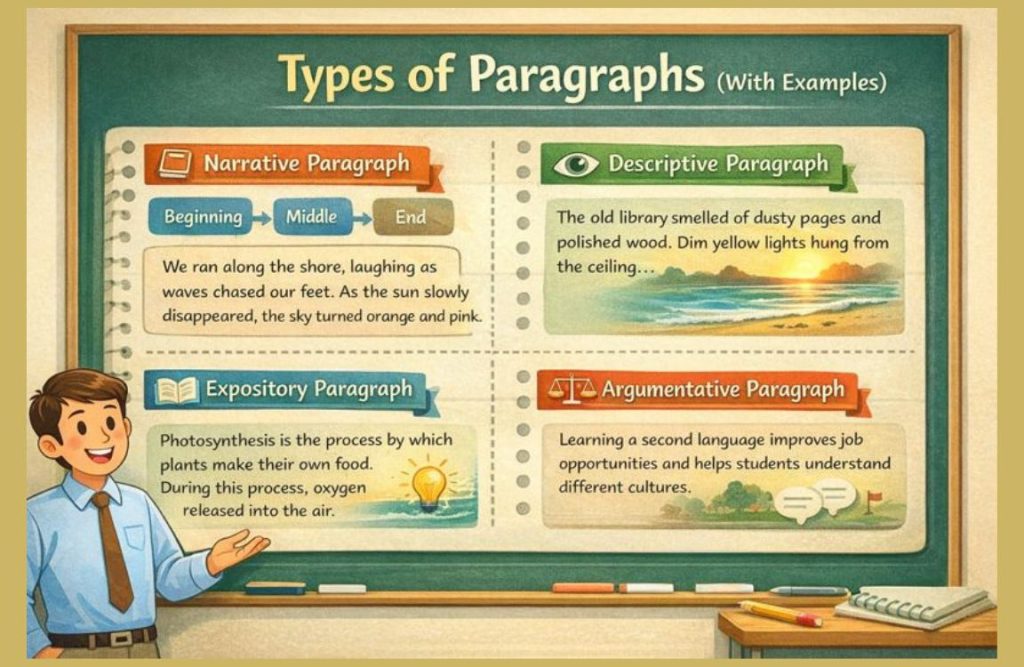
These are known as the four main types of paragraphs, and understanding them makes paragraph writing clearer, sharper, and more purposeful. Let’s walk through the 4 types of paragraph writing with examples, classroom-style.
i) Narrative Paragraph:
A narrative paragraph tells a short story. It focuses on an event or experience and usually follows a clear sequence: what happened first, next, and finally. When I explain this in class, I say, “If your paragraph has a heartbeat and a memory, it’s probably narrative.”
This type of paragraph often uses first-person (I) or third-person (he/she) narration and includes action, emotion, and reflection.
Example:
Last Sunday, I visited a sea beach with my friends. We ran along the shore, laughing as waves chased our feet. As the sun slowly disappeared, the sky turned orange and pink, and everything went quiet. That peaceful moment stayed with me long after we left.
Narrative paragraphs are common in diaries, personal essays, and storytelling tasks.
ii) Descriptive Paragraph:
A descriptive paragraph is all about the senses. Instead of telling the reader what something is like, it shows it through sight, sound, smell, taste, and touch. I often tell students, “If I can close my eyes and still see your paragraph, you’ve done it right.”
Example:
The old library smelled of dusty pages and polished wood. Dim yellow lights hung from the ceiling, casting soft shadows over rows of ancient books. Every corner felt quiet and alive at the same time.
This type of paragraph helps readers visualize scenes and is widely used in stories and creative writing.
iii) Expository Paragraph:
An expository paragraph explains or informs. No storytelling, no opinions- just clear facts presented logically. Think of this as the “teacher voice” of paragraph writing.
Example:
Photosynthesis is the process by which plants make their own food. Using sunlight, plants combine water and carbon dioxide to produce glucose. During this process, oxygen is released into the air.
You’ll find expository paragraphs in textbooks, exams, reports, and academic writing, where clarity matters more than creativity.
iv) Persuasive Paragraph:
A persuasive paragraph aims to gently (or not so gently) nudge the reader toward agreement. When I teach this, I tell my students, “You’re not arguing. You’re charming the reader into saying yes.”
Example:
Schools should reduce homework because students need time to rest, explore interests, and stay mentally healthy. A balanced life creates better learners.
You’ll see this style in speeches, advertisements, and opinion pieces where influence matters most.
Quick Reminder from the Classroom:
Mastering these four types of paragraphs gives you control. Once you know what kind of paragraph you’re writing, writing it becomes much easier.
Other Useful Types of Paragraphs
Now, let me share a little classroom secret. Not every paragraph likes to fit neatly into the big four we just studied (descriptive, narrative, expository, and argumentative). Some paragraphs are rule-breakers. They want their own purpose, their own shape, their own personality.
I like to think of these as the special tools in a writer’s toolbox, useful, but not always required in exams. You may not use them every day, but when the situation calls for one, nothing else will do. A bit like that odd screwdriver at home- you don’t know why it exists, but the day you need it, you’re very grateful.
Let me introduce you to six of these useful “bonus” paragraph types.
1. Classification Paragraph:
A classification paragraph groups people, ideas, or things into clear categories. Its job is to organize information and make messy ideas easier to understand.
Example: Different Types of Students in a Classroom
In every classroom, I notice three kinds of students: the energetic ones who raise their hands before the question is finished, the quiet ones who listen so carefully they could rewrite the lesson from memory, and the playful ones who are secretly planning their next snack. (Be honest, you know exactly where you belong.)
2. Compare or Contrast Paragraph:
A compare or contrast paragraph shows similarities (compare) or differences (contrast) between two things. It helps readers understand choices and perspectives more clearly.
Example: City Life vs. Village Life
City life feels like riding a rollercoaster—fast, noisy, and full of bright lights. Village life, on the other hand, feels like resting in a hammock—slow, peaceful, and close to nature. The real question is simple: do you want the thrill or the calm?
3. Definition Paragraph:
A definition paragraph explains what a word or concept truly means, going beyond a dictionary meaning to offer clarity and insight.
Example: Friendship
Friendship is not just sitting next to someone in class. It is trusting each other, sharing secrets, and standing together, whether life is serving ice cream or bitter medicine.
4. Explanation Paragraph:
An explanation paragraph shows how or why something happens in a clear, step-by-step way. Its purpose is to remove confusion.
Example: The Water Cycle
The water cycle is nature’s recycling system. Water evaporates from rivers and seas, forms clouds in the sky, and returns to the earth as rain. Then the process begins again, repeating endlessly.
5. Illustration Paragraph:
An illustration paragraph supports an idea by giving specific, relatable examples that make the point believable.
Example: Students’ Time Management
Many students struggle with time management. For example, some spend hours scrolling through social media, while others suddenly remember their homework when the clock strikes midnight. (Yes, I see those guilty smiles.)
6. Argumentative Paragraph:
An argumentative paragraph takes a clear position and supports it with reasons. When I teach this, I say, “If your paragraph sounds confident and slightly stubborn, you’re on the right track.”
Example:
Every student should learn a second language. It improves memory, increases job opportunities, and helps people understand different cultures. For these reasons, learning another language is essential in today’s world.
This type appears in essays, debates, and opinion writing, where convincing the reader is the goal.
Teacher’s Closing Note:
You don’t need to memorize all these types at once. Just remember this: the better you understand why a paragraph exists, the easier it becomes to write one that works.
What Is a Body Paragraph?
A body paragraph is where your writing finally gets to work. This is the section that explains, proves, or develops your main idea with logic and evidence. Think of it as the engine room of your essay- quietly powerful, but absolutely essential.
Body Paragraph Structure
Now, let me take you into a familiar classroom moment. I’m standing at the board, essay topic written at the top, and a brave student asks, “Sir, what exactly goes inside the body?”
Excellent question.
The body paragraphs’ structure is simple, but it must be respected. A body paragraph is not a random collection of sentences; it is a well-organized unit with a clear job. First comes a controlling idea- not the main thesis, but one specific point that supports it. This keeps the body in paragraph focused and prevents your writing from wandering like a lost tourist.
Next come development sentences. These are the muscles of the paragraph. Here you explain, give reasons, add facts, or describe examples. Each sentence should push the idea forward, not repeat it or escape from it. I often tell my students: if a sentence doesn’t help your point, it doesn’t deserve a seat in the paragraph.
Finally, the paragraph needs a closing or linking sentence. This gently signals completion or connects to the next idea. No sudden stops. No dramatic exits. Just a smooth landing. That balance is what turns an average paragraph into a confident one.
Example of a Body Paragraph
Let me show you a clear example of a body paragraph, the kind I love seeing in exam scripts.
Regular exercise plays an important role in improving students’ concentration. When students engage in physical activity, blood flow to the brain increases, helping them stay alert during classes. Exercise also reduces stress, which often distracts students from learning. For example, students who walk or play sports before studying often report better focus and memory. As a result, physical activity supports both mental clarity and academic performance.
Now pause with me for a second. See what happened? One focused idea, logical development, and a calm, confident ending. That’s not magic. That’s structure. And once you master it, your writing starts standing on its own two feet.
Paragraph Examples for Students
Whenever my students ask, “Sir, I understand the rules… but how does a real paragraph actually look?”– this is the moment I smile, pick up the marker, and say, “Ah, now we learn by seeing.” Because paragraph examples are where theory finally turns into confidence.
Below, I’m sharing three examples of paragraph styles I regularly use in class. Think of them as practice mirrors: you don’t just read them, you study how they stand.
i) Simple English Paragraph (Beginner-Friendly)
This is the kind of paragraph I give students who are just finding their writing feet.
Sample of Paragraph Writing: My School
My school is a happy place for learning. It has many classrooms and a large playground. The teachers are kind and help us understand our lessons. I enjoy going to school every day because I learn new things and spend time with my friends.
Short, clear, and calm. These are perfect examples of short paragraphs for younger learners or ESL students.
ii) Short Paragraph Example (Exam-Ready)
Now imagine I’m pacing the classroom saying, “You have ten minutes. Write neatly. No panic.”
Paragraph Example: Importance of Reading
Reading is an important habit for students. It improves vocabulary and helps us understand new ideas. Students who read regularly perform better in exams. Therefore, reading should be practiced every day.
This is one of those paragraph example models that examiners love: focused, structured, and tidy.
iii) Medium Academic Paragraph (Confidence Level)
This is where students start sounding… grown-up. (Yes, this is where I proudly nod.)
Paragraph Example: Online Learning
Online learning has changed the way students access education. It allows learners to attend classes from anywhere and manage their study time more flexibly. However, online education also requires strong self-discipline, as students must stay motivated without direct supervision. When used wisely, online learning can support both academic growth and independent learning skills.
This type fits perfectly into essays and assignments. If you’re aiming higher, this is the style to study closely.
Tips for Writing a Good Paragraph
I still remember a student once sighing, “Sir, my paragraph feels… weak.” I tapped the desk and said, “Then let’s give it some muscle.” Writing a good paragraph isn’t about fancy words or showing off. It’s about control, balance, and purpose- like riding a bicycle without wobbling into traffic.
Here are my classroom-tested paragraph writing tips, the ones I repeat so often my students could chant them in their sleep.
First, respect your main idea. A strong paragraph is loyal. Once it chooses an idea, it doesn’t cheat on it halfway through. If your paragraph starts about honesty, don’t suddenly bring in cricket scores or weekend plans. That focus alone makes your writing stronger than you think.
Second, let your sentences talk to each other. I tell my students, “If your sentences feel like strangers on a bus, something’s wrong.” Use simple links- because, for example, however– so ideas flow naturally. This is one of the most ignored but powerful tips for writing a paragraph effectively.
Third, balance is everything. Too short feels hungry. Too long feels heavy. A good paragraph gives just enough detail to satisfy the reader without exhausting them. Think of it as serving rice with the right amount of curry.
Fourth, revise like a teacher, not a machine. Read your paragraph aloud. If you run out of breath or feel confused, your reader will too. This habit alone can help you to write a strong paragraph.
Finally, write with intention. Every paragraph should do something- explain, describe, argue, or reflect. When you know its job, the paragraph behaves better.
These tips of paragraph writing won’t make you perfect overnight, but they will make you powerful, one paragraph at a time.
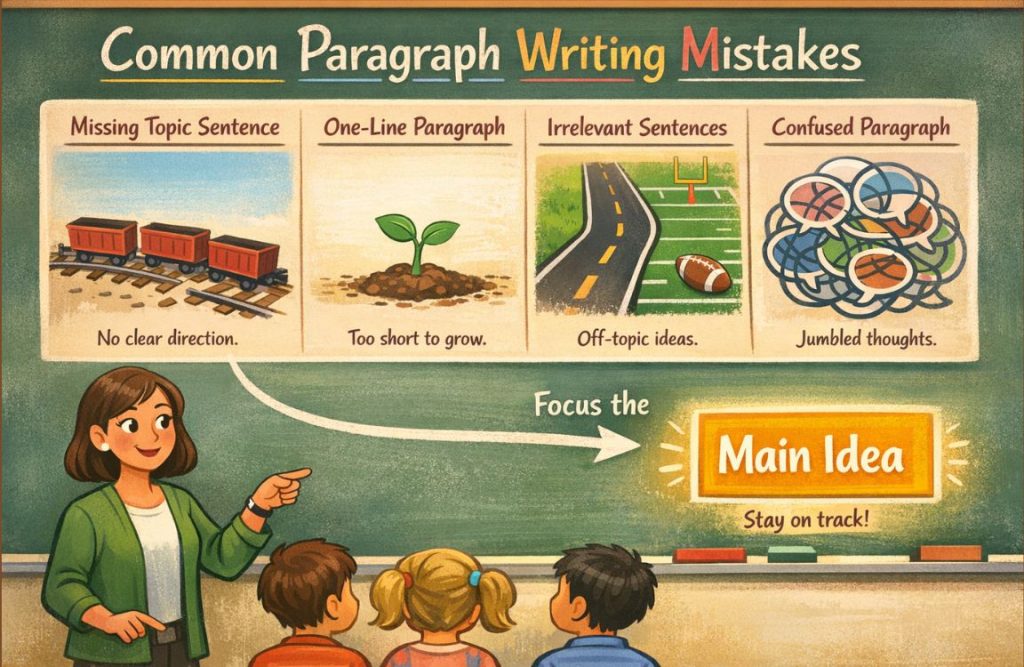
Common Paragraph Writing Mistakes
Let me confess something as a teacher. When I check paragraphs, I don’t look for mistakes first. I listen for confusion. And oh, confusion has a very loud voice. I once read a paragraph that began confidently, wandered off like a lost tourist, and then vanished without saying goodbye. That’s not a good paragraph. That’s a mystery novel with missing pages.
One common mistake is skipping the topic sentence. Without it, your paragraph feels like a train with no engine. The reader keeps asking, “Where are we going?” In a well-structured paragraph example, the opening line gently but clearly points the direction.
Another trap students fall into is the one-line paragraph. Yes, one sentence can be powerful, but most of the time, it’s just undercooked. I tell my class, “That’s not a paragraph. That’s a sneeze.” A paragraph needs space to breathe, explain, and grow.
Then there are irrelevant sentences- the ones that sneak in uninvited. The paragraph starts about discipline, suddenly mentions football, and somehow ends with friendship. When that happens, I pause, raise an eyebrow, and ask, “Did your paragraph change its mind halfway?”
Here’s my live-class rule: if a sentence doesn’t support the main idea, it doesn’t belong. A good paragraph is focused, loyal, and calm. Avoid these mistakes, and your paragraphs won’t just pass. They’ll speak with confidence.
Paragraph Writing Topics for Practice
Alright, my dear learners, it’s time to roll up your sleeves, because now comes the fun part: you get to write!
You’ve learned the recipe for a strong paragraph. Now let’s see how you cook with it. Don’t worry, I won’t grade you (yet), but I will challenge you to think, feel, and express your ideas like the writer you’re becoming.
Here are some topics to warm up your creative muscles. Pick one, or try them all if you’re feeling brave:
i) My Favorite Hobby
What’s that one thing that makes you forget about time? Whether it’s painting, playing football, or rearranging your bookshelf for the 10th time- write about why it fills your heart.
ii) A Day at the Park
Describe the sound of children’s laughter, the smell of roasted peanuts, or the lazy sway of trees in the wind. Let your reader be there with you.
iii) The Importance of Exercise
We all promise to start “next Monday,” don’t we? Tell your reader why moving your body isn’t just for fitness. It’s also for joy, focus, and mental peace.
iv) Why Honesty Matters
Ever told a little lie and wished you hadn’t? Reflect on that moment- and show how truth, though tough, always shines brighter in the end.
v) My Best Friend
Think about the person who makes even a bad day better. What makes your friendship special? What lesson has that bond taught you?
vi) The Value of Time
Time is like sand. The tighter you try to hold it, the faster it slips away. Write about moments when you learned how precious every second really is.
vii) A Place I Want to Visit
Is it Paris, Cox’s Bazar, or maybe your grandma’s village? Take us on a journey with your words- what do you want to see, feel, and experience there?
viii) My School Library
Ah, that magical place where stories live quietly on shelves, waiting for curious minds. What’s your favorite corner, your favorite book, or your favorite memory there?
ix) Benefits of Healthy Food
Spinach might not be everyone’s hero, but trust me. It’s mightier than it looks! Talk about how eating right makes you stronger, smarter, and happier.
x) A Memorable Journey
Think of a trip that left a mark on your heart- a family vacation, a school picnic, or maybe a rainy-day adventure. What made it unforgettable?
Remember, every paragraph you write is like a window into your thoughts. So open that window wide, let your ideas breathe, your words shine, and your imagination take flight.
FAQs About Paragraph Writing:
Can a paragraph be one sentence?
Yes, but only when it earns it. A single-sentence paragraph is like dramatic silence after a strong point. I show students how writers use it for impact, not laziness. Power, not shortcuts, decides this rule.
How do I start a paragraph?
I always say: start with a clear topic sentence. Think of it as knocking before entering the reader’s mind. It tells us what’s coming and why we should care- no mystery, no confusion, just confident direction.
How long should a paragraph be in exams?
In exams, I coach my students to aim for 80-120 words. Enough to explain, not enough to wander. Examiners love clarity, not storytelling marathons. Think focused answer, not a novel chapter under pressure.
What is a paragraph sentence?
I explain it this way: a paragraph sentence is a team player. Each sentence supports the main idea- introducing it, explaining it, or proving it. No rebels allowed. If a sentence doesn’t help, it doesn’t belong.
What is paragraph development?
It’s what happens when you take one idea and feed it with examples, reasons, and details until it feels complete. In other words, you’re building muscle around your main point, not just bones.
What to do if your paragraph is too long or too short?
If it’s too long, split it. Your reader needs breathing room! Too short? Add examples or details. A paragraph should feel just right- not rushed, not stretched.
How to end a paragraph?
End gracefully, either by wrapping up your point or linking smoothly to the next idea. Think of it as saying, “That’s all for now, but wait till you see what’s next!”
Final Thoughts:
So, what is a paragraph, really? To me, it’s the heartbeat of every piece of writing. Without paragraphs, your words would just lie flat on the page- lifeless, gasping for structure.
Once you master this skill, you’ll walk into essay writing, reports, and even books with the confidence of a word architect.
👉 Always remember my golden rule: A strong paragraph = one clear idea + solid support + smooth flow.
And yes, practice daily! Because writing is like playing an instrument- the more you play, the better your rhythm gets. One day, you’ll look at your own paragraph and think, “Wow, my words finally sing.”
So, grab your pen, open your notebook, and let your thoughts dance across the page. I’ll be here, cheering you on- one paragraph at a time.
Written by your friendly English teacher who still believes a well-written paragraph can change the world- one sentence at a time.