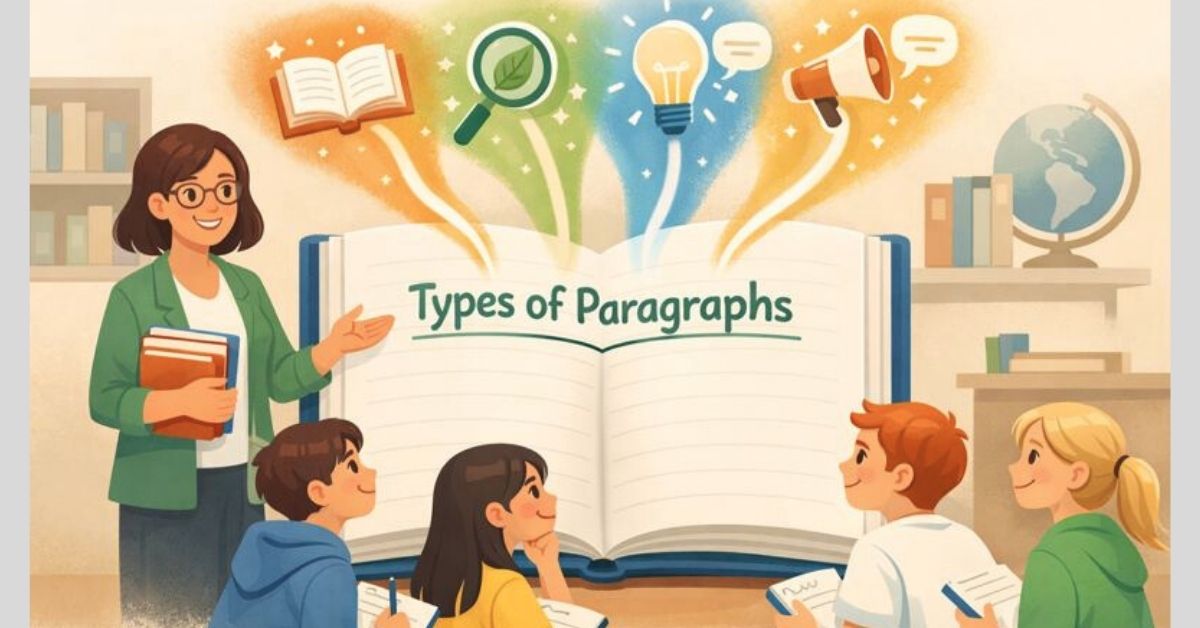
Before we dive into essays and thesis statements, let’s pause to meet the humble hero of writing- the paragraph, the heartbeat that keeps every piece alive.
Now here’s where things get interesting: not all paragraphs are born alike. Some explain ideas clearly when exams demand sharp answers. Some paint pictures with words. Others argue, persuade, or tell stories dramatic enough to win an Oscar.
Whenever I teach the types of paragraphs, I tell my learners it’s like discovering the moods of writing. Once you understand these moods, confusion fades, marks improve, and writing starts to feel less like panic and more like power.
So grab your metaphorical pen and curiosity- let’s explore the four main types every strong writer should master.
What Are the Types of Paragraphs?
Let me take you back to a real classroom moment. A student once asked me, “Sir, why does my writing feel confused even when my English is okay?” I smiled and said, “Because your ideas are standing in the wrong line.”
That’s where paragraph types come in.
Types of paragraphs are simply different ways of organizing sentences, depending on what you want to do with your idea. Think of them as different roads. One road tells a story. Another paints a picture. One explains facts. Another tries to convince. In English writing, we mainly use four types of paragraphs:
- Narrative
- Descriptive
- Expository
- Persuasive
Once you know which road to take, your writing stops wandering and starts moving with purpose.

Table of Contents
Why Learning the Types of Paragraphs Is Important?
Whenever my students ask, “Sir, why do we need to learn all these types of paragraphs?” I smile because that question is the start of real writing.
See, knowing the types of paragraphs is like learning different camera angles. Each one lets you capture an idea in its best light- whether you are storytelling, describing, explaining, or persuading.
If you use the wrong “lens,” your writing can feel flat or confusing. But once you master these paragraph types, your ideas will walk, talk, and even dance on the page.
Whether you’re writing an exam answer, an essay, or a social media caption, the right paragraph type turns your words from random lines into a clear, powerful message.

Basic Structure of a Paragraph
Every time I check exam scripts, I see one truth staring back at me: paragraphs fail not because of ideas, but because of weak structure. No matter the topic or style, every paragraph follows the same basic shape. Miss this, and even good English collapses like a chair with one leg missing.
The Three Essential Parts of a Paragraph
i) Topic sentence: This is the boss sentence. I tell my students, “If this sentence is weak, the whole paragraph goes on strike.” It clearly announces the main idea.
ii) Supporting sentences: These are the hardworking workers. They explain, describe, prove, or clarify the idea with details and examples.
iii) Concluding sentence: This is the final handshake. It closes the idea so the reader doesn’t feel abandoned mid-thought.

Simple Structure Example
Exercise keeps students healthy. It improves strength and reduces stress. So, regular exercise is important for students.
How to Write a Paragraph (That Actually Works)
Now that you know the three essential parts of a paragraph, let’s bring them to life.
Whenever I teach paragraph writing, I tell my students it’s a bit like building a tiny house. You don’t just throw in bricks and hope for the best. You plan, you build, and you make sure it stands strong enough to shelter your idea.
So, here’s how I build one step by step- no cement needed, just a clear mind and a pen that’s ready to work:
i) Start with the Topic Sentence:
This is your main idea, the sentence that says, “Hey reader, this is what we’re about to talk about.” If you skip it, your reader is basically wandering in the dark without a flashlight.
ii) Add Supporting Sentences:
Now, it’s time to prove, explain, or illustrate your point. Give examples, facts, or even little stories that make your idea feel alive. Think of these as the beams that keep your structure from collapsing.
iii) End with a Concluding Sentence:
You’ve made your point. Now wrap it up gracefully. A good conclusion reminds your reader what mattered most- without repeating everything like a parrot on replay.
Bonus Tip- Flow is Your Invisible Glue:
Use transition words (however, therefore, in addition) like bridges between thoughts. They make your paragraph feel like a smooth walk, not a rocky hike.
When you write this way, your paragraphs won’t just sit there. They’ll stand up straight and speak clearly. And trust me, there’s no better feeling than reading your own work and realizing, “Yes, that flows.”
The Four Main Types of Paragraphs in English
Think of each paragraph type as an actor on a stage. One explains facts like a calm teacher, another describes scenes like a painter. A third one argues fiercely like a lawyer, while the last one spins stories like a born storyteller.
Each plays a different role, but together they make writing come alive. We’ll explore each paragraph type- narrative, descriptive, expository, and persuasive- with examples you can use in essays and exams. Let’s meet them, one by one, and see how each type brings its own spark to your sentences.
i) Narrative Paragraph (The Storyteller’s Paragraph):
If a Descriptive Paragraph paints a picture, the Narrative Paragraph brings that picture to life.
It moves. It walks, talks, breathes, and sometimes even runs late for school. Whenever I teach this, I like to start with a question: “Have you ever told a story that made your friends laugh so hard they forgot to breathe?”
That’s narrative writing. It’s storytelling, plain and powerful, with a clear beginning, middle, and end.
What It Really Does:
A Narrative Paragraph tells a short story or a real-life event. It could be funny, emotional, suspenseful, or even a lesson learned the hard way (like forgetting your speech notes at home- yes, I’ve been there).
Its main goal isn’t just to tell what happened, but to make readers feel like they were there.
It turns simple moments into something meaningful- a little scene that says something big about life.
Example: A Lesson Learned
Last week, I walked into class only to realize my lesson plan was sitting peacefully at home, sipping coffee without me. For a moment, panic danced in my head. Then I looked at my students’ curious faces and began talking about panic itself. Somehow, that unplanned lesson became one of my best classes ever. Sometimes, the best stories come from accidents that teach us grace under pressure.
Here’s What’s Happening Behind the Scenes:
- Topic Sentence: Introduces the story (what it’s about).
- Supporting Sentences: Give actions, thoughts, and emotions- show, don’t tell.
- Concluding Sentence: Delivers a reflection, the “aha!” moment.
Teacher’s Tip:
When you write a narrative paragraph, think like a movie director. Zoom in on details, play with pacing, and don’t be afraid of emotion. Use short, punchy sentences for action. Slow down for feeling.
And remember: every story, no matter how small, has a heartbeat– make your readers hear it.
So, whether you’re writing about a childhood prank, your first speech, or the day you overcame something scary, tell it like it matters- because it does.
Types of Narrative Paragraphs
Students often ask me, “Sir, are there types of narrative paragraphs?” And I love that question- because it shows they’re thinking like writers, not just test-takers.
Technically, the narrative paragraph itself is one of the four main types of paragraph (alongside descriptive, expository, and persuasive). But inside this story-loving category, there are a few different styles of narration- each one shaping how your story feels and flows. Here are the main ones I teach:
i) Chronological Narrative:
This one tells the story in time order. Think of it as a movie that starts with “Once upon a time” and moves straight to “The End.” It’s simple, clear, and great for storytelling in essays or diary writing.
ii) Reflective Narrative:
Here, the writer looks back on an experience and shares what they learned. It’s part story, part wisdom. Perfect for personal essays or journal reflections.
iii) Anecdotal Narrative:
A short, sharp story that makes a point. Teachers and speakers love this style because it’s quick and memorable- like a real-life mini lesson.
iv) Character-Focused Narrative:
Instead of focusing on events, this one zooms in on who the story is about- exploring their emotions, reactions, and growth. Great for creative writing tasks or character sketches.
Every narrative paragraph has the same heartbeat- a moment, a movement, and a message. But these different types help you choose the best lens for the story you want to tell.
2. Descriptive Paragraph (The Artist’s Paragraph):
If the Expository Paragraph is a Reporter, the Descriptive Paragraph is an Artist. It doesn’t just tell facts. It paints pictures with words. It’s all about helping the reader see, hear, feel, smell, and even taste what’s being described.
Whenever I teach this, I remind my students, “A good descriptive paragraph doesn’t say the mango is sweet. It makes you crave one.”
Think of it this way: if an expository paragraph gives the map, a descriptive one gives the journey– the sunlight on the road, the sound of your footsteps, the smell of rain after months of heat. It’s sensory writing with emotion at its core.
Example: A Person (My Grandfather)
My grandfather’s face is a map of stories. Each wrinkle seems to mark a journey- some happy, some heavy. His white beard glows faintly in the morning light, and when he laughs, it’s the sound of an old song coming back to life. He smells faintly of sandalwood and tea, and his hands, though rough, always feel like home.
Here’s How the Writer Did It:
- Topic Sentence: “My grandfather’s face is a map of stories.” (What the paragraph describes)
- Supporting Sentences: Detailed images using senses and metaphors.
- Concluding Sentence: “His hands, though rough, always feel like home.” (Leaves the reader with emotion)
Teacher’s Tip:
If your paragraph feels flat, you’re probably telling instead of showing. Don’t say “The garden was beautiful.” Instead, say, “Marigolds blazed like tiny suns between the soft green of the leaves.”
And one more secret: close your eyes before you write. Let your mind walk through the scene. What do you notice first? That’s your opening. What stays with you last? That’s your ending.
Types of Descriptive Paragraphs
Technically, the descriptive paragraph has one main mission: to make readers see, feel, or even smell what you’re describing. But within that mission, there are different focuses. You might describe a person (their look or personality), a place (its mood or atmosphere), an object (its details or importance), or an event (how it unfolds and feels).
So, while they’re not “official” subtypes like narrative or persuasive paragraphs, thinking of them this way helps you pick your sensory focus. It’s like choosing your camera lens before you take the shot- close-up or wide-angle, both tell a story.
3. Expository Paragraph/The Informative Paragraph:
When I talk about the Expository Paragraph, I always imagine a reporter standing in front of a camera, holding a microphone, saying, “Here are the facts.” No drama. No gossip. Just the truth- neat, clear, and well-organized.
If the Narrative Paragraph tells a story and the Descriptive Paragraph paints a picture, then the Expository Paragraph explains how the world works. It’s the “teacher” paragraph- calm, informative, and allergic to opinions. It doesn’t shout or cry. It simply says, “Here’s how it is.”
You’ll find this type of writing in textbooks, research papers, reports, and even how-to guides, basically anywhere the goal is to explain, not entertain.
What It Really Does:
The expository paragraph is built to inform. It defines ideas, explains processes, or gives factual information. It’s writing with a mission to make something clear, understandable, and reliable.
I tell my students: Think of this paragraph as your inner science teacher with a clipboard. Everything must make sense, and everything must be true.
No emotions. No opinions. No “I think” or “I feel.” Just clean, crisp, fact-filled writing that leaves your reader smarter than before.
The Three Ways to Organize Facts
Expository writing has its own little toolbox of organization methods, and choosing the right one is like choosing the right recipe for a dish.
- Sequence (Steps): Used when you’re explaining a process (like how plants grow or how to bake a cake).
- Cause and Effect: Used to explain why something happens and what follows.
- Comparison: Used to show how two or more things are similar or different.
While teaching, I tell my students to imagine they’re explaining something to a curious friend who asks “why” or “how.” That’s the voice you want- patient, clear, and kind.
Example 1: Sequence (The Water Cycle)
The water cycle is nature’s recycling system that keeps water moving around the planet. First, water from oceans, rivers, and lakes evaporates due to the sun’s heat. Next, the vapor cools and condenses to form clouds. Finally, it falls back as rain, snow, or hail- returning to rivers and seas to start again. This endless loop keeps Earth alive and thriving.
Structure Breakdown:
- Topic Sentence: Introduces the water cycle.
- Supporting Sentences: Step-by-step process.
- Concluding Sentence: Explains its importance.
Example 2: Essential Process (Photosynthesis)
Photosynthesis is nature’s power factory. During this process, plants take in carbon dioxide from the air and water from the soil. With the help of sunlight, they produce glucose, their food, and release oxygen into the air. This oxygen is what humans and animals need to breathe and survive. In short, without photosynthesis, life on Earth would stop- quite literally.
Structure Breakdown:
- Topic Sentence: States the main idea.
- Supporting Sentences: Step-by-step explanation.
- Concluding Sentence: Highlights its vital importance.
Teacher’s Tip:
When writing an expository paragraph, remember: you’re not arguing or storytelling. You’re teaching.
i) Use transition words like first, next, finally, as a result, and in conclusion to guide your reader.
ii) Keep your sentences short, factual, and clear.
iii) And never, ever include “I think” or “I feel.” This paragraph wears a lab coat, not a heart on its sleeve.
I often tell my students: If your paragraph feels like it could be read aloud in a classroom or printed in a textbook- congratulations, you’ve nailed expository writing!
Types of Expository Paragraphs
Whenever my students ask, “Sir, aren’t all expository paragraphs the same?” I smile. Nope! Even the calm, fact-packed expository paragraph has a few personalities under its lab coat. Think of it as a superhero with different gadgets depending on the mission. Here are the main types:
- Informative Paragraph- Presents clear, factual information to educate the reader about a topic.
- Definition Paragraph– Explains a term or idea clearly.
- Process Paragraph– Guides readers step by step.
- Classification Paragraph– Divides big ideas into clear categories.
- Comparison Paragraph/Compare-and-Contrast Paragraph- Shows similarities or differences.
- Cause-and-Effect Paragraph– Explains why something happens and what follows.
Keep reading, below, I’ll dive into each type with examples, structure tips, and teacher-approved tricks to make your paragraphs clear, organized, and reader-friendly.
4. Persuasive Paragraph/The Opinion Paragraph:
Alright, class- put on your imaginary lawyer robes, because this paragraph is all about convincing. The Persuasive Paragraph is where you stop reporting facts and start making people believe you. It’s not enough to know something. You have to sell it.
When you write a persuasive paragraph, you’re stepping into a courtroom of ideas.
The jury? Your readers.
Your mission? To make them nod and say, “You know what? That actually makes sense.”
This is the paragraph you’ll use in debates, opinion pieces, editorials, or even when convincing your parents you deserve that extra hour of screen time.
Tip from Your Teacher
Use a voice that says, I believe this with all my heart. Choose bold words like must, should, clearly, vital, necessary, and undeniable- words that sound like they’ve already won the case.
Avoid weak phrases like I think or maybe– they make your argument sound unsure. Remember: a lawyer in court who says, “I think my client might be innocent,” is not winning that trial.
Example 1: Learning a Second Language
Every student should learn a second language. Knowing another language opens doors to better job opportunities, improves memory, and helps us understand other cultures. It also makes travel more enjoyable and communication smoother. In today’s global world, learning a second language isn’t just useful. It’s essential.
Breakdown:
- Claim: Every student should learn a second language.
- Proof: Jobs, brainpower, culture, and travel.
- Final Word: It’s essential today.
Quick Teacher’s Reminder:
When you make a claim, you must back it up with evidence. No proof, no case. That’s how writing and law work.
If your paragraph can make your reader pause, think, and maybe even change their mind… congratulations, counselor- you just won your first argument in writing.
Types of Persuasive Paragraphs
Whenever my students ask, “Sir, aren’t all persuasive paragraphs the same?” I shake my head. Nope, even the bold, opinion-packed persuasive paragraph has different flavors depending on your mission. Think of it as your lawyer hat with different cases to win.
- Argument Paragraph– Claim + Evidence
- Opinion Paragraph– Personal view + Reasoning
- Problem–Solution Paragraph– Identify problem + Propose solution
- Call-to-Action Paragraph– Encourage the reader to act
Keep reading… below, I’ll dive into each type with examples, structure tips, and teacher-approved tricks to make your paragraphs persuasive and powerful.
Final Thought for Main 4 Types:
Each paragraph type is like a voice in your writing choir- storytelling, painting, explaining, and convincing. Once you learn to use them all, your writing won’t just say something. It’ll sing.
How to Identify Different Types of Paragraphs in Writing
Here’s a confession: even my brightest students sometimes look at a paragraph and whisper, “Sir… what type is this again?” Don’t worry. It’s not magic. It’s pattern-spotting. Each paragraph type leaves clues, like fingerprints in writing.
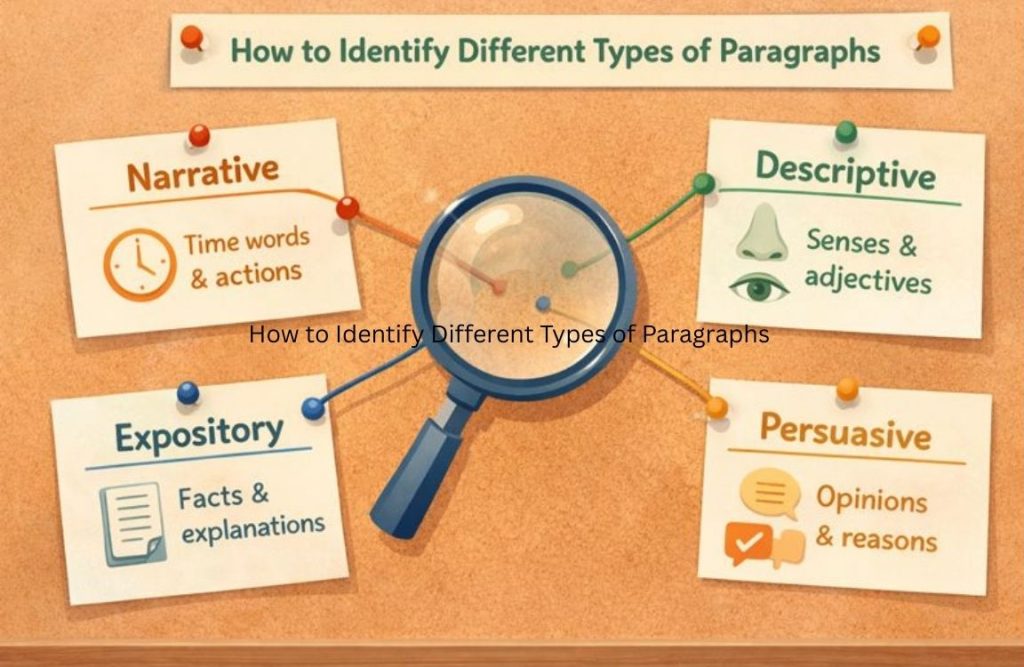
i) A Narrative paragraph loves action words and time markers– yesterday, then, suddenly- it’s telling a story.
ii) A Descriptive paragraph smells of adjectives and sensory details; you can almost see, hear, or taste what’s being described.
iii) The Expository paragraph is your classroom nerd- full of facts, logic, and explanations.
iv) Meanwhile, the Persuasive paragraph puts on its lawyer hat, waving opinions and reasons to win your heart (and mind).
Once you learn to notice these clues, identifying different types of paragraphs in English writing becomes less guesswork and more detective work, and yes, you’ll start spotting them everywhere, even in your favorite novels or news feeds!
Main Four Types of Paragraphs: Comparison Table
You know I love turning lessons into something you can see, not just read! Here’s your quick cheat sheet- a simple table that sums up the four main types of paragraphs, their purpose, an example, and the transitions that make them flow smoothly.
| Type | Purpose | Example | Common Transitions |
| Narrative | To tell a story | “A day I will never forget” | first, next, then |
| Descriptive | To paint a picture | “My village market” | beside, around, near |
| Expository | To explain or inform | “The process of photosynthesis” | for example, in addition, therefore |
| Persuasive | To convince or argue | “A day I will never forget.” | However, because, as a result |
Where Are Different Types of Paragraph Used?
I often tell my students that learning the different types of paragraphs in English writing isn’t just for passing exams. It’s for surviving them with style. Examiners love clear structure, and each paragraph type is like a superhero with a specific mission:
- Narrative for storytelling
- Expository for explaining
- Persuasive for arguing
- And descriptive for painting word pictures
But it doesn’t stop there. These four types of paragraphs sneak into everyday life too- from writing an email, posting on social media, or even explaining your point in a friendly debate.
Once you know how to mix and match paragraph structure, you’ll write with clarity, confidence, and a little creative flair that makes your words stand out anywhere.

Advanced Types of Paragraphs in English
You know how I always say writing has a mind of its own? It doesn’t always follow rules. It loves to break them with flair!
Beyond the four usual suspects (narrative, descriptive, expository, persuasive), there’s a whole squad of secret heroes- paragraphs that classify, define, argue, and explain. Let’s meet these clever rebels together.
1. Classification Paragraph/The Grouping Paragraph:
Whenever I teach classification paragraphs, I feel like Professor McGonagall handing out sorting hats- only this time, we’re sorting ideas, not students.
The classification paragraph brings order to chaos. It takes a big, messy topic like “students,” “food,” or “phone users” and neatly divides it into smaller, understandable groups.
It’s the writer’s way of saying, “Let’s make sense of this mess.” The goal? Clarity through smart organization- because good writing, like good magic, thrives on structure.
2. Compare and Contrast Paragraph:
While teaching compare and contrast paragraphs, I always tell my class-this is where writing becomes detective work. You’re not just describing things. You’re spotting clues, drawing connections, and asking: What’s really the difference between these two?
Think of it like holding up a mirror and a magnifying glass at the same time- the mirror shows you how two things are alike, and the magnifying glass reveals every little difference you didn’t notice before.
Whether you’re comparing city life vs. village life, or books vs. movies, this type of paragraph helps readers see both sides of the story clearly. A compare and contrast paragraph is perfect when you want to:
- Make sense of two ideas by seeing how they’re similar or different.
- Analyze or evaluate choices side by side.
- Or simply show your reader that both sunshine and rain have their own beauty.
3. Definition Paragraph/The Zoom-In paragraph:
If you’ve ever tried explaining love, success, or happiness to a friend and realized halfway that you’re both nodding but imagining totally different things- congratulations, you’ve just met the challenge of definition writing.
A definition paragraph is where we grab an idea that feels cloudy or fuzzy and give it a clear, sharp outline. In simple terms, you’re teaching your reader what something really means- not just what the dictionary says, but how it lives, breathes, and works in real life. I often tell my students while taking the class:
“A good definition isn’t about saying what something is. It’s about showing why it matters.”
4. Explanatory Paragraph/Explanation Paragraph:
Have you ever had a student (or maybe you!) raise an eyebrow in class and ask, “But how does that happen?” or “Why is it like that?”- congratulations. That’s the heartbeat of an explanation paragraph.
This type of paragraph is all about breaking things down- showing how something works or why something happens. It’s the writer’s version of a science experiment: clear steps, logical flow, and no magic tricks (well, except the magic of understanding!). When I teach this, I like to say:
“An explanation paragraph doesn’t just tell. It teaches.”
It’s the kind of paragraph you’ll meet in science, history, or even recipe books- anywhere someone needs to make a process or reason crystal clear.
5. Illustration Paragraph:
If I had a coin for every time I told my students, “Don’t just say it. Show it!”, I’d probably have enough to buy a lifetime supply of red pens. The illustration paragraph is built on that exact idea.
You see, it’s not enough to tell your reader what you think. You have to prove it- just like a lawyer brings evidence or a teacher uses examples on the board. This kind of paragraph is like holding up a flashlight in a dark room: it shines a clear light on your main idea so everyone can see what you mean.
When you use examples, your writing stops being vague and starts breathing. Suddenly, your reader nods and thinks, “Ah, yes! I’ve seen that happen!” That’s when you know your paragraph has done its job.
6. Argumentative Paragraph/Argument Paragraph:
Let’s be honest. Every classroom has that one student who loves to argue. Maybe that’s you. (And if you’re already nodding, this is your kind of paragraph.)
An argument paragraph is your chance to be that confident voice in writing- not the loud kind, but the logical kind. It’s where you take a stand on an issue and back it up with solid proof, not just strong feelings.
Think of it as being a lawyer with a pen instead of a gavel. You’re not yelling, you’re reasoning- calmly, smartly, and persuasively.
Now, here’s the big difference between an argument paragraph and a persuasive paragraph: the persuasive one tries to move hearts, but the argument paragraph tries to move minds.
It’s powered not by emotion, but by evidence- facts, data, research, and those lovely expert quotes that make your teacher’s eyes light up.
7) Process Paragraph:
I like to think of the process paragraph as your writing GPS. It guides readers from start to finish without a single wrong turn.
This type of paragraph explains how something happens or how to do something, one clear step at a time, just like following a recipe that actually works.
Whether it’s “how to write a good paragraph” or “how rain forms,” each step should flow in logical order.
Think of it as holding your reader’s hand and saying, “Don’t worry, I’ll walk you through this.” It’s often seen as a cousin of the expository or explanation paragraph.
8) Cause-and-Effect Paragraph:
I call this the “detective paragraph. It loves asking why something happens and what follows next. It’s where logic meets curiosity.
When you write a cause-and-effect paragraph, you’re basically solving mysteries: “Why is the Earth heating up?” “What happens when we ignore it?” (Hello, climate change!)
This kind of paragraph trains your brain to think in chains- one event triggers another, like dominoes falling. It’s a favorite in academic writing because it forces clarity and connection.
If you can explain the cause and predict the effect, you’ve just cracked the code of logical writing!
9) Problem-Solution Paragraph:
I like to call this the “doctor paragraph. It spots a problem, diagnoses it, and prescribes a cure.
Whether it’s too much plastic waste at school or too much phone time at home (ouch!), this paragraph teaches you to think like a fixer, not a complainer.
It’s perfect for essays, debates, or any moment when you want to sound smart and helpful. Logic and persuasion shake hands here. You show the issue, then calmly offer the cure.
10) Analytical Paragraph:
Here’s where your inner detective meets your inner philosopher. The analytical paragraph doesn’t just read or observe. It dissects. It breaks an idea, a poem, or a moment into pieces to see how it ticks.
Think: “How does Shakespeare’s imagery make Othello’s jealousy feel alive?” It’s the paragraph version of pulling back the curtain to see how the magic works, and realizing you can explain the trick.
11) Reflective Paragraph:
I like to label this the “mirror paragraph” because it’s where writing meets self-discovery. Here, you don’t just tell what happened. You look back and ask, “What did I learn from it?”
Maybe it’s the lesson you learned after losing a debate or the quiet realization that failure can teach more than success ever could. This paragraph is your thinking space- honest, emotional, and deeply personal.
It’s a great fit for journals, portfolios, or moments when you want your writing to sound like a conversation with your wiser self. Think of it as writing that helps you grow, not just show.
12) Call-to-Action Paragraph:
I like to call this the “wake-up paragraph”, the one that refuses to let the reader sit still. Here, your goal isn’t just to inform or convince. It’s to move your reader to do something about it.
Maybe you’re urging your audience to recycle more, read a certain book, or finally start that project they’ve been putting off. This paragraph ends with energy- a push, not a period.
It’s perfect for persuasive essays, speeches, or opinion pieces where words aren’t meant to just sit prettily on the page. They’re meant to spark action.
Think of it as writing with a heartbeat: bold, motivating, and impossible to ignore.
13) Summary Paragraph:
Ah, the summary paragraph- the grand finale of your writing concert! This is where you don’t introduce new instruments. You just let the music fade beautifully.
I often tell my students, “A good summary doesn’t repeat. It reminds.” You take the main ideas, tie them neatly with a bow, and leave your reader thinking, “Yes, that makes sense.”
It’s a great fit for conclusions, essays, or reports- your writing’s goodbye handshake: short, firm, and satisfying.
14) Evaluation Paragraph:
Here’s where you get to wear the critic’s hat, but nicely! An evaluation paragraph lets you share your judgment about something- a film, a book, a teacher (careful!), or even an idea. The key is to back your opinion with reasons, not just feelings.
I always say, “Don’t just say it’s good- prove why.” It’s a mix of logic and personal taste, like writing a mini review. Take it as your chance to sound both smart and honest- the kind of paragraph that says, “I’ve thought about this, and here’s my verdict.”
Writer’s Wrap-Up:
These advanced paragraph types are your next-level writing tools. They help you explain, analyze, and express ideas with power and precision. Mastering them won’t just make your writing better. It’ll make your thinking sharper, too.
Common Mistakes Students Make
Now, let’s talk about the part that makes me sigh deeply during exam paper checking- the common paragraph mistakes. I’ve seen brilliant ideas trapped in the wrong paragraph type, like a fish trying to climb a tree.
Sometimes students mix up types- turning an expository paragraph into a mini debate or writing a “persuasive” one that sounds like a diary entry.
Others forget transitions, jumping from idea to idea like popcorn in a hot pan. And my personal favorite?
Forgetting the conclusion sentence altogether- leaving readers hanging mid-thought, like a movie that ends just before the climax.
But hey, mistakes are our best teachers. The key is to spot them, laugh a little, and never repeat them twice.
FAQs:
What type of paragraph is used in essays?
Great question! Essays usually mix expository (to explain), persuasive (to argue), and analytical (to interpret or evaluate). A good essay doesn’t stick to one. It switches gears smoothly depending on what the writer wants to say.
What is the easiest type of paragraph to write?
Honestly? It depends on your personality! If you love stories, the narrative paragraph will feel natural. If you like facts and order, the expository paragraph is your comfort zone. The key is to start writing– every type gets easier with practice (and coffee).
Why should I learn all these different types of paragraphs?
Because each type trains a different writing muscle! Whether you’re describing a sunset, arguing your point in an essay, or explaining how Wi-Fi works, knowing the right paragraph type makes your writing clear and powerful. It’s like switching lenses on a camera- each gives your ideas a new focus.
Can one paragraph have more than one type?
Excellent question, and yes! Real writing often blends types. A paragraph might start with a story (narrative), slip in some facts (expository), and end with an opinion (persuasive). Writing isn’t a formula; it’s an art with structure behind the scenes.
Which type of paragraph helps in creative writing?
Creative writing thrives on narrative and descriptive paragraphs. They let your imagination stretch, painting pictures and emotions with words. But even creative writing borrows logic from expository types- the best stories are wild and well-built!
Conclusion:
Here’s what I love to say to my students at the end of every class: once you master these paragraph types, writing stops feeling like guesswork. It starts feeling like a craft. You’ll no longer sit in front of a blank page wondering where to begin.
Each sentence will know its place, like dancers moving to the rhythm of a clear purpose.
Whether you’re writing an essay, a story, or just a heartfelt Facebook post, the right paragraph type gives your words direction.
So, keep practicing, experiment boldly, and remember- good writing isn’t magic; it’s structure wearing creativity’s costume.