
Whenever I start teaching expository paragraph writing, I can almost hear my students’ silent panic: “Sir… is this another boring writing thing?” And that’s when I smile- because expository writing is secretly one of the most powerful tools in their academic toolkit.
It’s the paragraph that helps them explain ideas clearly, break down information logically, and sound like they actually know what they’re talking about (every teacher’s dream!).
In this guide, I’ll walk you through what an expository paragraph really is, why it matters, and how to write one without feeling like your brain is melting.
We’ll unpack structure, explore informative paragraph techniques, and practice strategies that make your writing sharper, smarter, and honestly… kind of satisfying.
Ready? Let’s dive in.
What Is an Expository Paragraph Writing?
Whenever I ask my students, “So, who can tell me what an expository paragraph is?” the room suddenly becomes a wildlife documentary- everyone avoids eye contact as if I’m a predator.
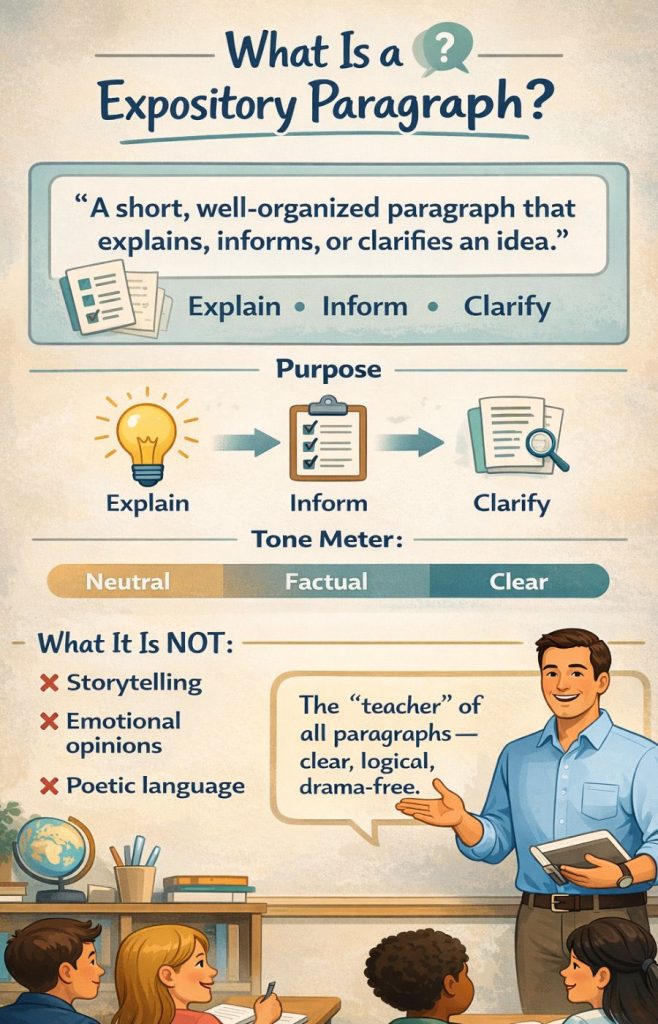
But the truth is far less dramatic: an expository paragraph is simply a short, well-organized block of writing that explains, informs, or clarifies an idea. That’s it. No poetry, no dramatic flair, no emotional spirals- just clear thinking on paper.
I like to think of it as the “teacher” of all paragraphs. It doesn’t gossip like a narrative paragraph or paint dreamy pictures like a descriptive one. Instead, it shows up with rolled-up sleeves and says, “Alright, let’s make this simple.”
A strong expository paragraph uses clarity, logic, and a factual tone to guide readers through information without confusion. It answers questions, breaks down ideas, and helps readers walk away thinking, “Oh… now that makes sense.”
Types of Expository Paragraph
Before my students panic at the thought of “another type of paragraph,” I like to remind them that expository writing isn’t one-size-fits-all. It’s more like a toolbox.
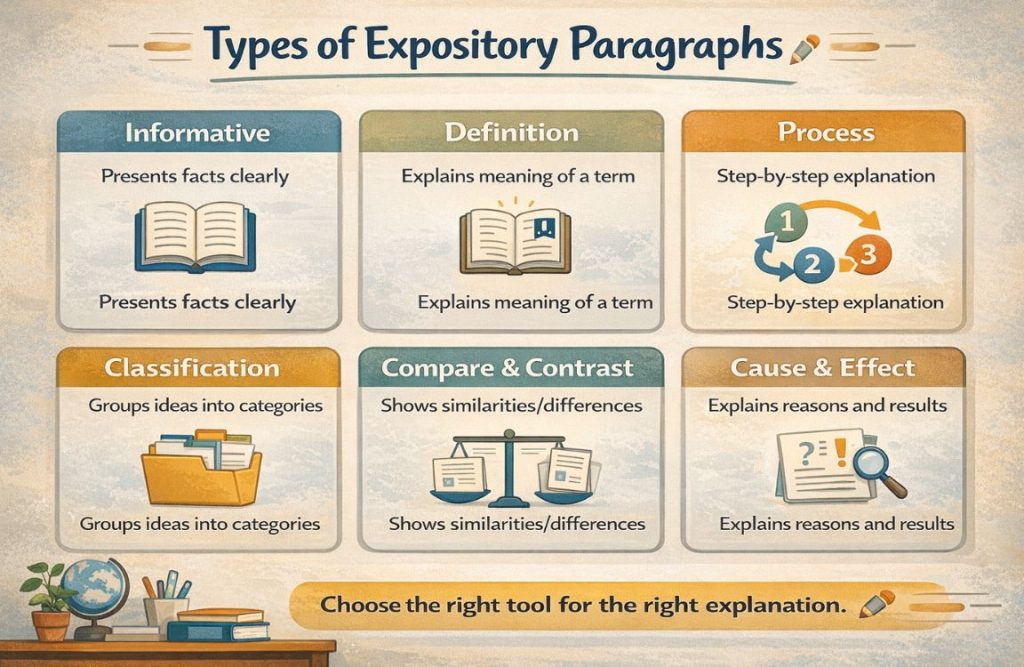
And every tool has a job. Once you understand these different types, writing becomes far less mysterious and far more manageable. Think of this as your guided tour through the expository universe.
Now, let’s explore the main types- each with its own personality, purpose, and superpower.
i) Informative Paragraph:
This one is the straight-talker. It presents clear, factual information without drama. If your goal is to explain something simply and accurately, this is your go-to.
ii) Definition Paragraph:
The “dictionary cousin” of expository writing. It explains what a term or idea really means. Perfect for moments when your reader might say, “Wait… what exactly is that?”
iii) Process Paragraph:
The step-by-step instructor. Whether you’re teaching how volcanoes erupt or how to make the perfect study schedule, this type breaks everything into logical, easy-to-follow steps.
iv) Classification Paragraph:
The organizer. It takes big, messy ideas and divides them into neat categories so readers don’t feel like they’re drowning in information.
v) Comparison/Compare-and-Contrast Paragraph:
The matchmaker of logic. It shows how two things are similar or different, helping readers make clearer judgments or connections.
vi) Cause-and-Effect Paragraph:
The detective. It explains why something happens and what results follow- great for science, history, and those “Why did this go wrong?” life moments.
Understanding these types doesn’t just help you define an expository paragraph. It helps you use the right tool at the right time.
Features of an Expository Paragraph
Whenever I teach expository writing, I tell my students to imagine the paragraph as that one friend who never exaggerates, never panics, and always gives directions you can actually follow.
That’s the heart of an expository paragraph: it’s dependable, straightforward, and refreshingly drama-free.
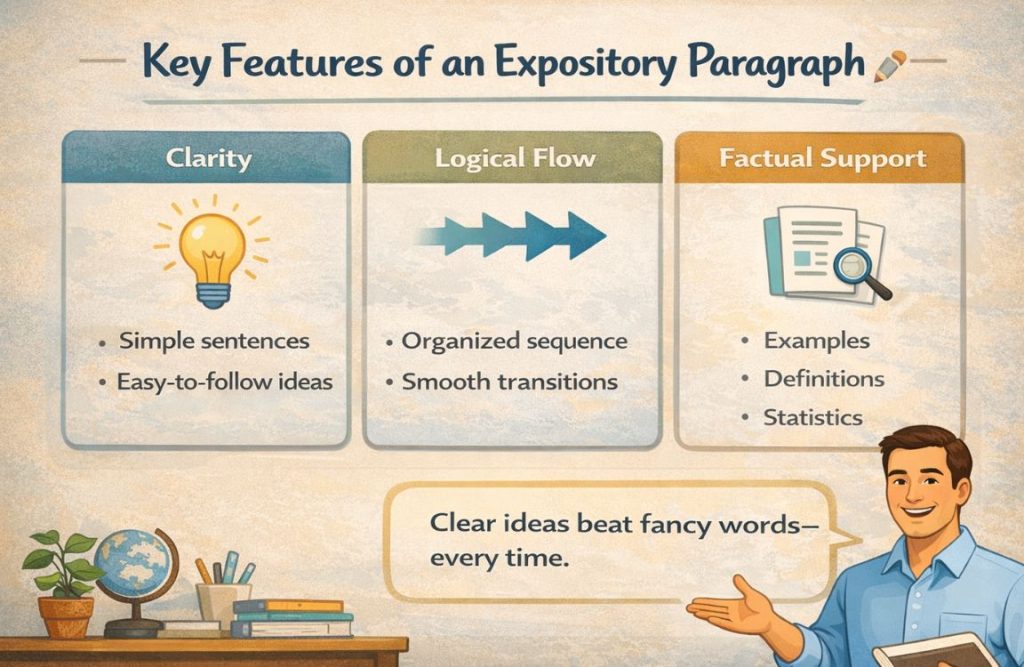
The first major characteristic is clarity. If your reader has to squint at your sentences the way I squint at my electricity bill, something’s wrong. An expository paragraph should feel like turning on a bright light- suddenly, the idea becomes easy to see.
Next comes a logical explanation. Think of it as guiding your reader through a clean hallway rather than a maze. Each sentence builds on the previous one, moving from point to point without detours or surprises. When your ideas flow smoothly, even complex information becomes surprisingly simple.
And finally, factual support. This is where expository and informative paragraphs shine. You’re not guessing or storytelling- you’re grounding your explanation in real information. Facts, examples, statistics, definitions… they give your paragraph backbone.
Put these characteristics together, and you get a paragraph that not only informs but actually makes sense– a small but mighty victory in the world of student writing.
Difference Between an Expository and Informative Paragraph
Whenever I explain the difference between an expository and an informative paragraph, I feel like I’m settling a quiet classroom debate no one wants to admit they’re confused about. So let’s clear the fog.
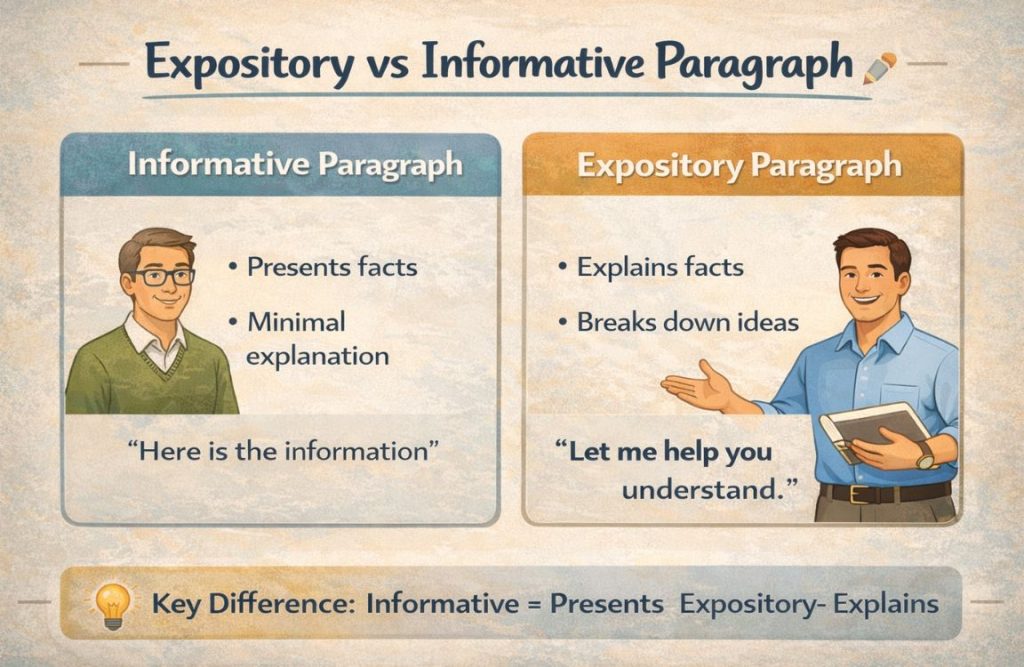
An informative paragraph is the friendly librarian of writing. It simply gives you facts. No arguments, no extra shaping, no guiding you toward a deeper conclusion. It says, “Here’s the information. Use it wisely.”
An expository paragraph, on the other hand, takes those facts and says, “Hold on, let me help you understand this.” It breaks things down, shows relationships, clarifies ideas, and connects the dots so the reader can actually follow the logic. Think of it as the librarian’s slightly more talkative sibling who not only hands you the book but explains the important parts.
So while both paragraphs deal with information, the difference lies in purpose:
- Informative = presents facts.
- Expository = explains facts.
Once students get this, the confusion melts faster than ice cream on exam day.
Structure of an Expository Paragraph
When I teach expository writing, I always remind my students that a strong paragraph isn’t magic. It’s a clear, logical structure doing the heavy lifting. Think of it as the blueprint that turns scattered ideas into a well-built explanation.
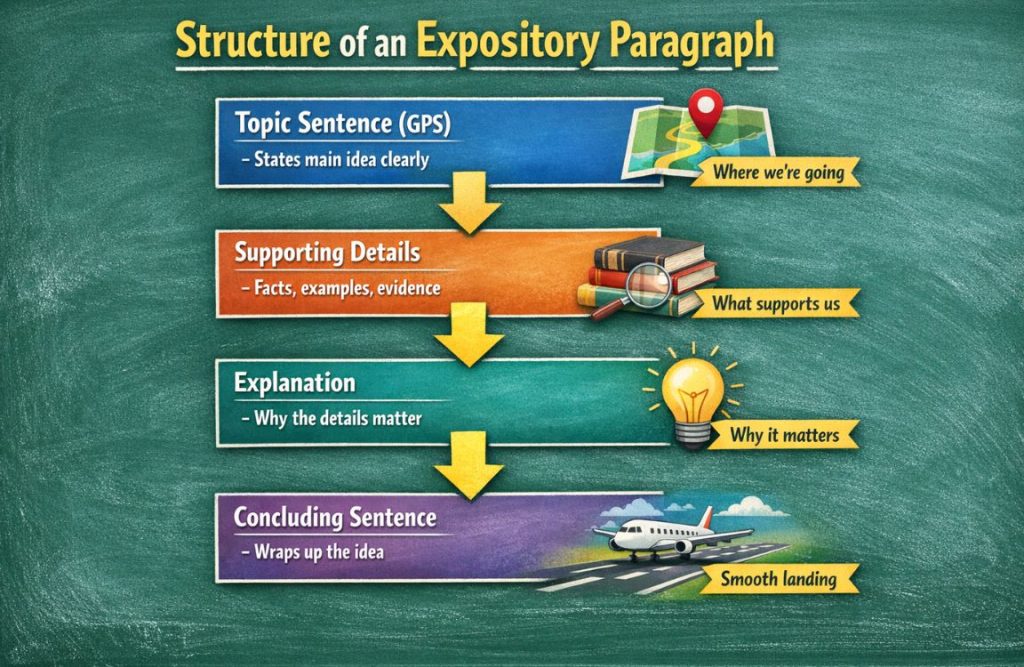
i) Topic Sentence:
Whenever I teach the expository paragraph structure, I tell my students to think of the topic sentence as the “GPS of your writing.” It’s that one powerhouse sentence that tells your reader exactly where they’re headed before you take a single step.
No mystery detours, no dramatic plot twists- just a clear, confident direction.
When I write mine, I imagine myself standing at the front of the classroom, saying, “Alright, team, here’s what we’re exploring today.”
ii) Supporting Details:
Here’s where the real magic of the expository paragraph format kicks in. Supporting details are your evidence, your mini-stories, your facts, your examples- the little sparks that make your main idea shine.
Think of them as the strong, dependable students who always have their homework done.
When I craft mine, I pick details that don’t just fill space but lift the whole paragraph, making the reader nod as though they’re discovering each idea with me in real time.
iii) Explanation:
Now, this is the part where I step into full teacher mode. The explanation section is where I slow down, roll up my sleeves, and actually walk my students through the “why” behind the details.
I love this moment because it transforms information into understanding. Here, you bridge the gap between fact and meaning.
It’s where the paragraph stops being a list of ideas and becomes an invitation to think- almost like whispering, “See how this all fits together?”
iv) Concluding Sentence:
The concluding sentence is your graceful exit- no slamming the door, no disappearing mid-lesson.
I like to treat it as a quick, satisfying echo of the main idea, something that wraps up the paragraph with a little nod of closure.
It’s the moment where you gently guide the reader back to solid ground, making them feel like the journey made sense and left them a little wiser than before. A simple, confident finish- nothing fancy, just right.
How to Write an Expository Paragraph: Step-by-Step
Before my students ever start typing, I tell them this: writing an expository paragraph is like guiding someone through a forest. You must know the path before you lead others. And once you learn the steps, trust me, the process becomes far less scary and a lot more empowering.
Step 1: Choose a Clear Topic (Topics List)
Whenever I begin teaching expository paragraph writing, I remind my students that the topic is the heartbeat of the whole paragraph. If the topic is fuzzy, the writing collapses like a poorly built sandcastle.
So, I always encourage them to pick something focused- something that can actually be explained in one solid paragraph.
Here are some simple expository paragraph topics that never fail in class:
- How rainbows form
- Why sleep matters
- How recycling works
- Causes of teen stress
- Benefits of reading daily
- And the science behind laughter
With a clear topic, students instantly feel more confident because they know exactly what they’re trying to explain.
Step 2: Plan Using a Graphic Organizer
Before I let students write a single sentence, I hand them a graphic organizer- their secret map to clarity.
Whether it’s a boxes-and-bullets chart or an expository paragraph anchor chart, planning saves them from mid-paragraph panic. They jot down the topic sentence, the supporting details, examples, and the final conclusion.
And honestly, this step feels like turning chaos into order. I’ve seen even the most overwhelmed writers breathe a sigh of relief once their ideas settle neatly into little boxes.
Step 3: Write With Clarity and Logic
Now comes the real fun- turning ideas into sentences. I coach my students to write with a factual, steady tone because expository writing should feel like opening a window and letting light in. No mystery, no confusion- just clean understanding.
Then we layer in transition words like first, next, for example, and as a result to keep the ideas flowing smoothly. This step transforms their explanations from choppy thoughts into a logical path the reader can easily follow.
It’s here that their expository paragraph writing becomes clear, organized, and surprisingly satisfying.
Step 4: Revise for Accuracy and Coherence
When we reach revision, I joke with my students that this is where the “real writing” happens. We zoom in on accuracy- checking facts, correcting vague statements, and trimming anything that wanders off-topic.
Next comes coherence: does every sentence connect? Does the explanation actually make sense?
This polishing step is what turns a basic paragraph into something that sounds thoughtful, intentional, and polished.
And whether they’re working on a full expository piece or not, this final pass always brings their work to life.
Expository Paragraph Examples (Short, Student-Friendly)
Whenever my students ask, “Sir, can you show us what a good expository paragraph looks like?”- I smile, because this is where the lightbulbs finally switch on. These short samples are the training wheels every writer needs before pedaling into their own paragraphs.
Example 1: About Life
Life often feels like a puzzle we’re solving without the final picture on the box, but understanding its small moments helps bring clarity. One meaningful part of life is learning from failure, because mistakes reveal where we need to grow. For example, when someone tries and fails at a task, like a school debate or a math contest. They gain insight into their strengths and weaknesses. These lessons shape who they become, guiding them toward better choices in the future. This shows that life becomes easier to navigate when we pay attention to the lessons each moment teaches.
Example 2: School Bag
A well-organized school bag can completely change a student’s day, even if it sounds like a small thing. When a bag is arranged neatly, students find their notebooks and supplies quickly, reducing unnecessary stress before class. For instance, keeping books in order of subject and using small pouches for essentials saves valuable time. This simple habit helps students stay prepared and attentive throughout the day. In short, a tidy backpack makes school life smoother and helps students take responsibility for their own learning.
Example 3: Photosynthesis
Photosynthesis is one of nature’s most important processes, and understanding it helps us appreciate how plants support life on Earth. In this process, plants use sunlight, carbon dioxide, and water to produce glucose, which acts as their food. For example, when sunlight hits a plant’s leaves, chlorophyll absorbs the light and triggers the chemical reaction that produces energy. This cycle not only feeds the plant but also releases oxygen into the atmosphere. As a result, photosynthesis plays a crucial role in keeping our environment balanced and breathable.
Expository Paragraph Topics for Exercise
When I teach expository writing, I tell my students this: your job isn’t to impress me. It’s to explain something so clearly that confusion doesn’t stand a chance. A strong topic does half the work for you. Here are 10 expository paragraph topics I love using in class because they invite clarity, structure, and real thinking:
- How social media shapes teenage identity
- Why sleep is essential for student success
- The causes of exam stress among students
- How peer pressure influences decision-making
- The importance of time management in school life
- Why critical thinking matters more than memorization
- How climate change affects everyday life
- The role of technology in modern education
- Why reading improves writing skills
- How habits shape long-term success
Each of these asks one simple thing: explain it well.
Common Mistakes in Expository Paragraph Writing
Whenever I check my students’ drafts, I can spot certain mistakes from a mile away- like brightly waving red flags shouting, “Fix me!” These are the traps that quietly weaken expository writing without students even noticing.
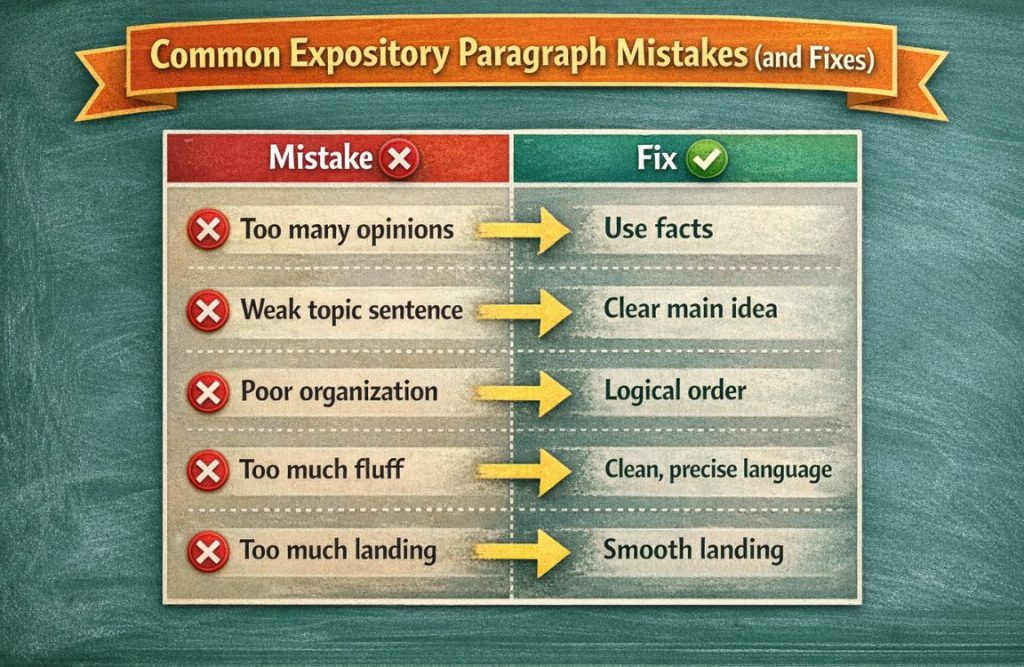
i) Too Many Opinions vs. Facts:
One of the biggest expository writing mistakes I see is when students slide into opinion mode without meaning to, almost like their paragraphs are having an identity crisis.
Instead of focusing on evidence, they start throwing in personal beliefs, emotional reactions, or dramatic expressions.
But an expository paragraph isn’t the place for “I feel” or “I think.” It survives on clear facts, logical explanations, and trustworthy information.
When you replace opinions with solid evidence, your writing becomes sharper, more credible, and much easier to understand.
ii) Weak Topic Sentence:
A weak topic sentence is like a teacher starting class without a plan- everyone ends up confused, including the writer. Many students jump into details without first making it clear what their paragraph is actually about. The solution?
Begin with a strong, focused statement that sets the direction from the very first line.
Think of it as the paragraph’s GPS signal: it tells the reader where they’re going and why it matters. Without it, the entire explanation feels scattered and hard to follow.
iii) Lack of Logical Order:
Sometimes students have great ideas, but they arrange them like a shuffled deck of cards. When details are out of order, the reader has to work twice as hard to understand the point.
Expository writing needs a clear structure: start with the main idea, follow with supporting details, and arrange them in a natural, logical sequence.
Whether you choose chronological order, classification, or cause-and-effect, stick with it. A steady flow makes your writing smoother and your message far more convincing.
iv) Overusing Adjectives or Fluff:
Some writers decorate their paragraphs like a festival stage- colorful but unnecessary. Expository writing isn’t about fancy words. It’s about clarity.
Extra adjectives, dramatic phrases, and filler lines only distract from your explanation. When you cut the fluff and keep your language clean, your ideas shine with much more confidence and precision.
Expository Paragraph vs Narrative & Descriptive Paragraph
Whenever my students ask me, “Sir, why does writing feel like switching personalities?” I can’t help but smile, because that’s exactly what happens when we move from an expository paragraph to a narrative or descriptive one. Each style has its own attitude, its own “mood,” and yes, sometimes its own drama.
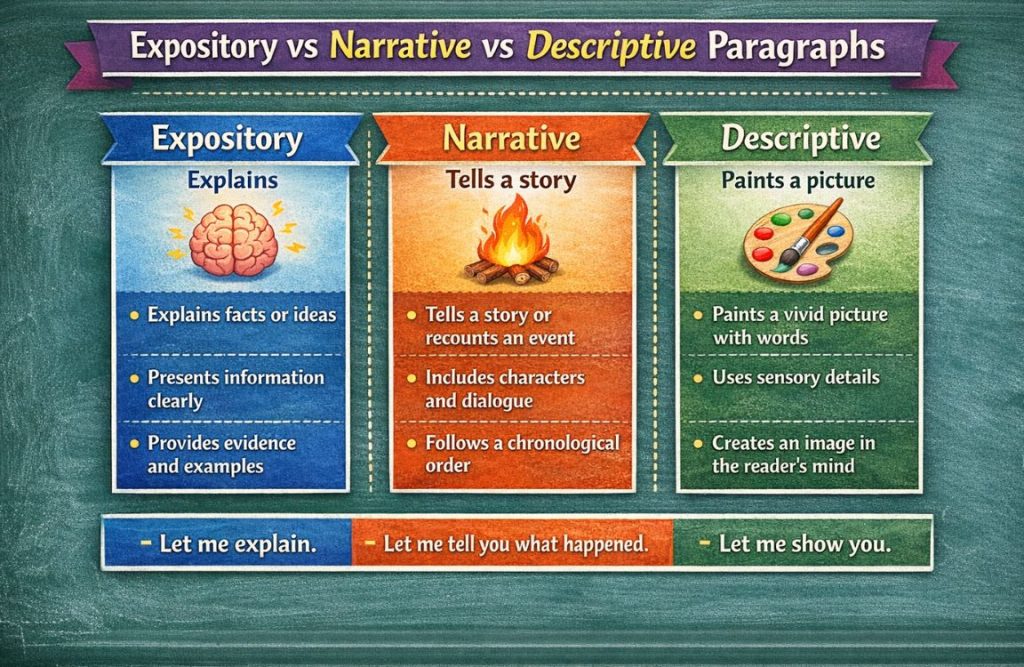
i) The Expository Paragraph: The Reliable Friend
The expository paragraph is that dependable, straight-talking friend who shows up with facts, clarity, and neat explanations. Its only mission is to inform.
- No drama.
- No suspense.
- No poetic side trips.
I often joke in class that expository writing is the student who submits homework neatly stapled, labeled, and even color-coded, because it’s all about organization and clarity.
ii) The Narrative Paragraph: The Campfire Storyteller
A narrative paragraph, on the other hand, is the storyteller warming up beside a campfire. It comes with characters, action, emotions, and maybe a twist or two.
Its goal?
To make you feel and follow something happening in real time.
iii) The Descriptive Paragraph: The Artist of the Group
Then we have the descriptive paragraph– the artist with a paintbrush in hand. It loves sensory details. It loves imagery. It loves showing you the world through colors, textures, sounds, and sensations.
While expository writing tells you what something is, descriptive writing shows you how it looks, feels, smells, or sounds.
My Simple Classroom Formulas:
Whenever students get confused, I give them these lines to keep things crystal clear:
- Expository = “Let me explain it to you.”
- Narrative = “Let me tell you what happened.”
And when comparing descriptive to expository, I remind them:
- Descriptive = “Let me show you the picture.”
- Expository = “Let me teach you the concept.”
Once you understand these differences, switching between writing styles becomes much easier- almost like choosing the right outfit for the right occasion. Each style shines beautifully in its own space.
Just be careful not to mix them up. Otherwise, your science explanation might suddenly start smelling like roses—and trust me, your readers will notice.
FAQ:
What makes a strong expository topic sentence?
Think of a topic sentence as a classroom announcement. It tells everyone exactly what’s coming. A good one states the main idea upfront, setting a clear direction so your reader isn’t wandering around wondering, “Where is this going?”
Can I include opinions in an expository paragraph?
You can, but only the well-behaved kind. Opinions must be backed by evidence, not vibes. If your claim can’t stand on its own two factual feet, it doesn’t belong here. Save the passionate speeches for persuasive writing or group discussions.
How long should an expository paragraph be?
It’s less about word count and more about completeness. Most solid paragraphs land between 120–180 words, but the real goal is balance: one clear idea, enough details to explain it, and a final sentence that neatly wraps up the thought.
How do I make my expository paragraph clearer?
Use strong transitions, organize your ideas in a natural order, and cut sentences that wander off-topic. I always tell my students: every sentence should be part of the same conversation. If it interrupts the flow, it needs a timeout.
What is the best way to end an expository paragraph?
Finish with a concluding sentence that gently ties everything together. It doesn’t introduce new information; it simply reinforces your main idea or leaves the reader thinking, “Ah, that makes perfect sense now.” A clean ending always wins.
Conclusion:
As I wrap up this little writing adventure with you, let me leave you with one truth I see every day in the classroom: strong paragraphs aren’t born. They’re built. And you build them the same way you’d build anything that matters… with clarity, intention, and just a pinch of courage.
If you’ve ever stared at a blank page thinking, “Where do I even start?”– trust me, you’re already miles ahead because now you know what makes writing work.
Every expository paragraph is simply you guiding your reader with honesty and logic. No drama. No fluff. Just clean thinking on paper.
So take a breath, take the lead, and let your writing do what good writing always does- teach, illuminate, and quietly impress.