
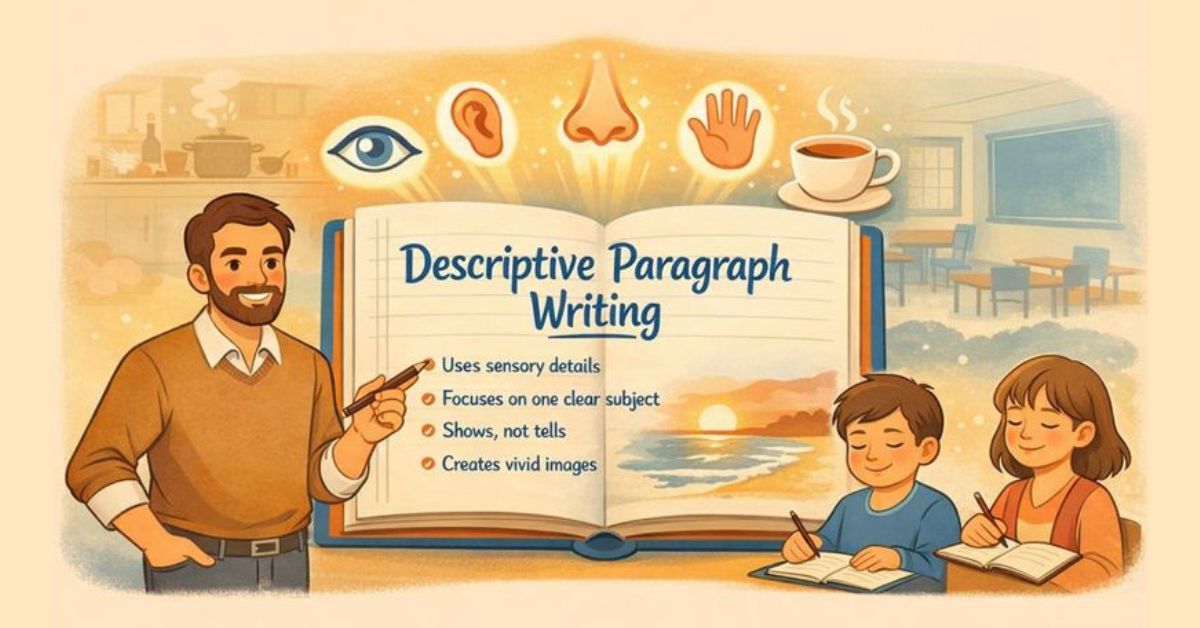
A descriptive paragraph is a piece of writing where I use sensory details to help my reader experience a person, place, object, or moment. In descriptive paragraph writing, instead of listing facts, I show how something looks, sounds, smells, feels, or even tastes. So, the reader can step inside the scene.
Now, let me take you into my classroom. I smile, clap once, and say, “Close your eyes. Describe this room, not what you see, but what you feel.” Instantly, I know who’s counting desks and who’s painting with words. That’s the difference.
A descriptive paragraph doesn’t report. It invites. Language becomes a camera lens, zooming in on details that matter. When I describe my grandmother’s kitchen, it’s never “she cooked food.” It’s onions hissing in oil, spices warming the air, bangles singing softly as memories stir.
That’s the magic. A good descriptive paragraph turns memory into experience and words into windows. If you’ve ever wondered how to make your writing feel real, congratulations. You’re already on the right path. Now, let’s learn to paint with words.
What Is Descriptive Paragraph Writing? (Definition & Meaning)
So, if we define a descriptive paragraph, it is a paragraph that uses vivid sensory details to help the reader clearly imagine a person, place, object, or moment. This is the definition of a descriptive paragraph I teach my students to remember.
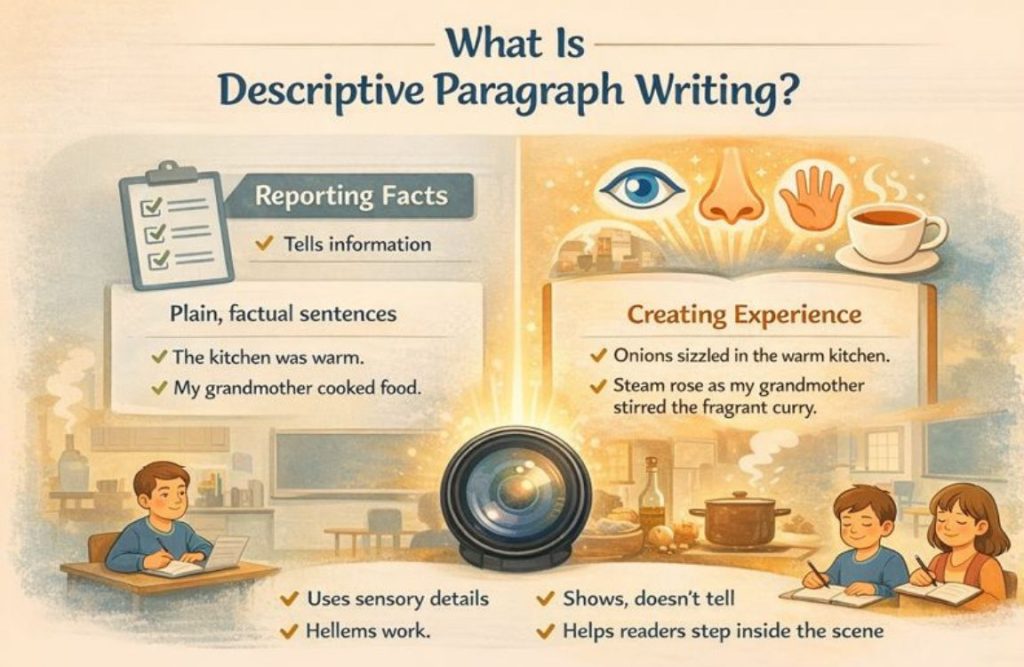
Now, class, let me slow you down before your pens sprint ahead. Imagine stepping into your grandmother’s kitchen. The air hums with a tired fan. Onions hiss in oil. Memory taps you on the shoulder. You don’t just see the place. You feel it. Right?
That’s what a descriptive paragraph does. It turns language into a lens. You’re not taking a quick photo. You’re letting the reader walk around the room, touch the walls, breathe the air.
Here’s my classroom rule: don’t write about something. Write through it. “It was sunny” is a weather report. “The sun sprawled lazily across the rooftop” is an experience.
When students get this right, the room goes quiet. Words stop behaving like words. They start behaving like magic.
Read Also, “What Is a Paragraph? Types, Structure & Examples Explained:”
Table of Contents
Characteristics of a Good Descriptive Paragraph
Many students think that writing a descriptive paragraph is just a pile of adjectives: beautiful, nice, wonderful. Absolutely not. That’s decoration, not description. A good descriptive paragraph has three real qualities, and each one has a job to do.
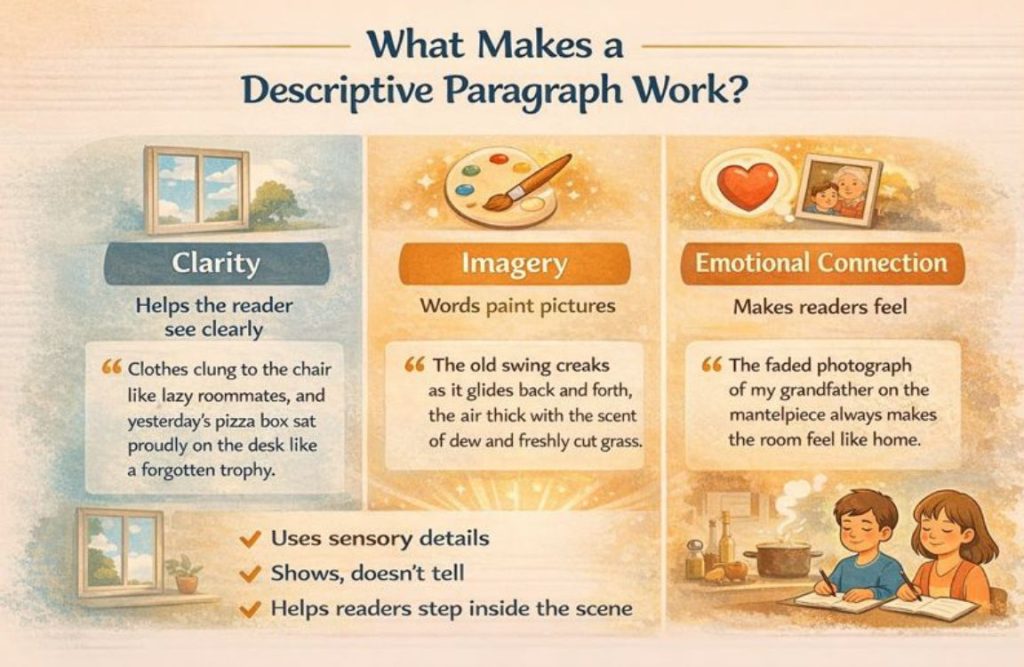
1. Clarity: Your Reader Deserves a Clear View
When you write, imagine you’re guiding someone through your memory. Don’t fog up the window.
Instead of saying, “The room was messy,” say, “Clothes clung to the chair like lazy roommates, and yesterday’s pizza box sat proudly on the desk like a forgotten trophy.”
See the difference? Clear writing helps your reader see the scene exactly as you do.
2. Imagery: Let the Words Paint, Not Preach
If your words can make the reader’s mind say, “Whoa, I can see that,” then congratulations. You’ve mastered imagery.
A descriptive paragraph without imagery is like biryani without spice- technically food, but deeply disappointing. Use sensory details: let your reader smell the rain, feel the chalk dust, or hear the ceiling fan’s tired hum.
3. Emotional Connection: Make Them Feel It
A great descriptive paragraph goes beyond showing the scene. It makes the reader feel something about it. It might be nostalgia, warmth, discomfort, or quiet joy. When your reader feels something, they remember it.
So, remember, clarity lets your reader see, imagery helps them imagine, and emotion makes them remember. Mix all three, and you’ve got yourself a paragraph that doesn’t just describe a moment. It keeps it alive.
Descriptive Paragraph Format & Structure
When I teach descriptive writing, I tell my students the paragraph is a tiny stage- everything and everyone must fit into the scene, and nothing should wander offstage. A good descriptive paragraph has a clear focus (one subject), vivid sensory detail, smooth sentence flow, and a short, memorable closing line.
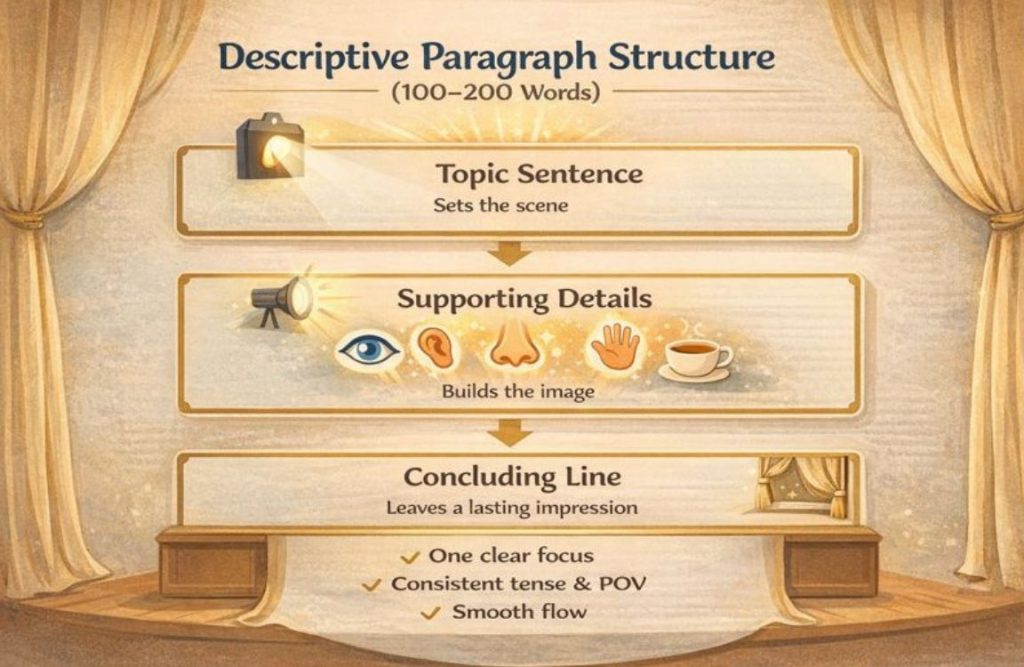
Think of format as the stage design:
- Topic Sentence: One strong topic sentence
- Supporting Details: 4–7 supporting sentences that paint the picture of your topic
- Concluding Line: And a concluding sentence that leaves the audience with a feeling, not a summary.
Keep your tense and point of view consistent, choose either first or third person, and keep each sentence working toward that central image. The ideal length for school work is usually 100–200 words: long enough to build atmosphere, short enough to keep attention.
How to Write a Descriptive Paragraph: Step by Step
Here, you’ll learn- step by step and in simple language- how to write a descriptive paragraph that paints a scene with clear focus and vivid detail.
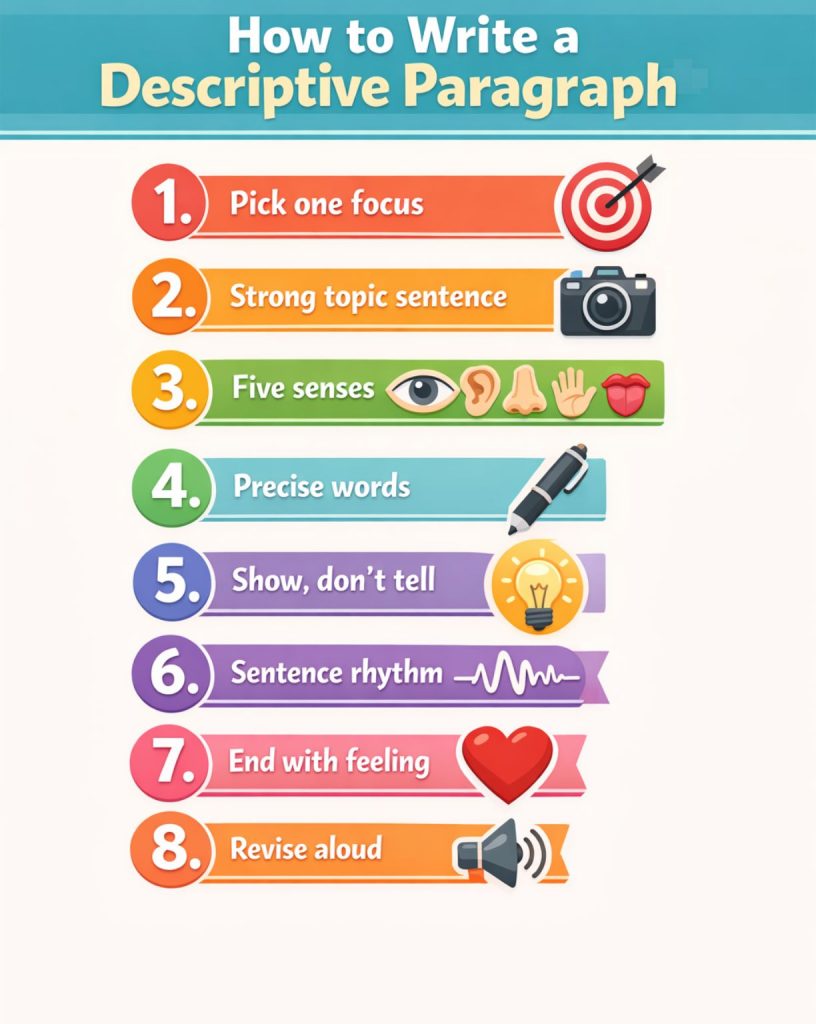
i) Pick a Single Focus: Choose one person, place, or object. Don’t describe the whole world- just your chosen corner.
ii) Anchor with a Strong Topic Sentence: Open your paragraph with a line that gives your reader the “camera angle.”
Example: “The old schoolyard smelled of mangoes and chalk dust.”
iii) Observe with Your Five Senses: List what you see, hear, smell, touch, and taste if relevant. In class, I make students close their eyes and jot down five details in sixty seconds- game on.
iv) Use Precise, Active Language: Swap vague words for sharper ones. Verbs carry movement. Adjectives color the scene.
v) Show, Don’t Label: Instead of “He was nervous,” try: “His fingers drummed the desk like a tiny, anxious drummer.”
vi) Vary Sentence Length and Rhythm: Short sentences punch. Long ones breathe. Mix them like music.
vii) End with a Feeling, Not a Recap: Your final line should leave an impression, not restate. Think mood, insight, or a lingering sensory note.
viii) Revise Aloud: Read it aloud. If it makes you feel something, it will make your reader feel it too.
Follow these steps, and your descriptive paragraph will stop being a list and start becoming a place someone can visit.
Descriptive Writing Techniques & Style
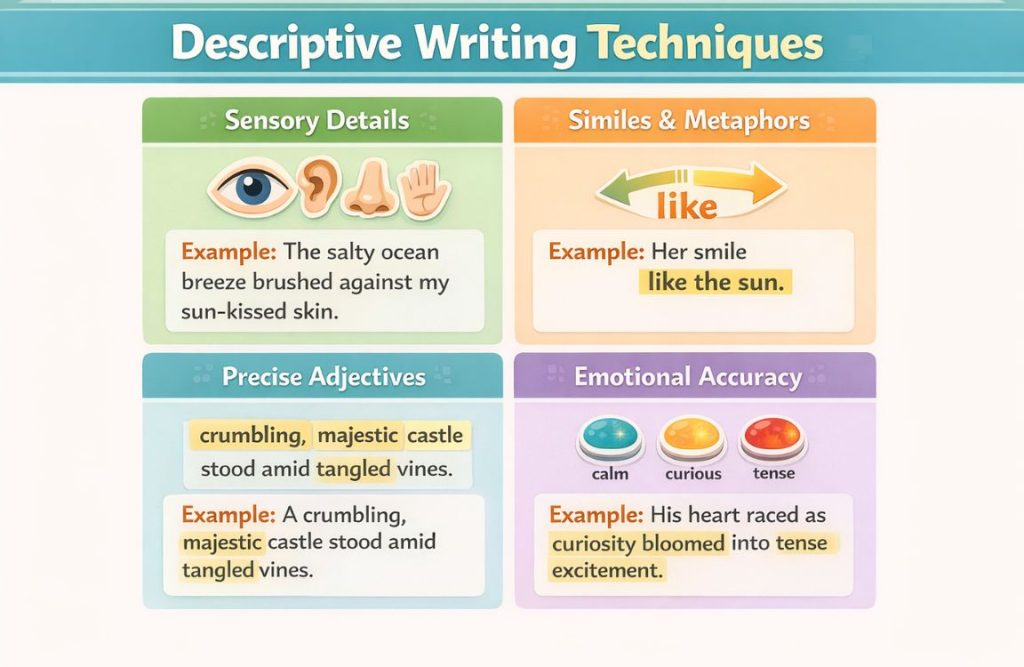
Here’s the real purpose of descriptive writing: to move your reader. Not with big emotions, but with the quiet magic of detail. This section focuses on tools, not steps.
1. Sensory Details:
These are the heartbeat of descriptive style. The crunch of dry leaves, the sting of sea air, the sweetness of your grandmother’s tea- details like these wake up your reader’s senses and make your scene feel real.
2. Similes and Metaphors:
They’re the jazz of descriptive writing. A simile compares: “Her smile was like sunrise.” A metaphor transforms: “Her smile was sunrise.” Both add energy and music to your language.
3. Precise Adjectives:
“Nice” is lazy. “Velvety,” “bitter,” “gleaming,” “dusty”- those words actually build images. I tell my students, “If your adjective doesn’t make a reader’s eyebrow twitch, find a better one.”
4. Emotional Accuracy:
Good style isn’t about fancy vocabulary. It’s about choosing words that capture the exact feeling or mood you want the reader to stand inside.
When these stylistic tools come together, your writing stops being a description and becomes an experience someone remembers. Don’t just write the scene. Paint it with words.
Descriptive Paragraph Examples for Students
Let’s be honest- reading about how to write a descriptive paragraph is one thing, but seeing it in action is where the real learning happens. So, let’s walk together through a few vivid examples that’ll make you feel the power of description, not just understand it.
Descriptive Paragraph About a Place: The Beach
The beach stretched endlessly before me, golden sand warm beneath my feet, whispering promises of summer. Waves curled and crashed like restless dancers, leaving foamy footprints behind. The salty breeze tangled my hair while the horizon melted into the sea, painting everything in gold. As I watched the sun dip below the water, I realized- the beach doesn’t just exist. It breathes, it listens, it remembers.
See what’s happening here? Description isn’t just about what a place looks like. It’s about how it feels. The best descriptive paragraphs don’t build walls of words. They open doors to experience.
Descriptive Paragraph About a Person: My Mother
My mother isn’t just a person. She’s a walking sunrise. Every morning, her laughter spills through our home like warm light through half-drawn curtains. Her hands, always busy with a cup of tea or a comforting touch, carry stories of care, sacrifice, and stubborn love. When she scolds me for leaving my socks everywhere (which happens far too often), I swear even her anger smells like cardamom. That’s how I know her, not just by what she does, but by the warmth she leaves behind in every room.
Or take a best friend- the one who finishes your sentences and laughs at your worst jokes. You don’t describe their height or hairstyle first. You describe how they make the world less heavy. A good descriptive paragraph paints a person so vividly that readers feel they’ve met them- or wish they could.
Descriptive Paragraph About a Famous Person
If I could describe one person who inspires me the most, it would be Dr. A. P. J. Abdul Kalam, the “Missile Man of India” and the teacher who never stopped teaching. Whenever I think of him, I picture a gentle face crowned with silver waves of hair- like a cloud carrying lightning inside. His eyes, kind yet fierce, held the light of a thousand dreams meant for others. Dr. Kalam wasn’t just a scientist. He was a storyteller of hope. He believed that dreams weren’t meant for sleep. They were blueprints for change. I still remember watching one of his speeches online. It felt like he was speaking directly to me, reminding me that greatness begins quietly, in classrooms like ours, with students who dare to think differently. To describe Dr. Kalam is to describe dedication made human. His simple white kurta, his soft-spoken words, and that ever-present smile- everything about him whispered humility. He’s proof that true power doesn’t shout. It teaches, uplifts, and leaves the world better than it found it.
Grammar, Tense & Point of View in Descriptive Writing
Alright, confession time. When my students begin a descriptive paragraph, they often look at me with that wide-eyed, slightly panicked expression that says:
“Sir… which tense am I supposed to use?!”

I get it. Grammar and tense can feel like juggling three oranges while riding a unicycle. But here’s the secret: once you find the rhythm, it’s actually fun. Let’s begin with the golden rule:
Choose your tense and point of view before you start describing. Otherwise, you’ll end up describing your grandmother in both past and present at once, and that’s a plot twist even Shakespeare would raise an eyebrow at.
i) Choosing the Right Tense:
Tense decides when your description lives.
➤ Use the Present Tense for immediacy:
Choose the present tense when you’re describing something as it appears right now. It makes the scene feel alive and unfolding.
My teacher stands at the front of the class, his eyes sharp but kind, like he can see the answers hiding behind our hesitation.
See the effect? We’re not remembering. We’re there.
➤ Use the Past Tense for memory:
When you’re writing about something that has already happened, the past tense wraps your description in reflection and nostalgia.
My teacher stood at the front of the class, his voice soft but steady, like a melody that could make even grammar rules sound poetic.
Same teacher. Same classroom. But now we’re looking back, and the mood quietly changes.
Teacher takeaway: Choose tense first. Description follows.
ii) First Person vs. Third Person Point of View:
The point of view decides whose eyes the reader sees through.
➤ First Person (“I,” “my,” “we”): Step inside the moment:
First person pulls readers directly into your experience. It’s personal, emotional, and close.
I still remember the way my grandmother’s bangles jingled as she cooked, like little bells celebrating every moment of her life.
➤ Third Person (“he,” “she,” “they”): Observe like a storyteller:
The third person creates a little distance, allowing the writer to observe more calmly and broadly.
Her bangles jingled as she cooked, filling the room with the music of memory and care.
Both work beautifully. The choice depends on what you want your reader to feel:
- To live the moment with you? Use first person.
- To watch the moment unfold? Use the third person.
Teacher takeaway: Point of view controls emotional distance. Choose it on purpose.
Final Classroom Reminder:
Grammar isn’t your enemy. It’s your camera.
- Tense sets the lighting.
- The point of view chooses the lens.
Once you control both, every descriptive paragraph you write becomes a vivid snapshot pulled straight from life- clear, focused, and emotionally true.
Descriptive Paragraph Topics & Creative Ideas
When I teach descriptive writing, I often tell my students, “Don’t just pick a topic. Pick a moment that feels alive in your memory.” The best descriptions come from places and people that stir something inside you- joy, nostalgia, even that bittersweet ache of time gone by.
Alright, let’s roll up our sleeves and explore!
i) Places That Tell a Story:
Ah, places- they’re not just locations. They’re living memories waiting to be described. A good description doesn’t just tell us what a place looks like. It tells us how it feels to stand there. Try writing about:
- The quiet corner of your classroom during exam week
- Your grandmother’s kitchen (bonus points for sensory details- the smell of spices, the hiss of frying oil!)
- A beach at sunset where the sky looks like it’s blushing
- Your favorite study spot (even if it’s your messy desk- chaos has its charm!)
- A rainy afternoon in your hometown
ii) People Who Stay in Our Hearts:
Descriptive paragraph writing about people isn’t about listing features. It’s about painting presence. Think of the gestures, voices, or quirks that make them unforgettable. You could describe:
- Your mother wakes up before sunrise to make breakfast
- A friend who can turn any bad day into a comedy show
- Your favorite teacher (and no, flattery won’t earn you extra marks- but it might make a great paragraph!)
- A grandparent who tells the same story every time but makes it sound new
- A stranger you met once but never forgot
iii) Memories That Refuse to Fade:
Ah, memory- the most emotional lens of all. Writing about memories lets you revisit them, relive them, and sometimes even rewrite how they felt. Practice with these:
- The day you achieved something you thought was impossible
- Your first day at school (panic, excitement, or both?)
- A festival or celebration that filled your home with laughter
- A time you got lost, and found something unexpected
- The moment you realized how much someone meant to you
iv) Objects with Hidden Stories:
Even the smallest objects can hold whole worlds inside them- like tiny time capsules of emotion. Try describing:
- An old diary or notebook filled with doodles and secrets
- Your favorite piece of jewelry or a family heirloom
- A childhood toy that’s seen better days but still makes you smile
- The handkerchief you still keep from a special moment (Othello, anyone?)
- The well-worn shoes that have “walked” through memories with you
v) Seasons That Speak in Colors:
Nature is the easiest and most poetic muse for description. Each season is like a character with its own mood, rhythm, and soundtrack. Play with ideas like:
- Winter mornings when the world feels wrapped in silence
- A spring garden bursting with impossible greens
- The first monsoon rain, hitting dry earth- that smell!
- Autumn leaves, dancing as they’ve just been set free
- The burning gold of a summer evening
When you pick a topic, don’t just describe what you see. Describe what you feel, smell, hear, and even what you remember. A great descriptive paragraph doesn’t just paint a picture. It plays a movie in the reader’s mind.
Now, take one topic from above, close your eyes, and start writing. I promise- the moment you do, your words will begin to breathe.
Descriptive Paragraph Revision & Checklist for Students
I often tell my students, “Revision is like cleaning your room before guests arrive.” You may think it looks fine, but there’s always a sock hiding somewhere it shouldn’t be. Descriptive writing works the same way. Before you submit your paragraph, pause and polish. It deserves that final care.
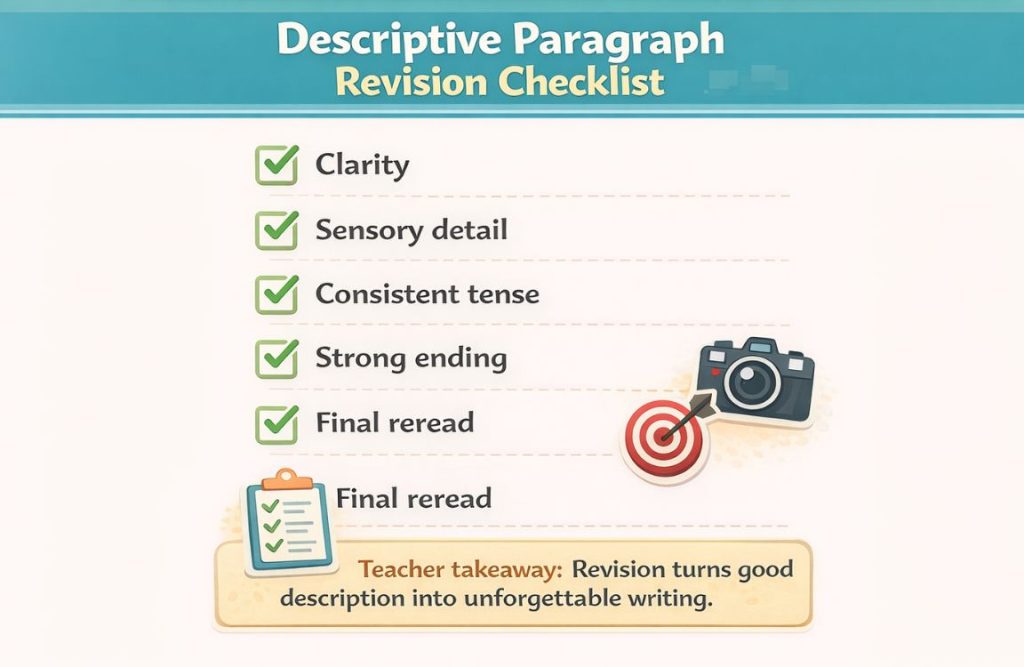
i) First, check clarity. Ask yourself: Can my reader see exactly what I see? Replace vague lines like “It was beautiful” with specific images that travel- blushing skies, warm air, familiar smells.
ii) Next, do a sensory check. Are at least two or three senses alive? Sight, sound, smell, touch- just enough to wake the scene up.
iii) Then, look at the tense. No time travel, please. Choose past or present and stay there.
iv) Finally, examine your ending. A good paragraph should linger, not fade out.
Give it one slow reread. If it feels right, it’s ready.
Teacher takeaway: Revision turns a good description into unforgettable writing.
FAQ:
How long should a descriptive paragraph be?
Usually 8-12 focused sentences. Not too short, not too long- just enough to create a clear impression.
What’s the difference between descriptive and narrative writing?
Narrative moves through events. Descriptive pauses and zooms in on one moment.
How can I make my description more creative?
Use comparisons (similes, metaphors) and precise words- not more words, just better ones.
Final Thought:
Let me leave you with this: description is the bridge between imagination and language. It’s how you take something that lives only in your mind and make others see it, feel it, believe it.
When I teach descriptive paragraph writing, I often tell my students, “You’re not just learning to write. You’re learning to translate the invisible.” Think about it: when you describe your mother’s smile, your childhood home, or the smell of rain hitting warm earth, you’re giving life to things that exist only as sensations. You’re turning memories into music. Words into worlds.
And yes, it’s not always easy. Sometimes you’ll stare at the screen, trying to describe a sunset that refuses to sound as beautiful as it looked. But that’s the magic of it. Descriptive writing is the practice of seeing. It trains you to notice the shade of emotion behind every face, the hum of silence in an empty room, the poetry in the ordinary.
So, my advice? Keep your eyes curious and your words brave. Carry a notebook if you must, but more importantly, carry wonder. Because the moment you start describing not just what you see, but how it makes you feel, you’ve already become a true writer.
Remember, imagination builds the bridge, but language is the way you let others cross it.