
A definition paragraph is a type of expository paragraph that explains the meaning of a word or concept by breaking it down clearly, accurately, and thoughtfully for the reader.
That’s the textbook truth, but let me put on my teacher hat for a second. When I stand in front of my students and see that “I kind of get it, but not really,” look, this is the paragraph I reach for.
A definition paragraph doesn’t just tell you what something is. It patiently walks you through why it means what it means. Think of it as turning on the classroom lights instead of handing you a flashlight.
In academic writing, we use it to clear confusion before ideas start running wild. Don’t worry, I’ll show you its structure and examples next.
Table of Contents
Definition Paragraph Writing: Meaning and Explanation
Think of this as the moment in class when I pause, lean on the desk, and say, “Alright, let’s really understand this.”
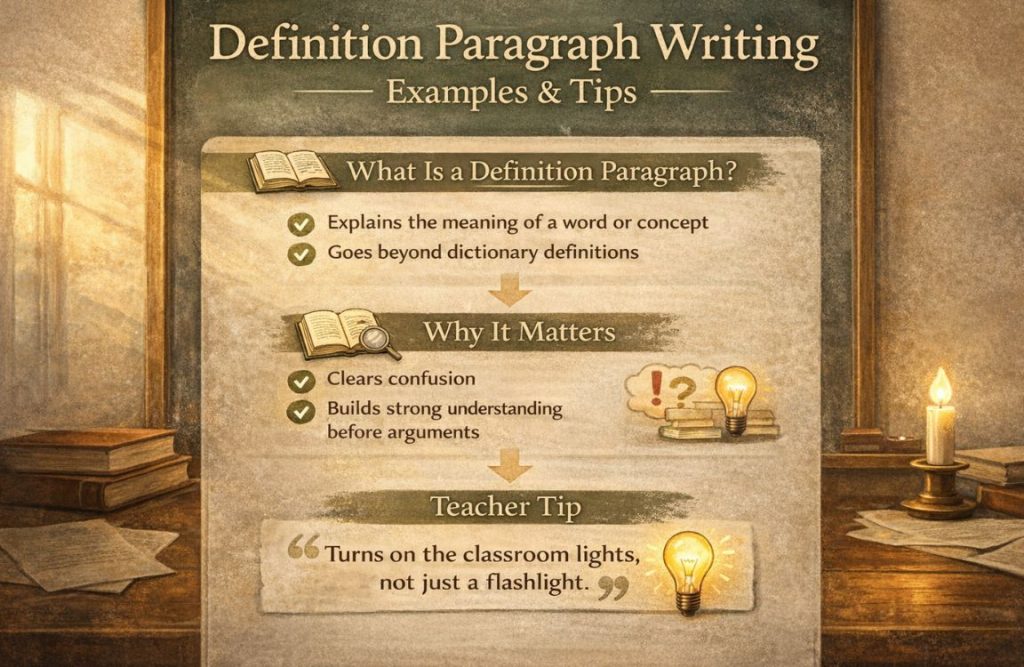
i) What Is a Definition Paragraph?
When students ask me for the definition of a definition paragraph, I smile, because this is where confusion loves to hide. A definition paragraph, explained simply, goes beyond a neat dictionary line.
A dictionary gives you a snapshot. A definition paragraph gives you the full story. It explains a term by placing it in context, unpacking its meaning, and showing how it actually works in real thinking and writing.
In class, I tell my students it’s the difference between knowing someone’s name and truly knowing who they are. This paragraph doesn’t rush. It clarifies, expands, and patiently removes misunderstanding, one sentence at a time.
ii) What Definition Paragraph Means in Writing?
In academic writing, a definition paragraph acts like a translator between complex ideas and human understanding. Many concepts, like justice, freedom, or identity, simply refuse to behave within one sentence.
I’ve watched students try, sigh, and try again. That’s because serious ideas need space to breathe. This paragraph gives them that space, allowing meaning to unfold logically and clearly for the reader.
iii) Key Characteristics of a Definition Paragraph:
A strong definition paragraph stays loyal to one idea, explains it with precision, and supports it thoughtfully. It may use examples, comparisons, or facts, but never wanders off-topic.
I tell my students: if your paragraph starts chasing squirrels, your definition loses its power. Stay focused, stay clear, and let evidence do the teaching alongside you.
Purpose of a Definition Paragraph
This is the moment in class when a hand goes up, and a student says, “But what does it really mean?” The purpose of a definition paragraph is to bring clarity where confusion sneaks in, especially in definition paragraphs in writing and research.

i) Why Do Writers Use Definition Paragraphs?
I’ve seen it happen a hundred times: a student uses a big, impressive word, and the room nods politely, while no one truly understands it. That’s where definition paragraphs earn their chalk.
Writers use them to tame abstract ideas and technical terms that refuse to behave. Without one, words like freedom, bias, or algorithm become fog machines, not tools. A definition paragraph clears that fog.
It eliminates ambiguity, aligns the writer and reader on the same mental page, and quietly says, “Here’s exactly what I mean, no guessing required.” It’s like agreeing on the rules of the game before the whistle blows.
ii) Definition Paragraph in Academic & Research Writing:
In academic and research writing, definition paragraphs are not decorative. They’re structural beams.
I often tell my students that strong essays are built, not hoped into existence. These paragraphs appear in introductions to ground readers and in body paragraphs to support complex arguments.
In exams, they show precision. In research papers, they protect credibility. When ideas are clearly defined, arguments stand taller, evidence lands harder, and readers trust the writer enough to keep reading.
Structure of a Definition Paragraph
This is the part of the lesson where I draw three boxes on the board and say, “Relax, this has a backbone.” A strong outline of a definition paragraph keeps ideas from collapsing, while thoughtful development of a definition paragraph turns meaning into something readers can actually follow.
i) Basic Structure of a Definition Paragraph:
Every definition paragraph I teach rests on three sturdy legs. First comes the topic sentence, where the term stands up and introduces itself clearly.
Next are the supporting sentences, the real classroom discussion, where meaning is explored, clarified, and tested.
Finally, the concluding sentence ties everything together, reminding the reader why this definition matters. I tell my students: skip one leg, and the paragraph wobbles like a broken desk.
ii) Definition Paragraph Format Explained:
Format is where thinking learns to walk in a straight line. A definition paragraph must move logically, guiding the reader step by step instead of dragging them through mental potholes.
Transitions act like signposts- for example, in contrast, in other words– quietly steering understanding. The academic tone keeps things respectful and precise, like a calm teacher who explains without shouting or oversimplifying.
iii) How does a Definition Paragraph Develop an Idea?
This is where definitions grow muscles. A paragraph may use examples to make meaning visible, comparisons to sharpen understanding, negation to explain what something is not, or classification to show where it belongs.
I’ve watched students’ faces change when an idea finally clicks; that moment happens because the paragraph expands beyond a bare definition. It explores, tests, and reshapes the idea until it feels solid enough to hold.
How to Write a Definition Paragraph (Step by Step)
This is the moment I roll up my sleeves and say, “Watch closely.” Here, writing becomes thinking- starting with a clear idea, building meaning patiently, and knowing when to stop. A strong paragraph doesn’t rush. It teaches, explains, and then steps back.
Step 1: Choose the Term to Define
I always tell my students: don’t bring a butter knife to a thinking problem. Concrete words like chair or apple don’t need a paragraph. They need a label.
Instead, choose abstract or layered terms such as success, justice, or digital privacy. These ideas invite explanation, disagreement, and depth.
Avoid words that are too simple, because a definition paragraph should stretch the mind, not just fill space.
Step 2: Write a Clear Topic Sentence
This is where your paragraph plants its flag. The topic sentence should offer a formal, confident definition and clearly position the term for the reader.
I imagine introducing a guest to the class: name them, explain who they are, and set expectations. A vague topic sentence confuses. A precise one earns trust and prepares the reader for what’s coming next.
Step 3: Develop the Definition
Now the real teaching begins. This is where students often light up, or panic. I remind them that development is simply a thoughtful explanation. Use examples to make ideas visible, facts to ground them, and comparisons to sharpen meaning.
One golden rule I repeat like a mantra: never define a word by repeating the word. That’s like explaining a joke by telling the same joke again. Expand the idea, test its boundaries, and let understanding grow naturally.
Step 4: Conclude the Paragraph Effectively
A good ending doesn’t repeat. It reinforces. The concluding sentence should gather the meaning you’ve built and leave the reader with clarity, not clutter.
I tell my students to imagine closing a lesson: you don’t re-teach every point. You remind them of what they now understand. End with confidence, not echo.
Types of Definition Paragraphs
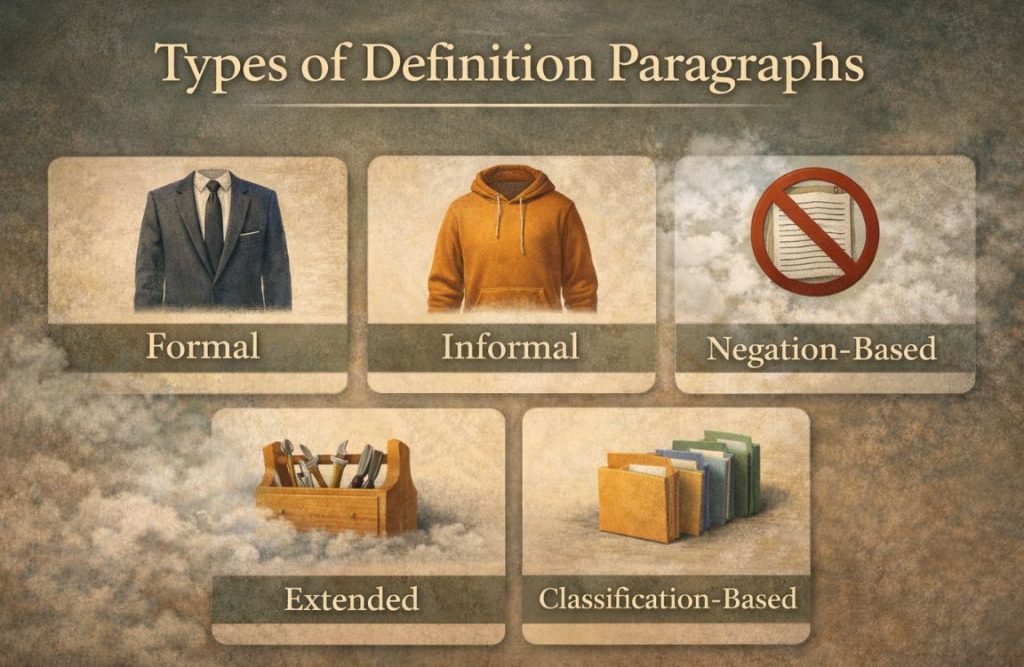
This is one of my favorite teaching days, the day students suddenly realize that paragraphs have personalities. I watch their faces when I say, “Yes, writing has moods. Some paragraphs wear suits. Others show up in sneakers.” Definition paragraphs are no different. Their tone, length, and strategy shift depending on why they’re written and who they’re talking to.
i) Formal Definition Paragraph:
The formal definition paragraph is the straight-backed student in the front row. You meet it in exams, essays, and research papers.
Its job is simple but serious: explain a term clearly, precisely, and without flair getting in the way. Every word earns its place.
ii) Informal Definition Paragraph:
Then there’s the informal definition paragraph, the one leaning casually against the desk. It lives in blogs, reflections, and creative writing.
The meaning stays clear, but the language relaxes, allowing personality, humor, and voice to step forward without losing control.
iii) Extended Definition Paragraph:
Some ideas refuse to behave. That’s where the extended definition paragraph steps in. When a concept is abstract or layered, I tell students to slow down and unpack it- using examples, comparisons, and explanations until the idea finally clicks in understanding.
iv) Negation-Based Definition Paragraph:
The negation-based definition paragraph works like a bouncer at the door. It says, “This is not that,” clearing confusion before letting meaning enter.
I use this when students keep mixing concepts or holding onto misconceptions.
v) Classification-Based Definition Paragraph:
The classification-based definition paragraph is the organizer. It is defined by sorting- placing an idea into groups so readers can see where it belongs and how it relates to similar concepts.
My classroom rule? If an idea feels slippery, misunderstood, or complex, don’t force it into one box. Good writing often blends types, just like good teaching does.
Formal vs Informal Definition Paragraphs
A formal definition paragraph is the student who sits up straight and raises a hand before speaking. It belongs in essays, exams, and academic writing, using precise language and a serious tone.
An informal definition paragraph, on the other hand, relaxes a little. It appears in blogs, personal writing, or reflective pieces, where creativity and voice are welcome.
I tell my students: same idea, different outfits. The context decides whether your paragraph wears a blazer or a hoodie.

Definition Paragraph vs Descriptive Paragraph
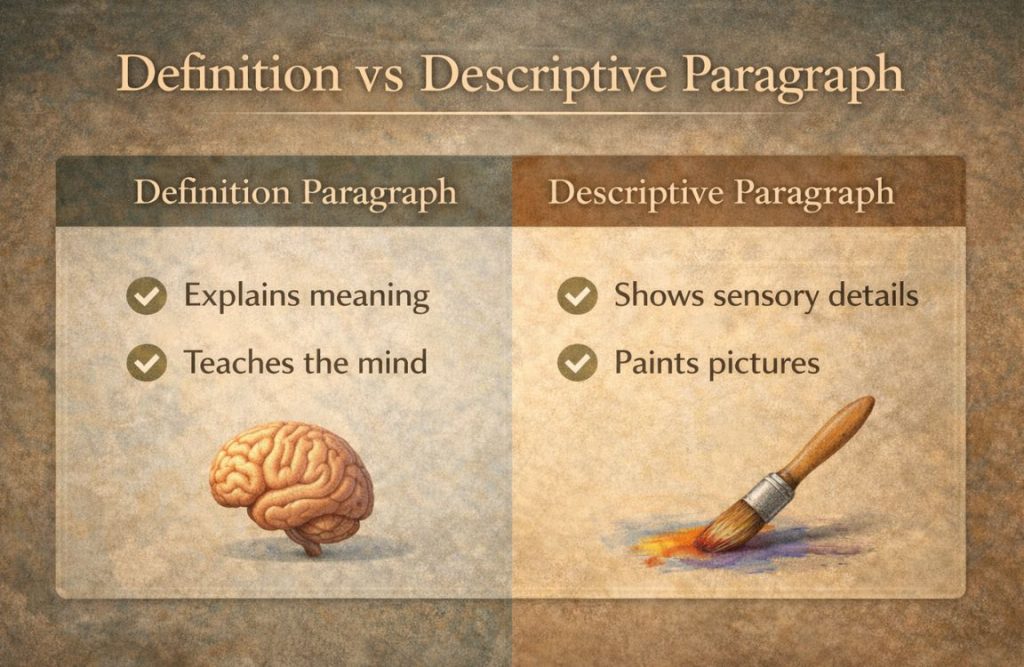
This comparison always sparks a few “Ohhh” moments in class. A definition paragraph focuses on explaining what something means, while a descriptive paragraph focuses on what something looks, feels, or sounds like.
One teaches the mind. The other paints pictures for the senses. If you describe a storm, you show the rain and thunder. If you define it, you explain what makes it a storm in the first place.
Definition Paragraph vs Expository Paragraph
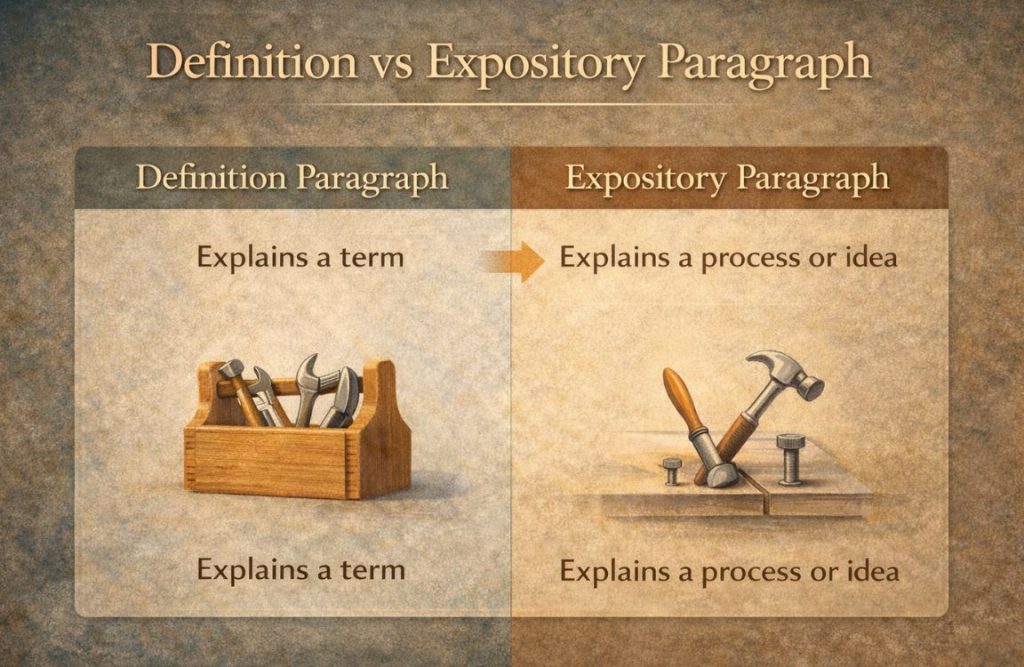
Here’s where lines blur, but not completely. A definition paragraph explains a term, while an expository paragraph explains a broader idea or process. They overlap because both aim to inform, but their jobs differ.
I explain it like this: definition paragraphs introduce the tools. Expository paragraphs show how the tools work together. Knowing when to use each keeps writing sharp and purposeful.
Definition Paragraph Examples
This is the day I stop lecturing, step aside, and let the writing do the teaching.
Nothing makes a concept click faster than seeing it in action. Below, I walk my students through an example of a definition paragraph, moving from simple to more academic samples of definition paragraphs, just like we do in class.
Example of a Simple Definition Paragraph:
Honesty
Honesty is the practice of telling the truth and acting with fairness in words and actions. It means being sincere even when lying would be easier or more beneficial. An honest person does not twist facts to gain an advantage or hide mistakes. In daily life, honesty builds trust between people and strengthens relationships. Without honesty, communication loses its value, and trust slowly disappears.
I show this example first because it’s short, clear, and unintimidating- perfect for beginners finding their footing.
Definition Paragraph Example for Students (With Explanation)
Responsibility
Responsibility refers to a person’s ability to recognize duties and follow through on them consistently. It involves being accountable for one’s actions and understanding how those actions affect others. For students, responsibility includes completing assignments on time, respecting rules, and accepting consequences when mistakes are made. This quality plays an important role in personal growth and academic success.
In class, I pause here and point out why this works: the topic sentence defines the term, the middle explains it with student-friendly context, and the final sentence reinforces its importance. No wasted words, every sentence earns its place.
Academic Definition Paragraph Sample
Cultural Identity
Cultural identity is a complex concept that refers to an individual’s sense of belonging to a particular cultural group. It is shaped by shared traditions, language, values, and social practices that influence perception and behavior. Scholars argue that cultural identity is not fixed but continuously constructed through social interaction and historical context. Understanding cultural identity is essential for analyzing social dynamics and intercultural communication.
When I show this one, students sit up straighter. It sounds academic. And that’s the point.
Definition Paragraph for Students
This is when I smile before an exam and say, “Relax, this isn’t a trick.” For students, a definition paragraph isn’t about fancy words. It’s about clear thinking, honest explanation, and helping the reader understand what you mean- nothing more, nothing less.
i) How Students Should Approach Definition Paragraphs:
When exams or homework are on the line, I remind my students to choose clarity over complexity every single time. This isn’t the place to parade difficult vocabulary like trophies.
It’s the place to explain an idea so clearly that even a sleepy reader gets it. Think like a teacher, not a show-off. If your paragraph answers the question calmly, logically, and confidently, you’ve already done most of the work.
ii) Common Mistakes Students Make:
Here’s the honest truth: I write on the board in big letters: the dictionary is not your paragraph. Copying definitions is the fastest way to lose depth and marks. Another common slip is forgetting examples altogether.
Without them, ideas float like balloons with no strings. I tell my students: if your reader can’t see what you mean, you haven’t finished teaching yet.

Definition Paragraph Topics & Sample Subjects
This is my favorite classroom moment- the one where students stop asking “What should I write?” and start asking “Can I write about this?” Choosing the right topics for a definition paragraph is like choosing the right door in a hallway of ideas: some open easily, others lead to deeper thinking. Below, you’ll find 20 definition paragraph ideas to help you practice.
Abstract Concepts (Student Favorites)
- Love: emotional, complex, and universally relatable
- Freedom: social, political, and personal meanings
- Success: varies by culture, age, and values
- Happiness: subjective yet deeply debated
- Friendship: a simple word, layered meaning
- Honesty: moral value with real-life consequences
- Identity: personal, cultural, and social dimensions
- Responsibility: perfect for student-centered writing
Social & Ethical Topics
- Justice: abstract, powerful, and argumentative
- Equality: social relevance and academic depth
- Leadership: widely used in exams and essays
- Discipline: common in school-related writing
- Courage: moral and emotional exploration
Science, Technology & Modern Life
- Climate Change: ideal for academic and exam writing
- Artificial Intelligence: modern, engaging, and challenging
- Technology: a broad term that needs careful definition
- Computer: great for explaining technical ideas clearly
- Internet: social, educational, and technological angles
Education & Personal Growth
- Education: rich academic relevance
- Critical Thinking: excellent for higher-level writing
FAQs:
How long should a definition paragraph be?
In class, I tell students to think “long enough to explain, short enough to stay focused.” Most definition paragraphs are about one solid paragraph, usually 100–150 words, where every sentence earns its place, and none wander off like bored students.
Can a definition paragraph include examples?
Absolutely, and I insist on them. Examples are the chalk dust on the idea. They make meaning visible. Without examples, definitions feel slippery. A well-chosen example anchors the concept and helps readers nod along instead of rereading in confusion.
Is a definition paragraph the same as a paragraph definition?
No, and this mix-up happens a lot in class. A paragraph definition is a quick explanation. A definition paragraph is a focused piece of writing that explores meaning in depth, with purpose, clarity, and careful development.
Where is a definition paragraph usually placed in an essay?
I often see it near the beginning, where readers need grounding, or in body paragraphs when a key term appears. Think of it as setting the rules before the argument starts playing the game.
Conclusion:
As I close this lesson, I always notice the same quiet confidence settling in. Students stop wrestling with definitions and start owning them. That’s the real magic here: a definition paragraph teaches you how to slow down, think clearly, and guide someone else toward understanding.
It’s not about fancy words or memorized lines. It’s about making meaning accessible. When you can explain an idea so well that a reader feels an aha moment, you’ve succeeded as a writer.
I tell my students this before they leave class: choose a word that matters, explain it with care, and let your paragraph do what good teaching always does, make confusion disappear.