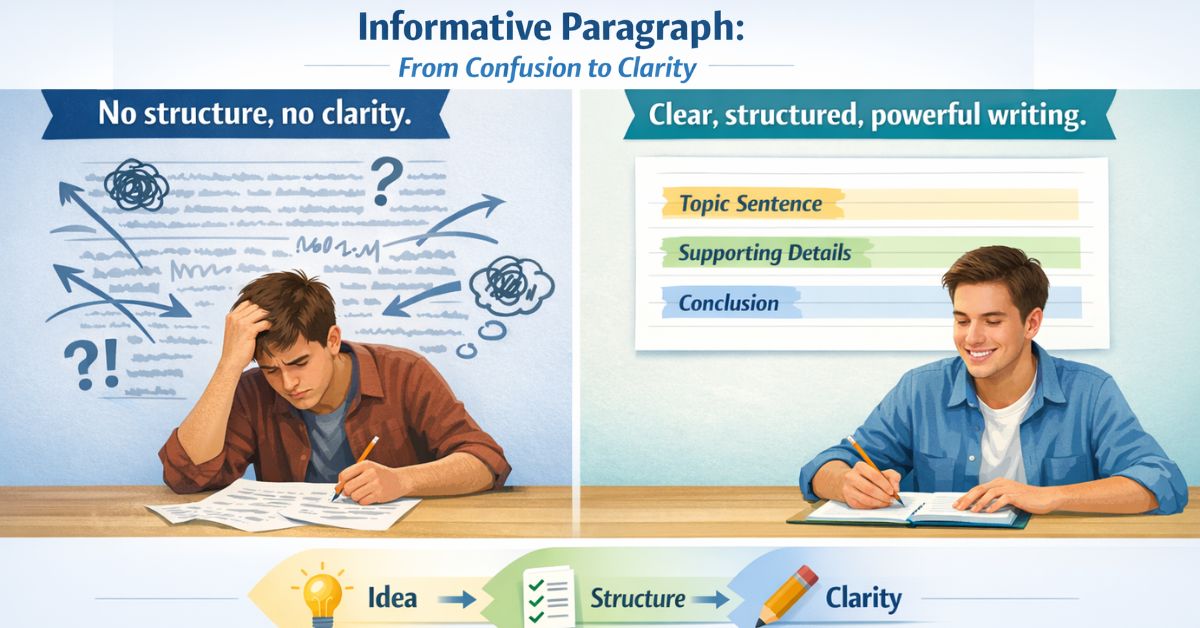
I still remember a student staring at a blank exam sheet, whispering, “Sir, I know the answer, but I can’t explain it.” That’s the real struggle. Not ignorance, but expression.
Many students write like they’re throwing ideas into a blender: no order, no clarity, just noise. But then I show them one simple tool, the informative paragraph, and suddenly, everything clicks. It’s like turning a foggy thought into a clean window.
In my classroom, I often say: “If you can write one strong paragraph, you can control your entire essay.” That’s the power of informative paragraph writing. It doesn’t just help you pass exams. It teaches you how to think clearly.
So today, let me take you into a live teaching moment where we turn confusion into clarity, one paragraph at a time.
What is an Informative Paragraph?
An informative paragraph is a structured piece of writing that clearly explains a single idea using facts, examples, and logical details, without personal opinion.
When I teach the definition of an informative paragraph, I avoid textbook jargon. I tell my students:
“Imagine you’re explaining something to a curious friend who knows nothing about it.”
That’s exactly what an informational paragraph does. It informs, explains, and describes. Nothing more, nothing less. No drama, no bias, just clarity.
Let me give you a quick classroom example. If I write:
👉 “Rainforests are important,”- that’s vague.
But if I say:
👉 “Rainforests play a crucial role in maintaining Earth’s oxygen levels and biodiversity,”- now I’m informing. That’s the shift.
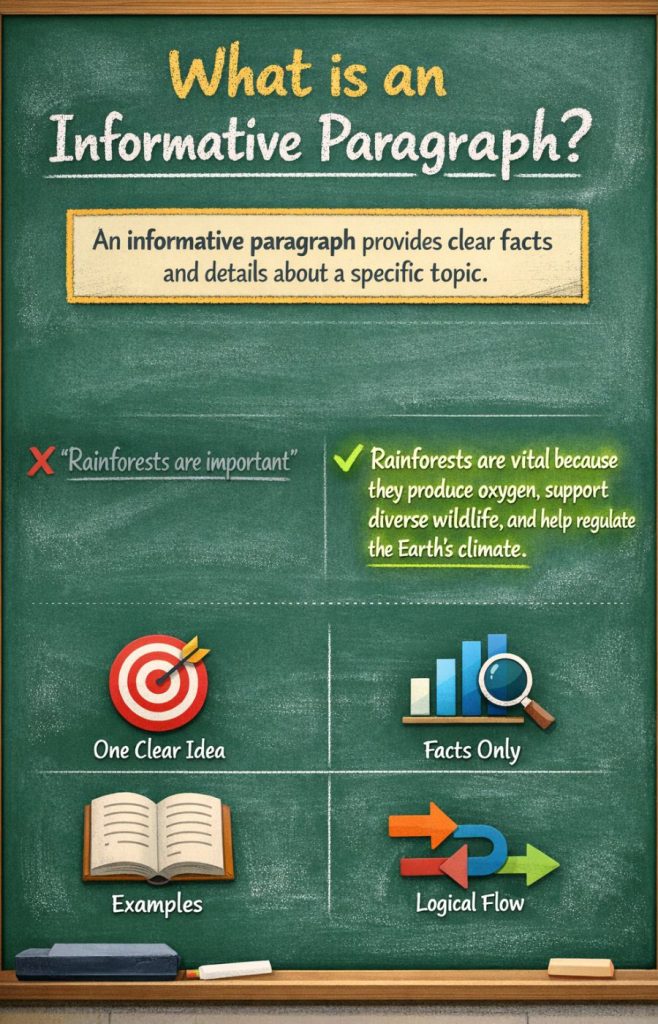
Table of Contents
Key Features I Always Teach:
- It focuses on one clear idea
- It uses facts, not opinions
- It explains with examples or evidence
- It maintains a logical flow
Here’s the twist I often tell my students:
👉 “An informative paragraph is like a teacher. It doesn’t argue, it explains.”
And once you understand that, writing becomes less stressful and more purposeful.
Informative Paragraph vs Expository Paragraph
An informative paragraph presents clear facts to explain what something is, while an expository paragraph goes deeper to explain how or why something works, often using analysis or step-by-step logic.
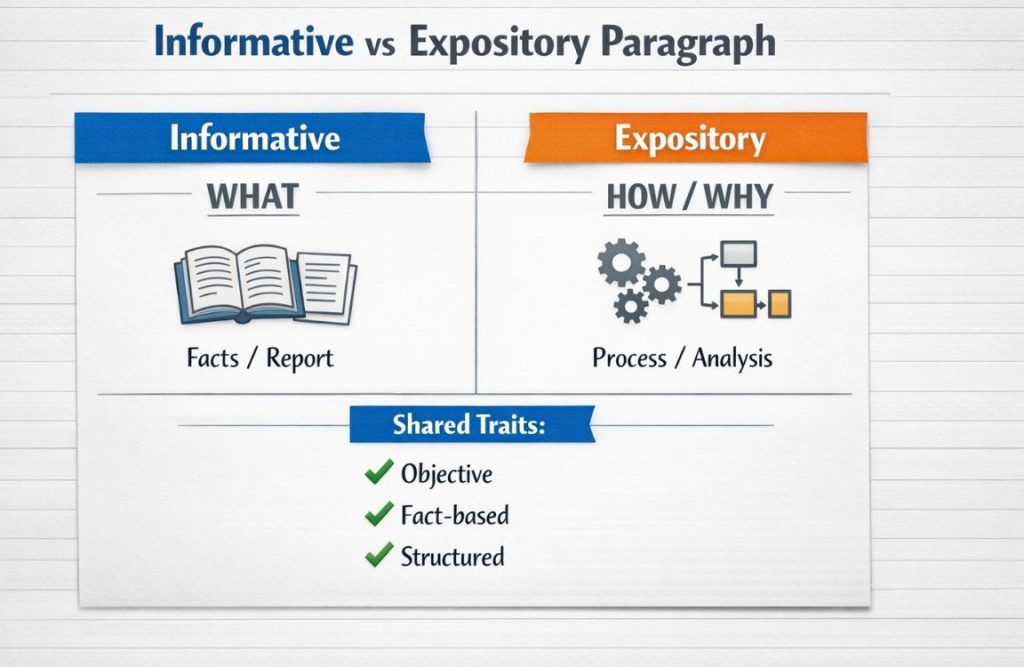
I often see my students mix these two, and honestly, it’s an easy mistake. One day, a student wrote a paragraph explaining how photosynthesis works, thinking it was purely informative. I smiled and said, “You didn’t just inform. You explained the process. That’s expository.”
Here’s how I simplify it in class:
👉 “Informative tells the story; expository breaks it down.”
An informative paragraph answers basic questions- who, what, when, and where. For example, a short report about the Amazon rainforest.
But an expository paragraph goes further. It explains causes, effects, or steps- like describing how deforestation impacts climate.
Both are objective, both rely on facts, but their depth is different.
Think of it this way:
👉 Informative = giving knowledge
👉 Expository = unfolding knowledge
Structure of an Informative Paragraph
If writing is a building, then the informative paragraph structure is your blueprint. Without it, everything collapses. In class, I draw a simple three-part diagram on the board, and trust me, it works every time.
1. Topic Sentence (The Leader)
This is where you introduce your idea clearly.
I always tell my students:
👉 “Your first sentence should answer- What am I about to explain?”
Example:
“Exercise improves both physical and mental health.”
It’s simple, direct, and focused.
2. Supporting Sentences (The Workers)
This is where the real job happens. You add facts, examples, or explanations.
Think of these sentences as proof. Without them, your paragraph is just a claim floating in the air.
In a live class, I once compared this to cooking:
👉 “Your topic sentence is the menu, but supporting sentences are the actual food.”
3. Concluding Sentence (The Finisher)
This wraps up your idea neatly. Not repetition, but reinforcement.
Example:
“Therefore, regular exercise is essential for a healthy lifestyle.”
The Simple Informative Paragraph Format:
- Start→ Topic sentence
- Middle→ Supporting details
- End→ Conclusion
This basic informative paragraph outline is powerful because it turns scattered thoughts into structured meaning. And once you master this, you’re no longer just writing. You’re teaching through your words.
How to Write an Informative Paragraph (Step-by-Step)
In this part, I’ll walk you through how to start an informative paragraph and build it step by step, from idea to polished clarity, just like I guide my students during live writing practice in class.
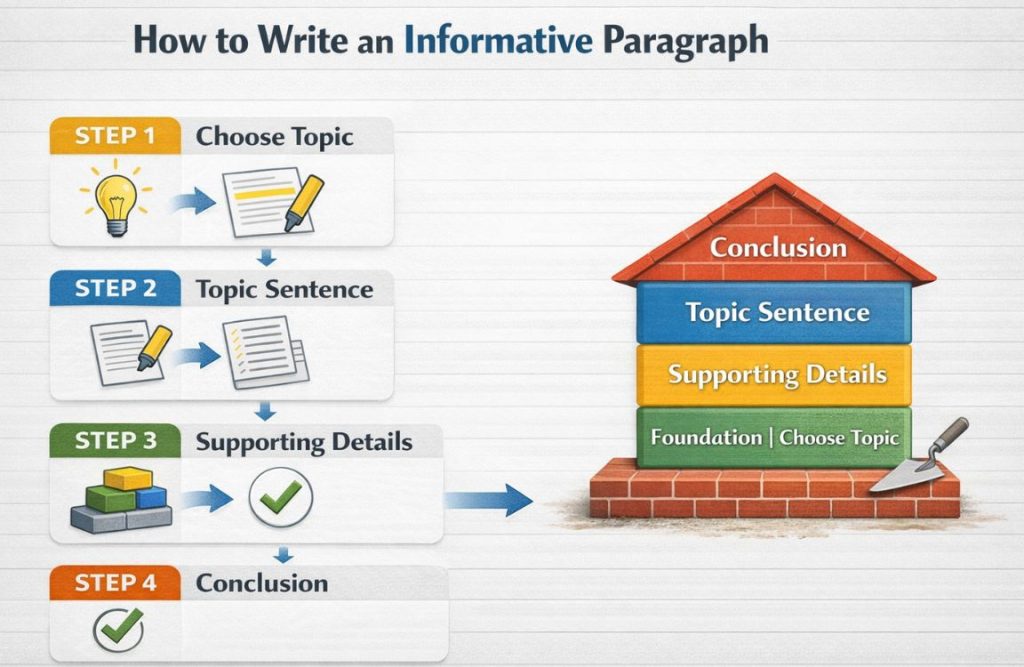
Step 1: Choose a Topic
I always tell my students, “A confused topic creates a confused paragraph.” So choose something clear and specific. Not “technology”- that’s too wide. Instead, try “how smartphones affect student learning.”
Once, a student picked “life” as a topic. I smiled and said, “That’s a lifetime of paragraphs!” We refined it, and suddenly, writing became easier.
Good informative paragraph writing begins with a topic you can actually explain, not one that overwhelms you.
Step 2: Write a Strong Topic Sentence
Now comes the moment where many students hesitate- how to start an informative paragraph.
I give them a simple trick:
👉 Answer this question in one line- What is your paragraph about?
For example:
“Online learning has transformed modern education by increasing accessibility and flexibility.”
Notice how it’s clear and focused. No storytelling, no wandering.
Think of your topic sentence as a promise to your reader. If it’s weak, the whole paragraph feels uncertain. If it’s strong, everything else flows naturally.
Step 3: Add Supporting Details
This is where your paragraph earns its marks. I often tell my class, “Don’t just say it, prove it.”
Add facts, examples, or explanations. For instance, if you mention online learning, explain how platforms like Zoom or recorded lectures help students learn anytime.
Once, a student wrote, “Exercise is good.” I asked, “Why?” That one question turned a dull line into a detailed explanation.
Strong informative paragraph writing depends on how well you develop your idea, not how fancy your words are.
Step 4: Conclude Effectively
Ending a paragraph is like landing a plane. You can’t just jump off mid-air. Your final sentence should gently close the idea. Not repetition, but a sense of completion.
For example:
“Thus, online learning continues to reshape education in meaningful ways.”
I remind my students: “Leave your reader satisfied, not confused.”
A good conclusion doesn’t shout. It settles the thought quietly, like a teacher finishing a lesson with a knowing smile.
Sentence Starters & Transition Words for an Informative Paragraph
In this section, I’ll show you how the right words can guide your reader like signposts- using informative paragraph sentence starters and informative paragraph transition words to create clarity, flow, and confidence in your writing.
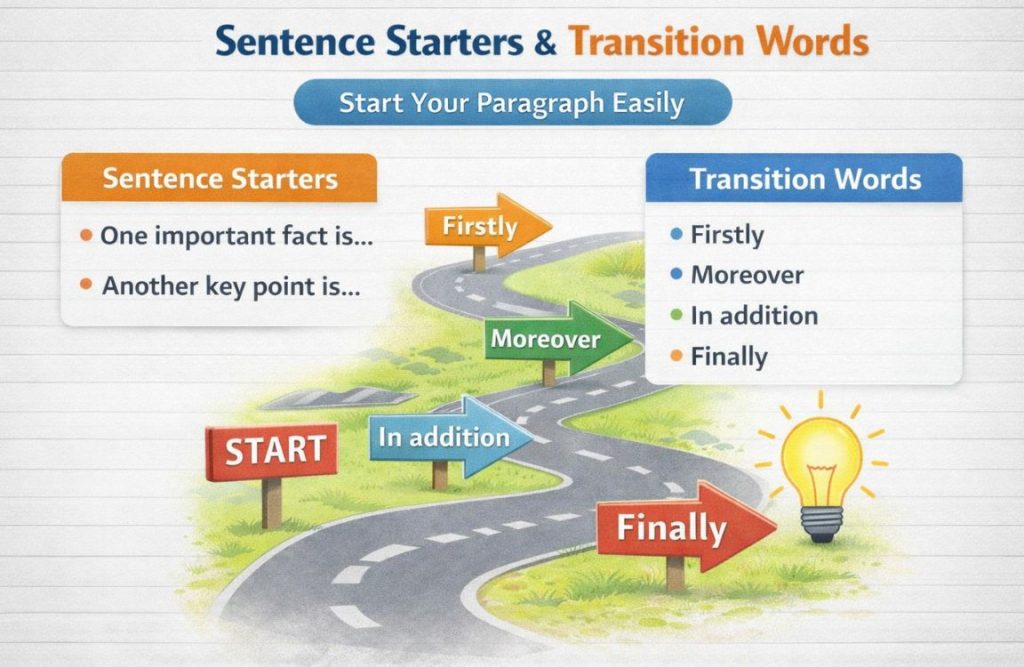
i) Useful Sentence Starters
One day in class, a student told me, “Sir, I know what to write, but I don’t know how to begin.” That’s when I introduced sentence starters, and suddenly, hesitation turned into momentum.
Think of sentence starters as keys that unlock your ideas. Instead of staring at a blank page, you begin with direction:
- “One important fact is…”
- “Another key point is…”
- “It is important to note that…”
These aren’t just phrases. They are thinking tools. They push your brain to organize ideas logically.
I often compare them to a train engine. Once it starts moving, the rest of the paragraph follows naturally. Without them, your writing stalls before it even begins.
ii) Transition Words for Flow
Now imagine reading a paragraph where every sentence feels disconnected. It’s like walking on a broken bridge. That’s where informative paragraph transition words come in.
Words like:
- Firstly
- Moreover
- In addition
- Finally
These are not decorations. They are connectors. They guide your reader smoothly from one idea to the next.
In a live session, I once removed all transitions from a student’s paragraph. It became confusing instantly. Then we added them back, and clarity returned like magic.
Here’s my rule:
👉 “Good writing is not just about ideas. It’s about how ideas travel.”
And transition words are the road.
Informative Paragraph Examples
Now let’s move from theory to practice. In this section, I’ll show you clear, informative paragraph examples so you can see how ideas, structure, and clarity come together in real writing.
i) Short Informative Paragraph Example
Here’s a short informative paragraph on a simple topic:
Topic: Importance of Drinking Water
Drinking enough water is essential for maintaining good health. One important fact is that water helps regulate body temperature and supports digestion. Moreover, it aids in transporting nutrients to different parts of the body. In addition, staying hydrated improves concentration and energy levels. For example, students who drink enough water often feel more alert during classes. Finally, proper hydration prevents headaches and fatigue. Therefore, drinking sufficient water daily is necessary for overall well-being.
Now notice how each sentence builds logically. No confusion, no jumping- just steady explanation.
ii) Informative Paragraph Example for Students
Let me share an example of an informative paragraph I once developed with my students during a class discussion.
Topic: Benefits of Reading Books
Reading books plays a vital role in personal and academic growth. One important fact is that reading improves vocabulary and language skills. Moreover, it enhances imagination by exposing readers to new ideas and perspectives. For instance, students who regularly read storybooks often develop better writing abilities. In addition, reading helps reduce stress by allowing the mind to relax and focus. I remember a student who struggled with writing, but after developing a reading habit, his improvement was remarkable. Finally, books also strengthen concentration and critical thinking skills. Therefore, reading books is a powerful habit that contributes to overall development.
This informative paragraph sample works because it connects real-life observation with a clear explanation.
And that’s the secret I always share:
👉 “Good writing doesn’t just inform. It quietly transforms the reader.”
Informative Paragraph Topics for Students
In this section, I’ll help you discover engaging, informative paragraph topics– from simple classroom ideas to more thought-provoking ones- so you never feel stuck again when choosing what to write about.
i) Easy Topics
When I begin with younger students, I don’t throw them into deep water. I give them topics they already understand. That’s where confidence begins. Here are some informative paragraph topics for students that work beautifully:
- Importance of morning exercise
- My favorite teacher and why
- Benefits of a balanced diet
- How to stay healthy during exams
- Uses of the internet in education
- Importance of good manners
- My daily routine
- Benefits of reading books
- Importance of clean surroundings
- My favorite hobby and its benefits
I often say, “Start with what you know, then grow into what you don’t.” Simple topics train your mind to explain clearly.
ii) Advanced Topics
Once students gain confidence, I gently challenge them with deeper ideas. This is where thinking sharpens. Try these:
- Impact of social media on students
- Climate change and its effects
- Role of technology in modern education
- Importance of mental health awareness
- Online learning vs traditional learning
- Effects of global warming on biodiversity
- Importance of time management for students
- Role of artificial intelligence in daily life
- Causes and effects of air pollution
- Importance of critical thinking in education
I remember a class debate on social media. It turned into one of the most thoughtful writing sessions I’ve seen. The right topic doesn’t just test writing. It awakens thinking.
Informative Paragraph for Students (Tips & Common Mistakes)
Now, let me step into a more practical space. Here, I’ll guide you through essential tips for crafting a strong informative paragraph for students, along with common mistakes I’ve seen, even among bright learners.
i) Tips for Better Writing
Over the years, I’ve noticed one thing: good writing is not talent. It’s a habit.
- Focus on clarity over complexity
- Stick to one idea per paragraph
- Use simple, precise language
- Read your paragraph aloud. It reveals hidden flaws
I once asked a student to read his paragraph aloud. He stopped halfway and said, “Sir, this sounds confusing.” I smiled; that realization was his real progress.
👉 “If your reader struggles, your writing needs revision.”
ii) Common Mistakes to Avoid
Even strong students make predictable mistakes. Let me warn you before you fall into them:
- Writing multiple ideas in one paragraph
- Using unnecessarily difficult words
- Repeating the same point in different ways
- Forgetting to logically connect sentences
One of my students used five fancy words in one sentence, none of them correctly. We laughed, but it was a lesson.
👉 “Writing is not about sounding smart. It’s about being understood.”
Avoid these traps, and your writing will instantly become clearer and more effective.
Tools for Writing: Graphic Organizer & Anchor Chart
In this section, I’ll introduce two powerful classroom tools, the informative paragraph graphic organizer and the informative paragraph anchor chart, that I personally use to turn confused writers into confident ones, step by step.
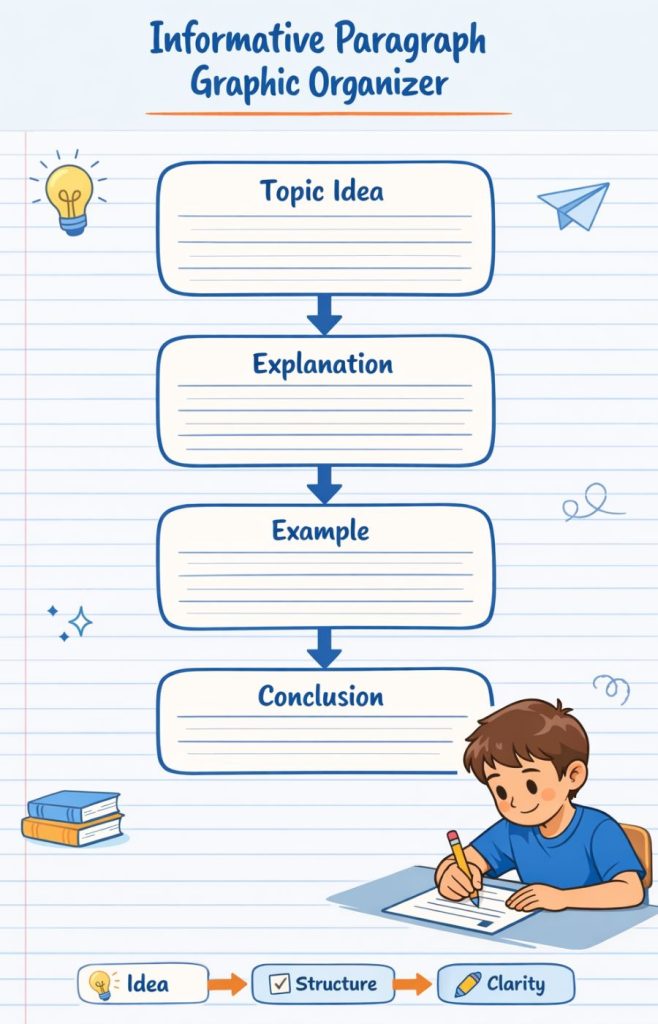
i) Graphic Organizer
I still remember handing out a blank organizer sheet to a nervous class. Within minutes, chaos turned into structure. That’s the magic of an informative paragraph graphic organizer.
It visually breaks writing into parts- idea, explanation, example, and closing. Students no longer “guess” what to write; they see it.
I often say, “Your brain loves patterns; give it a map, and it will find the destination.”
For beginners, especially, this tool feels like training wheels, but even advanced writers secretly rely on it.
ii) Anchor Chart
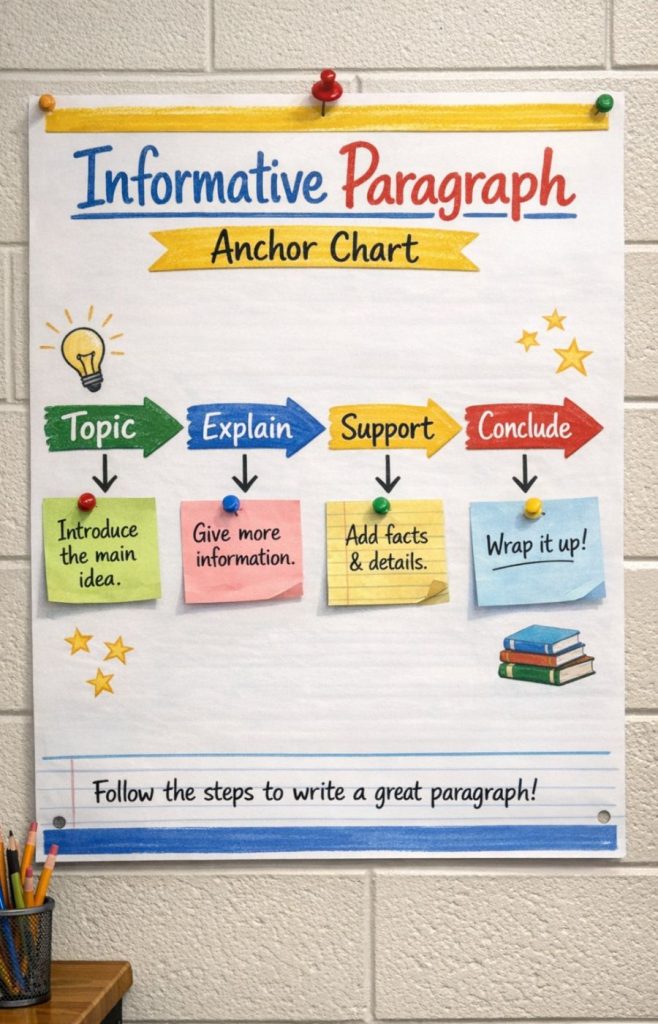
Now imagine a permanent guide hanging on your classroom wall- that’s an informative paragraph anchor chart.
Mine usually includes simple cues:
👉 Topic → Explain → Support → Conclude
During one class, a student paused mid-writing, looked up at the chart, and said, “Oh, I forgot the explanation!” That moment, that self-correction, is why anchor charts matter.
They don’t just decorate walls. They build independent writers. Think of them as silent teachers who never get tired.
Informative Paragraph Checklist/Rubric
Here, I’ll give you a practical way to evaluate your writing using an informative paragraph checklist and an informative paragraph rubric, just like I assess my students’ work in real classroom situations.
i) Checklist
Before submitting any paragraph, I train my students to pause and ask:
- Did I clearly explain one idea?
- Are my sentences logically connected?
- Did I support my idea with examples or facts?
- Does my ending feel complete?
This informative paragraph checklist is like a final mirror.
I often joke, “Don’t send your paragraph into the world without checking its appearance!”
A quick review can transform average writing into strong writing.
ii) Rubric
Now comes the teacher’s lens, the informative paragraph rubric.
When I evaluate, I focus on:
- Clarity of idea
- Depth of explanation
- Organization and flow
- Language accuracy
I once showed my class two paragraphs- one average, one excellent- and asked them to grade them. Their eyes lit up. They finally understood what “good writing” actually looks like.
👉 “A rubric doesn’t judge you. It guides you.”
FAQs:
How long should an informative paragraph be for academic writing?
In my classroom, I guide students to write 5-8 well-developed sentences. It’s not about length but clarity. A paragraph should feel complete- like a solved puzzle, not a half-told story.
Can an informative paragraph include personal opinions?
Here’s a rule I repeat often: “Inform, don’t argue.” An informative paragraph avoids personal opinions. However, you can include real-life examples- as long as they explain, not persuade or emotionally influence the reader.
What is the difference between an informative and descriptive paragraph?
I tell my students: “One explains, the other paints.” An informative paragraph delivers facts and clarity, while a descriptive paragraph creates imagery and emotion. One teaches the mind; the other touches the senses.
How do teachers evaluate an informative paragraph?
When I assess, I look beyond grammar. I check clarity, logical flow, and depth of explanation. A strong paragraph answers questions before I ask them- like a student who anticipates the teacher’s curiosity.
Can one topic be explained in multiple informative paragraphs?
Absolutely, and that’s where real writing begins. I often tell students, “One idea opens the door to many paragraphs.” Each paragraph can explore a different angle, building a complete understanding step by step.
Conclusion:
If there’s one skill I wish every student would master, it’s writing a strong, informative paragraph. Not because exams demand it, but because life does. Whether you’re explaining an idea, teaching someone, or expressing knowledge, clarity is power.
I’ve seen struggling students transform simply by learning how to organize one paragraph well. That’s where confidence begins.
So here’s my simple advice:
👉 Start writing your first informative paragraph today.
👉 Practice with the topics above and refine your skills step by step.
Because in the end, writing isn’t just about words. It’s about making yourself understood.