
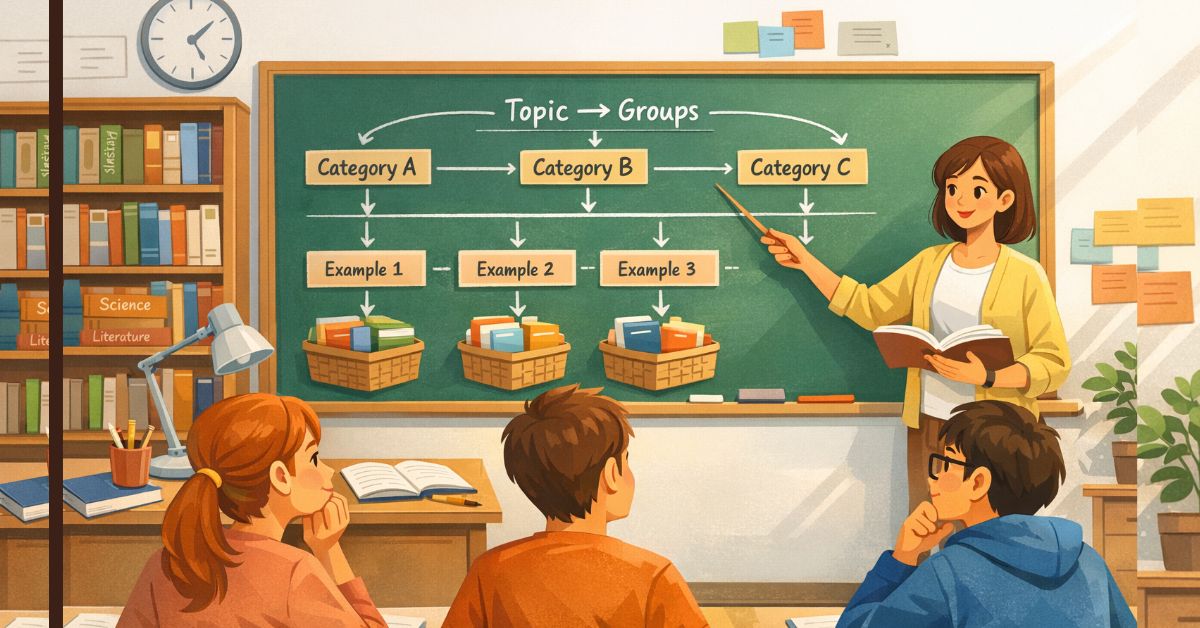
When I introduce paragraph writing in class, I often begin with something very simple: organization. Good writing, I tell my students, is not just about ideas. It is about how we arrange them. This is where a classification paragraph becomes extremely useful. Instead of presenting ideas randomly, a writer groups related items, people, or concepts into clear categories.
Think of it like arranging books in a library. History goes in one section, science in another, and literature somewhere else. Instantly, everything becomes easier to find and understand. Writers use the same method to organize thoughts on paper.
That is why classification paragraph examples frequently appear in academic writing, essays, and exams. They help readers see patterns and relationships within a topic. In this guide, I will explain what classification means in writing, how a classification paragraph works, and how students can structure and write one effectively.
What Is a Classification Paragraph? (Definition & Meaning)
A classification paragraph is a paragraph that organizes a broad subject into smaller categories based on a shared principle or characteristic. In classification in writing, the writer introduces a general topic, divides it into logical groups, and explains each category with examples to help readers understand complex ideas clearly.
Now let me explain it the way I usually do in class.
When my students ask, “What is classification paragraph writing?” I tell them it is simply the art of grouping similar things together. Our minds naturally search for patterns, and classification gives those patterns a clear structure on the page.
In practical terms, the classification paragraph definition includes three key elements. First, a topic sentence introduces the subject and the basis of classification– the rule used to sort the categories. Next, body sentences describe each group and provide examples. Finally, a concluding sentence ties the categories together and reminds readers of the main idea.
But why do writers classify ideas at all? Because classification turns complexity into clarity. When readers see information divided into logical groups, they can quickly understand relationships within the topic.
Here is a simple example I often give students:
Students preparing for exams usually fall into three types: early planners, steady workers, and last-minute crammers.
The rest of the paragraph would describe these groups. That is the essence of a classification paragraph writing- organizing ideas so readers can understand a topic step by step.
To understand how this works in writing, we also need to look at the structure of a classification paragraph.
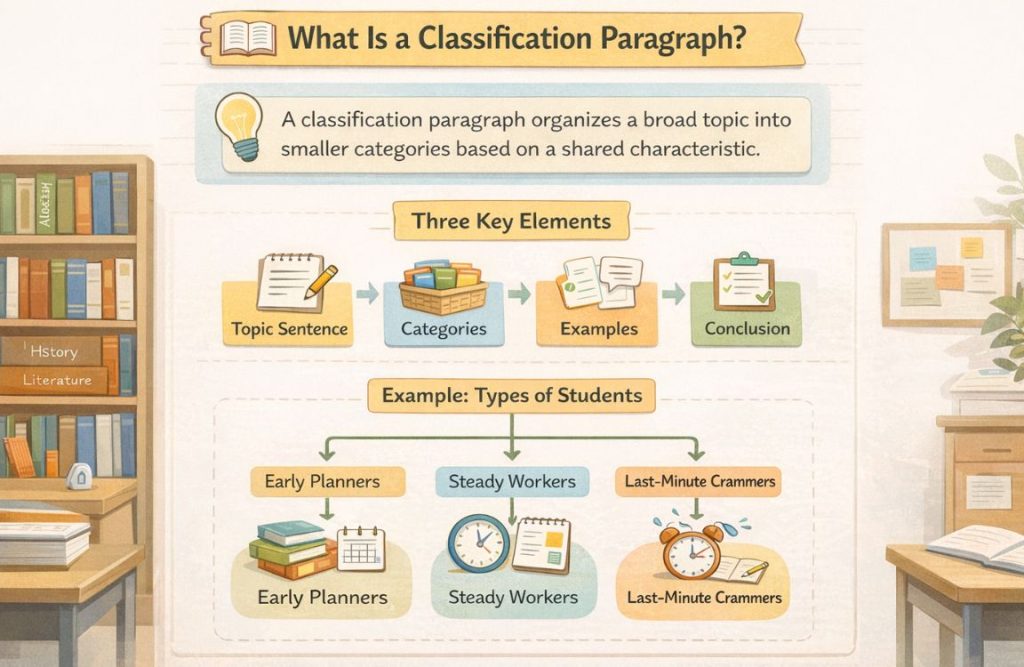
Table of Contents
Structure of a Classification Paragraph Writing
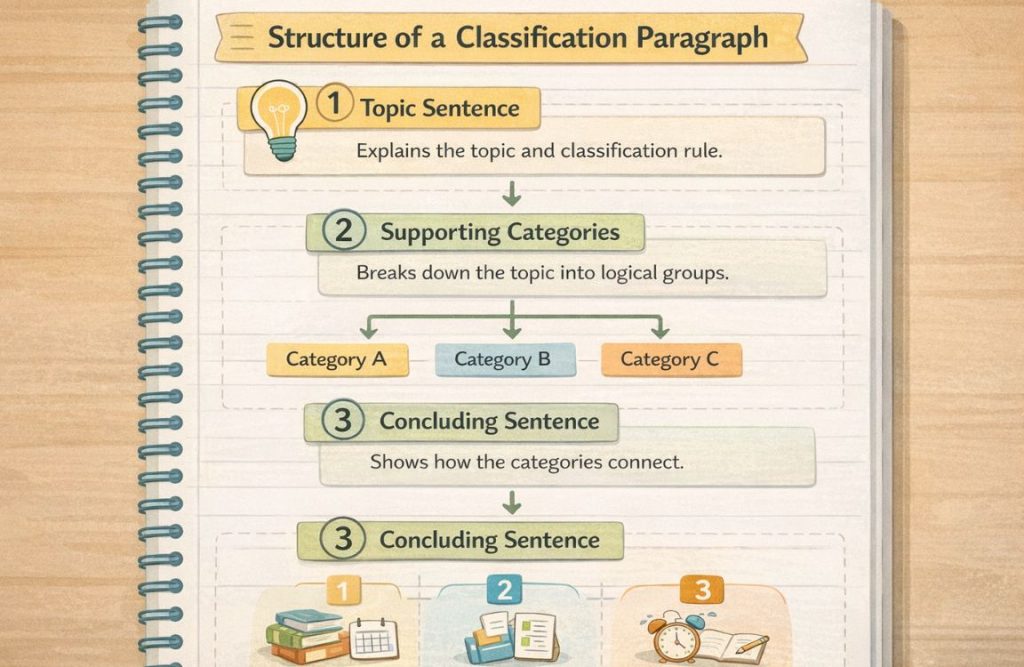
In my classroom, I often remind students that ideas need architecture. A classification paragraph format usually contains three essential parts: a topic sentence introducing the categories, supporting details explaining each group, and a concluding sentence that ties the classification together clearly.
i) Topic Sentence in a Classification Paragraph
Whenever I teach classification paragraph structure, I begin with the topic sentence. This opening line is where the writer introduces the general subject and announces the basis of classification– the rule used to divide the topic into groups.
A strong topic sentence of a classification paragraph, therefore, performs two tasks at once: it identifies the subject and previews the categories that will follow. Without this clear signal, readers may feel as if they have entered a conversation halfway through.
Let me show you a classroom-style example:
College libraries usually attract three types of students based on their study habits: silent researchers, determined exam fighters, and quiet procrastinators hiding behind laptops.
Notice how the sentence clearly states both the topic (students in the library) and the classification principle (study habits). The categories are already visible, giving readers a roadmap for the rest of the paragraph.
ii) Supporting Details: Categories and Examples
After the topic sentence sets the direction, the paragraph moves into supporting details. This is where the real explanation happens.
I often tell my students that this section is like opening three labeled boxes and showing the contents inside each one. Each category must be described clearly, and the examples must logically belong to that group.
The key principle here is logical grouping. Categories should be consistent and based on the same classification rule. If the topic divides students by study habits, then every category must relate to study behavior- not personality, hobbies, or sleep schedules.
For instance, consider this example of a classification paragraph about readers:
One group reads to escape reality, devouring fantasy novels and adventure stories. Another group reads to learn, filling their shelves with history and science books. A third group reads selectively, opening books only when a recommendation or requirement appears.
Each category reveals a pattern. Through these examples, the writer helps readers recognize different types within the same larger group.
iii) Concluding Sentence in a Classification Paragraph
Finally, every classification paragraph needs a closing moment. The concluding sentence brings the categories together and reminds the reader of the overall insight.
In teaching classification paragraph development, I often say the conclusion should feel like a teacher summarizing a lesson at the end of class. After discussing several groups, the writer briefly reinforces what the classification reveals about the topic.
For example:
Although students approach studying in different ways, these patterns show that preparation styles often shape academic success.
The paragraph ends not simply with repetition but with understanding- showing how the categories together explain the broader topic.
Classification Pattern of Paragraph Development
Beyond individual paragraphs, classification also functions as a broader strategy in classification paragraph development. In academic writing, this approach is known as a classification text structure- a rhetorical pattern used to organize complex subjects into meaningful groups.
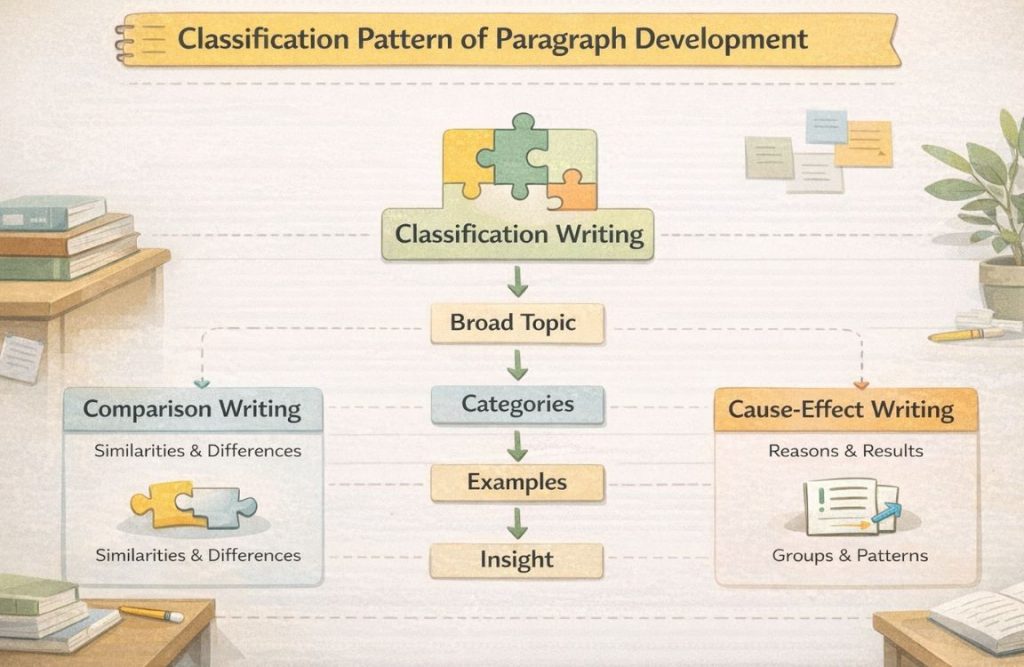
When I explain this concept to my students, I often compare it with other paragraph patterns. For instance, comparison paragraph writing explores similarities and differences between two subjects, while cause-and-effect writing investigates reasons and results. Classification, however, performs a different intellectual task: it sorts a large idea into categories so readers can understand its internal organization.
Why is this important? Because many academic subjects are naturally diverse. Without classification, explanations become scattered. By grouping ideas into categories, writers transform a complicated topic into something readers can navigate step by step.
Imagine explaining types of social media users. Instead of describing everyone randomly, a writer might classify them into observers, active creators, and influencers. Each category then receives its own explanation and examples.
Here is a brief mini example:
Online learners generally fall into three groups: the disciplined self-starter who studies daily, the guided learner who depends on structured schedules, and the casual participant who logs in only when necessary.
Notice how the pattern works. A broad topic appears first, categories follow, and each category reveals a distinct characteristic.
When used thoughtfully, classification becomes more than organization. It becomes insight. By dividing a subject into groups, writers show readers that even chaos has patterns waiting to be discovered.
How to Write a Classification Paragraph (Step-by-Step)
When my students ask me how to write a classification paragraph, I remind them that clarity grows from method. The steps to write a classification paragraph are simple: choose a clear principle, divide the topic logically, illustrate categories with examples, and conclude effectively.
Step 1: Choose a Topic and Classification Principle
Every strong paragraph begins with a decision: what exactly are we sorting, and by what rule? That rule is the classification principle– the basis used to divide the topic into groups.
In class, I often demonstrate this with a familiar subject: students’ study habits. But the key question is not just who studies, but how they study. That becomes the classification basis.
For instance, we might classify learners by preparation style: planners, steady workers, and last-minute crammers. Once the principle is clear, the paragraph gains focus and direction.
Step 2: Divide the Topic into Categories
Once the principle is chosen, the next step is logical grouping. This is where writers divide the subject into clear categories.
I often tell my students to imagine themselves as careful librarians. A librarian would never shelve poetry beside physics simply because both books are blue. Categories must follow the same rule established earlier.
Suppose we classify types of classroom participants. One group eagerly raises its hands and debates ideas. Another listens carefully but rarely speaks. A third contributes only when called upon.
Notice the pattern: each category reflects participation style. Logical grouping keeps the paragraph organized and meaningful.
Step 3: Provide Examples for Each Category
Now comes the moment when categories come alive. Without examples, classification remains abstract. With examples, it becomes vivid and convincing.
During a lesson on reading habits, I once described three types of readers. The first devour novels like a traveler exploring new countries. The second reads slowly, annotating every page like a detective gathering clues. The third opens books only before exams- an academic sprinter racing against time.
These examples help readers recognize real-world patterns. In effective writing, examples serve as evidence, turning categories into believable portraits rather than empty labels.
Step 4: Conclude the Paragraph Clearly
Finally, a classification paragraph needs a thoughtful closing. This sentence gathers the categories together and reminds readers what the classification reveals about the topic.
I often compare this moment to the final minutes of a lecture. After discussing several groups, the teacher pauses and reflects on the larger insight.
For example, although readers approach books differently- explorers, detectives, or exam sprinters- their habits show how motivation shapes the reading experience.
A clear conclusion does more than stop the paragraph. It leaves the reader with understanding, and sometimes a quiet realization about human patterns.
Classification Paragraph Examples
Students often understand theory only after seeing it in action. That is why I always bring examples of classification paragraphs into the classroom. Real writing shows how categories work, turning abstract structure into something students can observe, analyze, and eventually imitate confidently.
Example 1: Types of Students
Here is a simple classification paragraph example I often share with exam candidates.
In every classroom, students usually fall into three recognizable types based on their learning habits. The first group is the strategic planners. These students prepare early, organize notes carefully, and treat assignments like long-term projects. The second group consists of steady learners who work consistently, completing tasks step by step without dramatic bursts of effort. The third group, however, is the last-minute sprinters. They suddenly appear before deadlines, racing through chapters with heroic determination. Each type approaches study differently, yet together they reveal the diverse rhythms of academic life.
Whenever I present this example of a classification paragraph, my students immediately start identifying themselves in one category or sheepishly admitting they belong to the third.
Example 2: Types of Social Media Users
Another sample paragraph of classification can be drawn from our digital lives.
Social media platforms also reveal three distinct types of users. First are the observers, people who scroll quietly through posts, rarely commenting but constantly consuming information. Next come the active participants who regularly post updates, share photos, and engage in conversations with friends. Finally, there are the influencers, individuals who treat social media as a stage, carefully crafting content to attract large audiences. These categories demonstrate how the same platform can serve very different purposes for different users.
Example 3: Types of Friends
Let me share one more simple classification paragraph example that students often find relatable.
Friendships also form natural categories. Some friends are advisers– the thoughtful listeners who offer guidance during difficult decisions. Others are companions, the cheerful partners who make everyday moments enjoyable. Then there are motivators, the energetic friends who push us to pursue goals we might otherwise avoid.
This sample paragraph of classification reminds us that friendships vary in role, yet each type enriches life in its own way.
Classification Paragraph Topics & Ideas
In class, a question I often hear is, “But what should I write about?” That simple moment sparks creativity. Good classification paragraph ideas usually come from everyday life- ordinary things we see, experience, and can easily sort into meaningful groups.
Here are some engaging classification paragraph ideas students can explore:
- Types of readers
- Types of movies
- Types of travelers
- Types of teachers
- Types of mobile apps
- Types of students in a classroom
- Types of social media users
- Types of study habits among students
- Types of morning routines people follow
- Types of music listeners
- Types of online shoppers
- Types of vacation destinations
- Types of sports fans
- Types of book lovers
- Types of smartphone users
Classification and Division Paragraph (Key Difference)
Students often confuse the division and classification paragraphs, so I like to explain it with a simple classroom metaphor.
Classification moves from many items to groups. Division moves from one whole to its parts.
In classification writing, a writer takes a large collection- such as students, movies, or travelers- and organizes them into categories based on shared characteristics.
Division works differently. Instead of grouping many items, it breaks a single subject into components. For example, a writer might divide a smartphone into its screen, processor, battery, and operating system.
Think of it this way: classification is like sorting different fruits into baskets, while division is like slicing one fruit to study its sections. Understanding this distinction helps students choose the right paragraph strategy in academic writing.
Common Mistakes in Classification Paragraphs
During essay practice, I often notice a few predictable mistakes. First, students create overlapping categories, where ideas fit into more than one group.
Second, the classification principle becomes unclear, leaving readers confused about the organizing rule.
Finally, some paragraphs lack examples. Without concrete illustrations, categories remain vague labels rather than meaningful insights.
FAQs:
Why is classification writing important for students?
Classification writing is important for students because it helps them organize complex ideas into clear groups. By sorting information into categories, students develop logical and critical thinking, recognize relationships between ideas, and present essays more clearly and systematically in academic writing.
How many categories should a classification paragraph have?
A classification paragraph usually contains three to five categories. This number gives enough detail without confusing readers. Each category should follow the same classification principle and include clear examples, focusing on depth and clarity rather than listing too many shallow groups.
What makes a good classification principle?
A good classification principle is clear, logical, and consistent. All categories must follow the same rule, avoid overlap, and cover the entire topic. For example, when students are classified by study habits, each category should describe a distinct learning behavior.
Can classification be used in essays, not just paragraphs?
Yes, classification can be used in both paragraphs and full essays. In a classification essay, each category becomes a separate body paragraph. The essay begins with an introduction, explains each group with examples, and ends with a conclusion that summarizes the classification.
Conclusion:
Whenever I finish teaching the classification paragraph writing, I remind my students that this technique is more than a writing exercise. It is a way of thinking clearly. We began by understanding the definition: organizing a broad topic into meaningful categories.
Then we explored its structure- topic sentence, supporting categories with examples, and a concluding insight. Through several examples, we saw how everyday subjects can be arranged into logical patterns.
In academic writing, this method is invaluable. It transforms scattered ideas into an organized understanding. And once students master classification, they discover a quiet truth about writing: clarity often begins with the simple act of sorting ideas.